




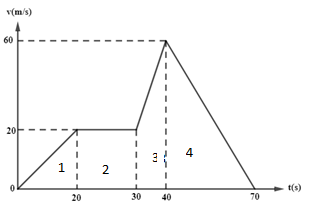
The velocity time graph of a body is given in figure. The maximum acceleration in $m/{{s}^{2}}$ is
(a) 4
(b) 3
(c) 2
(d) 1
Answer
 Verified
639.9k+ views
Hint: We know that acceleration of a body means the change in velocity of the body with respect to change in time. It can also be said that the slope of the v-t graph is given by acceleration and it can be seen mathematically as, $a=\dfrac{\Delta v}{\Delta t}$. Using this formula, we will find the maximum acceleration of the body.
Formula used: $a=\dfrac{\Delta v}{\Delta t}$
Complete step-by-step answer:
In question we are asked to find the maximum acceleration of the body from the given graph, but before that we will understand what is acceleration.
So, acceleration of a body means the change in velocity of the body with respect to change in time. It can also be said that slope of v-t graph is given by acceleration and it can be seen mathematically as, $a=\dfrac{\Delta v}{\Delta t}$ …………………….(i)
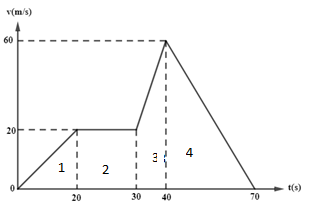
Now, to find the maximum acceleration we will find the graph in 4 parts.
In part 1, velocity of the body increases from 0 to 20 $m/s$ with respect to time which changes from 0 to 20 seconds. So, from this it can be said that for part 1,
${{v}_{1}}=0m/s$ and ${{v}_{2}}=20m/s$, ${{t}_{1}}=0s$ and ${{t}_{2}}=20s$
Now, substituting these values in expression (i) we will get,
$a=\dfrac{{{v}_{2}}-{{v}_{1}}}{{{t}_{2}}-{{t}_{1}}}=\dfrac{20-0}{20-0}$
$\Rightarrow a=\dfrac{20}{20}=1m/{{s}^{2}}$
Now, for part 2, velocity remains constant and we know that when the value of y remains constant, the slope is zero so the acceleration of the body is also zero.
Now, for part 3, velocity of the body increases from 20 to 60 $m/s$ with respect to time which changes from 30 to 40 seconds. So, from this it can be said that for part 3,
${{v}_{1}}=20m/s$ and ${{v}_{2}}=60m/s$, ${{t}_{1}}=30s$ and ${{t}_{2}}=40s$
Now, substituting these values in expression (i) we will get,
$a=\dfrac{{{v}_{2}}-{{v}_{1}}}{{{t}_{2}}-{{t}_{1}}}=\dfrac{60-20}{40-30}$
$\Rightarrow a=\dfrac{40}{10}=4m/{{s}^{2}}$
Now, in part 4, after the velocity of the body reaches maximum its velocity reduces and becomes zero, so it is known as deceleration. So, from this it can be said that for part 4,
${{v}_{1}}=60m/s$ and ${{v}_{2}}=0m/s$, ${{t}_{1}}=60s$and ${{t}_{2}}=70s$
Now, substituting these values in expression (i) we will get,
$a=\dfrac{{{v}_{2}}-{{v}_{1}}}{{{t}_{2}}-{{t}_{1}}}=\dfrac{0-60}{70-60}$
$\Rightarrow a=\dfrac{-60}{10}=-6m/{{s}^{2}}$
Thus, from this we can say that the maximum acceleration of the body is $4m/{{s}^{2}}$.
Hence, option (a) is the correct answer.
Note: Now, students might forget to consider the decrease in velocity from 60 to 0 as deceleration and they might consider as acceleration, by doing this the acceleration becomes $a=\dfrac{60}{10}=6m/{{s}^{2}}$. But it is wrong so students must be careful in problems of graphs and work accordingly.
Formula used: $a=\dfrac{\Delta v}{\Delta t}$
Complete step-by-step answer:
In question we are asked to find the maximum acceleration of the body from the given graph, but before that we will understand what is acceleration.
So, acceleration of a body means the change in velocity of the body with respect to change in time. It can also be said that slope of v-t graph is given by acceleration and it can be seen mathematically as, $a=\dfrac{\Delta v}{\Delta t}$ …………………….(i)
Now, to find the maximum acceleration we will find the graph in 4 parts.
In part 1, velocity of the body increases from 0 to 20 $m/s$ with respect to time which changes from 0 to 20 seconds. So, from this it can be said that for part 1,
${{v}_{1}}=0m/s$ and ${{v}_{2}}=20m/s$, ${{t}_{1}}=0s$ and ${{t}_{2}}=20s$
Now, substituting these values in expression (i) we will get,
$a=\dfrac{{{v}_{2}}-{{v}_{1}}}{{{t}_{2}}-{{t}_{1}}}=\dfrac{20-0}{20-0}$
$\Rightarrow a=\dfrac{20}{20}=1m/{{s}^{2}}$
Now, for part 2, velocity remains constant and we know that when the value of y remains constant, the slope is zero so the acceleration of the body is also zero.
Now, for part 3, velocity of the body increases from 20 to 60 $m/s$ with respect to time which changes from 30 to 40 seconds. So, from this it can be said that for part 3,
${{v}_{1}}=20m/s$ and ${{v}_{2}}=60m/s$, ${{t}_{1}}=30s$ and ${{t}_{2}}=40s$
Now, substituting these values in expression (i) we will get,
$a=\dfrac{{{v}_{2}}-{{v}_{1}}}{{{t}_{2}}-{{t}_{1}}}=\dfrac{60-20}{40-30}$
$\Rightarrow a=\dfrac{40}{10}=4m/{{s}^{2}}$
Now, in part 4, after the velocity of the body reaches maximum its velocity reduces and becomes zero, so it is known as deceleration. So, from this it can be said that for part 4,
${{v}_{1}}=60m/s$ and ${{v}_{2}}=0m/s$, ${{t}_{1}}=60s$and ${{t}_{2}}=70s$
Now, substituting these values in expression (i) we will get,
$a=\dfrac{{{v}_{2}}-{{v}_{1}}}{{{t}_{2}}-{{t}_{1}}}=\dfrac{0-60}{70-60}$
$\Rightarrow a=\dfrac{-60}{10}=-6m/{{s}^{2}}$
Thus, from this we can say that the maximum acceleration of the body is $4m/{{s}^{2}}$.
Hence, option (a) is the correct answer.
Note: Now, students might forget to consider the decrease in velocity from 60 to 0 as deceleration and they might consider as acceleration, by doing this the acceleration becomes $a=\dfrac{60}{10}=6m/{{s}^{2}}$. But it is wrong so students must be careful in problems of graphs and work accordingly.
Recently Updated Pages
Master Class 11 English: Engaging Questions & Answers for Success

Master Class 11 Social Science: Engaging Questions & Answers for Success
Master Class 11 Maths: Engaging Questions & Answers for Success
Master Class 11 Biology: Engaging Questions & Answers for Success
Master Class 11 Physics: Engaging Questions & Answers for Success
Master Class 11 Chemistry: Engaging Questions & Answers for Success
Trending doubts
One Metric ton is equal to kg A 10000 B 1000 C 100 class 11 physics CBSE
Difference Between Prokaryotic Cells and Eukaryotic Cells
Two of the body parts which do not appear in MRI are class 11 biology CBSE
Find the value of the expression given below sin 30circ class 11 maths CBSE
Draw a diagram of a plant cell and label at least eight class 11 biology CBSE
10 examples of friction in our daily life