




The velocity of raindrop attains limited value because of?
A) Surface tension
B) Upthrust due to air
C) Viscous force exerted by air
D) Air current
Answer
 Verified
580.2k+ views
Hint: To solve this question first we have to observe all the forces on a raindrop. We see there are 3 forces acting on a free-falling raindrop.
1. Gravitational force due to the mass of the drop
2. A upthrust or buoyancy of air
3. Viscous drag forces can find with the help of stokes law
Complete step by step answer:
We assume that the radius of the raindrop is $r$ And the density of drop is $\rho $ falling from the sky.
We take the volume of the raindrop as $V$ and the density of air is $\sigma $.
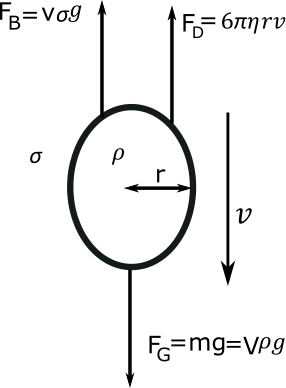
In our diagram, we mention all the forces which act on the drop when the drop falls down.
Where ${F_B}$ is the upthrust or buoyancy of air.
${F_d}$ is the viscous drag force.
${F_g} = W$ Weight of drop or force due to gravity.
When a raindrop starts to fall, the various forces acting on the raindrop are:
1) Weight of raindrop or gravitational force vertically downward
${F_G} = mg = V\sigma g$
Where $\sigma $ is the density of raindrop, and $V$ Is the volume of the drop.
2) Upward thrust equal to the weight of air displaced given as
${F_B} = V\rho g$
Where $\rho $ is the density of air, and $V$ Is the volume of air displaced by drop which is equal to the volume of the drop.
These two forces make the effective weight of raindrop or net downward force on raindrops.
$ \Rightarrow {F_{net}} = W - {F_B}$
$ \Rightarrow {F_{net}} = V\sigma g - V\rho g$
$ \Rightarrow {F_{net}} = V(\sigma - \rho )g$
Here we can clearly see that due to this net force there is acceleration in a downward direction due to this acceleration the velocity of raindrop increases initially.
3) Force of viscosity or viscous drag force in the upward direction according to stoke’s law.
Stokes showed that if a small sphere of radius $r$ is moving with velocity $v$ in a homogenous medium (liquid or gas) of infinite extension then the viscous force acting on the sphere is
${F_D} = 6\pi \eta rv$
Where $v$ is the velocity of a raindrop, $r$ Is the radius of the drop, and $\eta $ Is the viscosity of air.
Here we can clearly see that the viscous force ${F_D}$ is increasing with the velocity.
As well as velocity increase (due to net force) the ${F_D}$ will also increase. A stage is reached, where the effective weight of the body or net downward force ${F_{net}}$ becomes just equal to the viscous force ${F_D}$.
$\Rightarrow {F_{net}} = {F_D}$ ................... (1)
At this stage, there is no net force on the drop in a downward direction so the acceleration in downward direction becomes zero.
So raindrops fall with zero acceleration; it means no change in velocity or with a constant velocity.
In eq. (1) put the value of ${F_{net}}$ and value of ${F_D}$ then
$ \Rightarrow V(\sigma - \rho )g = 6\pi \eta rv$
$\Rightarrow \dfrac{4}{3}\pi {r^3}(\sigma - \rho )g = 6\pi \eta rv $
Here $V = \dfrac{4}{3}\pi {r^3}$ volume of the spherical raindrop.
$\therefore v = \dfrac{2}{9}\dfrac{{(\sigma - \rho )g}}{\eta }{r^2}$
This is the constant velocity called terminal velocity
Therefore, the correct option is (C).
Note:
We can see it in another way, we can say that when the upward and downward force becomes equal then the net force on the drop is zero then only drop can fall without acceleration.
And one more point came here, the terminal velocity is directly proportional to the square of its radius; it is also an important result which is used in many questions.
1. Gravitational force due to the mass of the drop
2. A upthrust or buoyancy of air
3. Viscous drag forces can find with the help of stokes law
Complete step by step answer:
We assume that the radius of the raindrop is $r$ And the density of drop is $\rho $ falling from the sky.
We take the volume of the raindrop as $V$ and the density of air is $\sigma $.
In our diagram, we mention all the forces which act on the drop when the drop falls down.
Where ${F_B}$ is the upthrust or buoyancy of air.
${F_d}$ is the viscous drag force.
${F_g} = W$ Weight of drop or force due to gravity.
When a raindrop starts to fall, the various forces acting on the raindrop are:
1) Weight of raindrop or gravitational force vertically downward
${F_G} = mg = V\sigma g$
Where $\sigma $ is the density of raindrop, and $V$ Is the volume of the drop.
2) Upward thrust equal to the weight of air displaced given as
${F_B} = V\rho g$
Where $\rho $ is the density of air, and $V$ Is the volume of air displaced by drop which is equal to the volume of the drop.
These two forces make the effective weight of raindrop or net downward force on raindrops.
$ \Rightarrow {F_{net}} = W - {F_B}$
$ \Rightarrow {F_{net}} = V\sigma g - V\rho g$
$ \Rightarrow {F_{net}} = V(\sigma - \rho )g$
Here we can clearly see that due to this net force there is acceleration in a downward direction due to this acceleration the velocity of raindrop increases initially.
3) Force of viscosity or viscous drag force in the upward direction according to stoke’s law.
Stokes showed that if a small sphere of radius $r$ is moving with velocity $v$ in a homogenous medium (liquid or gas) of infinite extension then the viscous force acting on the sphere is
${F_D} = 6\pi \eta rv$
Where $v$ is the velocity of a raindrop, $r$ Is the radius of the drop, and $\eta $ Is the viscosity of air.
Here we can clearly see that the viscous force ${F_D}$ is increasing with the velocity.
As well as velocity increase (due to net force) the ${F_D}$ will also increase. A stage is reached, where the effective weight of the body or net downward force ${F_{net}}$ becomes just equal to the viscous force ${F_D}$.
$\Rightarrow {F_{net}} = {F_D}$ ................... (1)
At this stage, there is no net force on the drop in a downward direction so the acceleration in downward direction becomes zero.
So raindrops fall with zero acceleration; it means no change in velocity or with a constant velocity.
In eq. (1) put the value of ${F_{net}}$ and value of ${F_D}$ then
$ \Rightarrow V(\sigma - \rho )g = 6\pi \eta rv$
$\Rightarrow \dfrac{4}{3}\pi {r^3}(\sigma - \rho )g = 6\pi \eta rv $
Here $V = \dfrac{4}{3}\pi {r^3}$ volume of the spherical raindrop.
$\therefore v = \dfrac{2}{9}\dfrac{{(\sigma - \rho )g}}{\eta }{r^2}$
This is the constant velocity called terminal velocity
Therefore, the correct option is (C).
Note:
We can see it in another way, we can say that when the upward and downward force becomes equal then the net force on the drop is zero then only drop can fall without acceleration.
And one more point came here, the terminal velocity is directly proportional to the square of its radius; it is also an important result which is used in many questions.
Recently Updated Pages
Master Class 11 Computer Science: Engaging Questions & Answers for Success

Master Class 11 Business Studies: Engaging Questions & Answers for Success
Master Class 11 Economics: Engaging Questions & Answers for Success
Master Class 11 English: Engaging Questions & Answers for Success
Master Class 11 Maths: Engaging Questions & Answers for Success
Master Class 11 Biology: Engaging Questions & Answers for Success
Trending doubts
One Metric ton is equal to kg A 10000 B 1000 C 100 class 11 physics CBSE
There are 720 permutations of the digits 1 2 3 4 5 class 11 maths CBSE
Discuss the various forms of bacteria class 11 biology CBSE
Draw a diagram of a plant cell and label at least eight class 11 biology CBSE
State the laws of reflection of light
Explain zero factorial class 11 maths CBSE