




The vector $\overrightarrow {OA} $, where $O$ is the origin is given by $\overrightarrow {OA} = 2\widehat i + 2\widehat j$. Now it is rotated by $45^\circ $ anticlockwise about $O$. What will be the new vector?
1.$2\sqrt 2 \widehat j$
2.$2\widehat j$
3.$2\widehat i$
4.$2\sqrt 2 \widehat i$
Answer
 Verified
587.7k+ views
Hint: We will first find the angle that $\overrightarrow {OA} $ makes with the $x - $ axis. Then we will rotate $\overrightarrow {OA} $ anticlockwise about the origin and find the new angle. Finally, we will find the $x$ and $y$ components of the new vector and represent it in the form of a vector.
Formula used:
If $O$ is the origin and $A$ is any point such that the vector $\overrightarrow {OA} = x\widehat i + y\widehat j$, then $\left| {\overrightarrow {OA} } \right| = \sqrt {{x^2} + {y^2}} $.
If $\theta $ is the angle that $\overrightarrow {OA} $ makes with the $x - $ axis, then $\tan \theta = \dfrac{y}{x}$.
Complete step-by-step answer:
It is given that $\overrightarrow {OA} = 2\widehat i + 2\widehat j$, where $\widehat i{\text{ and }}\widehat j$ are unit vectors along $x{\text{ and }}y$ respectively.
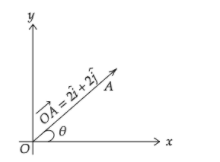
Here, $x - $ component of $\overrightarrow {OA} $ is $2$ and $y - $ component of $\overrightarrow {OA} $ is $2$.
Let $\theta $ be the angle that $\overrightarrow {OA} $ makes with the $x - $ axis. Then,
$ \tan \theta = \dfrac{y}{x} \\
\Rightarrow \tan \theta = \dfrac{2}{2} = 1 \\ $
We know that $\tan 45^\circ = 1$, so substituting this in above equation, we get
$ \Rightarrow \tan \theta = \tan 45^\circ $
$ \Rightarrow \theta = 45^\circ $
Now, let us rotate $\overrightarrow {OA} $ anticlockwise about the origin by $45^\circ $. Let $\alpha $ be the angle that the new vector makes with the $x - $axis.
We observe that
$\alpha = \theta + 45^\circ $
Substituting $\theta = 45^\circ $ in the above equation, we get
$ \Rightarrow \alpha = 45^\circ + 45^\circ \\
\Rightarrow \alpha = 90^\circ \\ $
Let us now find the components of the new vector.
Substituting $x = y = 2$ in the formula $\left| {\overrightarrow {OA} } \right| = \sqrt {{x^2} + {y^2}} $, we get
$\left| {\overrightarrow {OA} } \right| = \sqrt {{2^2} + {2^2}} $
Applying the exponent on the terms, we get
$ \Rightarrow \left| {\overrightarrow {OA} } \right| = \sqrt 8 = 2\sqrt 2 $
The $x - $component of \[\overrightarrow {OA} = \left| {\overrightarrow {OA} } \right|\cos \alpha \widehat i\]
Substituting $\left| {\overrightarrow {OA} } \right| = 2\sqrt 2 $ in the above equation, we get
$\overrightarrow {OA} = 2\sqrt 2 \cos 90^\circ \widehat i$
Now substituting $\cos 90^\circ = 0$ in the above equation, we get
$ \Rightarrow \overrightarrow {OA} = 0\widehat i$
The $y - $component of $\overrightarrow {OA} $ \[ = \left| {\overrightarrow {OA} } \right|\sin \alpha {\text{ }}\widehat j\]
Substituting $\left| {\overrightarrow {OA} } \right| = 2\sqrt 2 $ in the above equation, we get
\[\overrightarrow {OA} = 2\sqrt 2 \sin 90^\circ \widehat j\]
Now substituting $\sin 90^\circ = 1$ in the above equation, we get
\[ \Rightarrow \overrightarrow {OA} = 2\sqrt 2 \widehat j\]
Hence, the new vector $\overrightarrow {OA} = 0\widehat i + 2\sqrt 2 \widehat j = 2\sqrt 2 \widehat j$.
Thus, option (1) is the correct option .
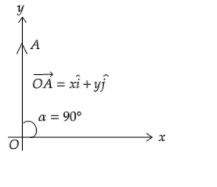
Note: If a vector $\overrightarrow {OA} $ makes an angle $\theta $ with the $x - $axis, then the $x{\text{ and }}y$ components of $\overrightarrow {OA} $ are given as $\left| {\overrightarrow {OA} } \right|\cos \theta $ and $\left| {\overrightarrow {OA} } \right|\sin \theta $ with unit vectors $\widehat i{\text{ and }}\widehat j$ respectively. We have selected the position of $\overrightarrow {OA} $ in the first quadrant since both $x{\text{ and }}y$ components are positive. We can also approach the above problem as follows: After rotating the vector by $45^\circ $, the new vector lies on the $y - $axis. In this case, the $x - $component of the new vector will be zero, which is what we obtained.
Formula used:
If $O$ is the origin and $A$ is any point such that the vector $\overrightarrow {OA} = x\widehat i + y\widehat j$, then $\left| {\overrightarrow {OA} } \right| = \sqrt {{x^2} + {y^2}} $.
If $\theta $ is the angle that $\overrightarrow {OA} $ makes with the $x - $ axis, then $\tan \theta = \dfrac{y}{x}$.
Complete step-by-step answer:
It is given that $\overrightarrow {OA} = 2\widehat i + 2\widehat j$, where $\widehat i{\text{ and }}\widehat j$ are unit vectors along $x{\text{ and }}y$ respectively.
Here, $x - $ component of $\overrightarrow {OA} $ is $2$ and $y - $ component of $\overrightarrow {OA} $ is $2$.
Let $\theta $ be the angle that $\overrightarrow {OA} $ makes with the $x - $ axis. Then,
$ \tan \theta = \dfrac{y}{x} \\
\Rightarrow \tan \theta = \dfrac{2}{2} = 1 \\ $
We know that $\tan 45^\circ = 1$, so substituting this in above equation, we get
$ \Rightarrow \tan \theta = \tan 45^\circ $
$ \Rightarrow \theta = 45^\circ $
Now, let us rotate $\overrightarrow {OA} $ anticlockwise about the origin by $45^\circ $. Let $\alpha $ be the angle that the new vector makes with the $x - $axis.
We observe that
$\alpha = \theta + 45^\circ $
Substituting $\theta = 45^\circ $ in the above equation, we get
$ \Rightarrow \alpha = 45^\circ + 45^\circ \\
\Rightarrow \alpha = 90^\circ \\ $
Let us now find the components of the new vector.
Substituting $x = y = 2$ in the formula $\left| {\overrightarrow {OA} } \right| = \sqrt {{x^2} + {y^2}} $, we get
$\left| {\overrightarrow {OA} } \right| = \sqrt {{2^2} + {2^2}} $
Applying the exponent on the terms, we get
$ \Rightarrow \left| {\overrightarrow {OA} } \right| = \sqrt 8 = 2\sqrt 2 $
The $x - $component of \[\overrightarrow {OA} = \left| {\overrightarrow {OA} } \right|\cos \alpha \widehat i\]
Substituting $\left| {\overrightarrow {OA} } \right| = 2\sqrt 2 $ in the above equation, we get
$\overrightarrow {OA} = 2\sqrt 2 \cos 90^\circ \widehat i$
Now substituting $\cos 90^\circ = 0$ in the above equation, we get
$ \Rightarrow \overrightarrow {OA} = 0\widehat i$
The $y - $component of $\overrightarrow {OA} $ \[ = \left| {\overrightarrow {OA} } \right|\sin \alpha {\text{ }}\widehat j\]
Substituting $\left| {\overrightarrow {OA} } \right| = 2\sqrt 2 $ in the above equation, we get
\[\overrightarrow {OA} = 2\sqrt 2 \sin 90^\circ \widehat j\]
Now substituting $\sin 90^\circ = 1$ in the above equation, we get
\[ \Rightarrow \overrightarrow {OA} = 2\sqrt 2 \widehat j\]
Hence, the new vector $\overrightarrow {OA} = 0\widehat i + 2\sqrt 2 \widehat j = 2\sqrt 2 \widehat j$.
Thus, option (1) is the correct option .
Note: If a vector $\overrightarrow {OA} $ makes an angle $\theta $ with the $x - $axis, then the $x{\text{ and }}y$ components of $\overrightarrow {OA} $ are given as $\left| {\overrightarrow {OA} } \right|\cos \theta $ and $\left| {\overrightarrow {OA} } \right|\sin \theta $ with unit vectors $\widehat i{\text{ and }}\widehat j$ respectively. We have selected the position of $\overrightarrow {OA} $ in the first quadrant since both $x{\text{ and }}y$ components are positive. We can also approach the above problem as follows: After rotating the vector by $45^\circ $, the new vector lies on the $y - $axis. In this case, the $x - $component of the new vector will be zero, which is what we obtained.
Recently Updated Pages
Master Class 11 Social Science: Engaging Questions & Answers for Success

Master Class 11 English: Engaging Questions & Answers for Success
Master Class 11 Maths: Engaging Questions & Answers for Success
Master Class 11 Chemistry: Engaging Questions & Answers for Success
Master Class 11 Biology: Engaging Questions & Answers for Success
Master Class 11 Physics: Engaging Questions & Answers for Success
Trending doubts
One Metric ton is equal to kg A 10000 B 1000 C 100 class 11 physics CBSE
Difference Between Prokaryotic Cells and Eukaryotic Cells
How many of the following diseases can be studied with class 11 biology CBSE
Draw a diagram of a plant cell and label at least eight class 11 biology CBSE
Two of the body parts which do not appear in MRI are class 11 biology CBSE
10 examples of friction in our daily life