




The variable line drawn through the point $\left( 1,3 \right)$ meets the $x-axis$ at $A$ and $y-axis$ at $B$. If the rectangle $OAPB$ is completed. Where $O$ is the origin, then locus of $P$ is?
A. $\dfrac{1}{y}+\dfrac{3}{x}=1$.
B. $x+3y=1$
C. $\dfrac{1}{x}+\dfrac{3}{y}=1$
D. $3x+y=1$
Answer
 Verified
558k+ views
Hint: In this problem we need to find the locus of the point $P$ according to the given conditions. Given that the line passes through the point $\left( 1,3 \right)$ which is assumed to be $C$ meets the $x-axis$ at $A$ and $y-axis$ at $B$. So, we will assume the coordinates of the points $A$ and $B$ as $\left( h,0 \right)$, $\left( 0,k \right)$ respectively. Now we will calculate the slope of the line $BC$, $AC$. Use the geometry rule which is the slope of the lines $BC$, $AC$ are equal because they both are single lines. Now simplify the equation and replace $h$, $k$ with $x$, $y$ respectively to get the required result.
Complete step-by-step answer:
Given data, The variable line drawn through the point $\left( 1,3 \right)$ meets the $x-axis$ at $A$ and $y-axis$ at $B$ and the rectangle $OAPB$ is completed. Where $O$ is the origin. The diagrammatic representation of the above data is given by
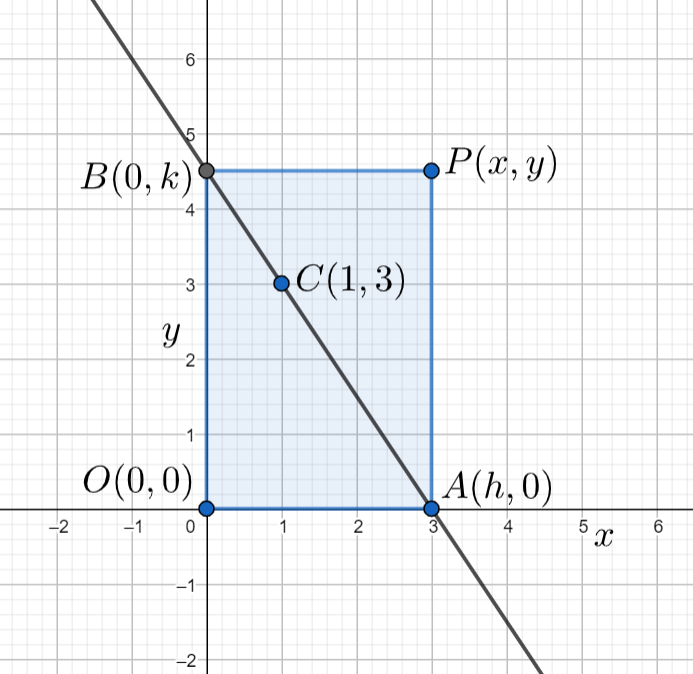
Let the coordinates of the points $A$ and $B$ are assumed to be $\left( h,0 \right)$, $\left( 0,k \right)$ respectively.
Now the slope of the line $BC$ will be given by
$m=\dfrac{{{y}_{2}}-{{y}_{1}}}{{{x}_{2}}-{{x}_{1}}}$
Substituting the values $\left( {{x}_{1}},{{y}_{1}} \right)=\left( 0,k \right)$, $\left( {{x}_{2}},{{y}_{2}} \right)=\left( 1,3 \right)$ in the above equation, then we will get
$\begin{align}
& m=\dfrac{3-k}{1-0} \\
& \Rightarrow m=\dfrac{3-k}{1} \\
\end{align}$
Now the slope of the line $AC$ will be calculated by substituting $\left( {{x}_{1}},{{y}_{1}} \right)=\left( h,0 \right)$, $\left( {{x}_{2}},{{y}_{2}} \right)=\left( 1,3 \right)$ in $m=\dfrac{{{y}_{2}}-{{y}_{1}}}{{{x}_{2}}-{{x}_{1}}}$, then we will get
$\begin{align}
& m=\dfrac{3-0}{1-h} \\
& \Rightarrow m=\dfrac{3}{1-h} \\
\end{align}$
Now the line $BC$, $AC$ represents the same line, so the slopes of the two lines should be equal, then we will have
$\dfrac{3-k}{1}=\dfrac{3}{1-h}$
Doing cross multiplication in the above equation, then we will get
$\left( 3-k \right)\left( 1-h \right)=3$
Using distribution law of multiplication in the above equation, then we will have
$3-3h-k+hk=3$
Cancelling the term $3$ which is on both sides of the above equation and divide whole equation with $hk$, then we will get
$\dfrac{-3h-k+hk}{hk}=0$
Simplifying the above equation by using mathematical operations, then we will have
$\begin{align}
& \dfrac{-3h}{hk}-\dfrac{k}{hk}+\dfrac{hk}{hk}=0 \\
& \Rightarrow -\dfrac{3}{k}-\dfrac{1}{h}+1=0 \\
& \Rightarrow \dfrac{1}{h}+\dfrac{3}{k}=1 \\
\end{align}$
Replace the terms $h$, $k$ with $x$, $y$ respectively in the above equation, then we will get
$\dfrac{1}{x}+\dfrac{3}{y}=1$
So, the correct answer is “Option c”.
Note: We can also use the collinear property form the points $A$, $C$, $B$ and simplify the determinant obtained to get the required result. Here we need to solve the determinant $\left| \begin{matrix}
h & 0 & 1 \\
1 & 3 & 1 \\
0 & k & 1 \\
\end{matrix} \right|=0$ which shows that the points are collinear.
Complete step-by-step answer:
Given data, The variable line drawn through the point $\left( 1,3 \right)$ meets the $x-axis$ at $A$ and $y-axis$ at $B$ and the rectangle $OAPB$ is completed. Where $O$ is the origin. The diagrammatic representation of the above data is given by
Let the coordinates of the points $A$ and $B$ are assumed to be $\left( h,0 \right)$, $\left( 0,k \right)$ respectively.
Now the slope of the line $BC$ will be given by
$m=\dfrac{{{y}_{2}}-{{y}_{1}}}{{{x}_{2}}-{{x}_{1}}}$
Substituting the values $\left( {{x}_{1}},{{y}_{1}} \right)=\left( 0,k \right)$, $\left( {{x}_{2}},{{y}_{2}} \right)=\left( 1,3 \right)$ in the above equation, then we will get
$\begin{align}
& m=\dfrac{3-k}{1-0} \\
& \Rightarrow m=\dfrac{3-k}{1} \\
\end{align}$
Now the slope of the line $AC$ will be calculated by substituting $\left( {{x}_{1}},{{y}_{1}} \right)=\left( h,0 \right)$, $\left( {{x}_{2}},{{y}_{2}} \right)=\left( 1,3 \right)$ in $m=\dfrac{{{y}_{2}}-{{y}_{1}}}{{{x}_{2}}-{{x}_{1}}}$, then we will get
$\begin{align}
& m=\dfrac{3-0}{1-h} \\
& \Rightarrow m=\dfrac{3}{1-h} \\
\end{align}$
Now the line $BC$, $AC$ represents the same line, so the slopes of the two lines should be equal, then we will have
$\dfrac{3-k}{1}=\dfrac{3}{1-h}$
Doing cross multiplication in the above equation, then we will get
$\left( 3-k \right)\left( 1-h \right)=3$
Using distribution law of multiplication in the above equation, then we will have
$3-3h-k+hk=3$
Cancelling the term $3$ which is on both sides of the above equation and divide whole equation with $hk$, then we will get
$\dfrac{-3h-k+hk}{hk}=0$
Simplifying the above equation by using mathematical operations, then we will have
$\begin{align}
& \dfrac{-3h}{hk}-\dfrac{k}{hk}+\dfrac{hk}{hk}=0 \\
& \Rightarrow -\dfrac{3}{k}-\dfrac{1}{h}+1=0 \\
& \Rightarrow \dfrac{1}{h}+\dfrac{3}{k}=1 \\
\end{align}$
Replace the terms $h$, $k$ with $x$, $y$ respectively in the above equation, then we will get
$\dfrac{1}{x}+\dfrac{3}{y}=1$
So, the correct answer is “Option c”.
Note: We can also use the collinear property form the points $A$, $C$, $B$ and simplify the determinant obtained to get the required result. Here we need to solve the determinant $\left| \begin{matrix}
h & 0 & 1 \\
1 & 3 & 1 \\
0 & k & 1 \\
\end{matrix} \right|=0$ which shows that the points are collinear.
Recently Updated Pages
Master Class 11 Social Science: Engaging Questions & Answers for Success

Master Class 11 English: Engaging Questions & Answers for Success
Master Class 11 Maths: Engaging Questions & Answers for Success
Master Class 11 Chemistry: Engaging Questions & Answers for Success
Master Class 11 Biology: Engaging Questions & Answers for Success
Master Class 11 Physics: Engaging Questions & Answers for Success
Trending doubts
One Metric ton is equal to kg A 10000 B 1000 C 100 class 11 physics CBSE
Difference Between Prokaryotic Cells and Eukaryotic Cells
Draw a diagram of a plant cell and label at least eight class 11 biology CBSE
Two of the body parts which do not appear in MRI are class 11 biology CBSE
Which gas is abundant in air class 11 chemistry CBSE
10 examples of friction in our daily life