




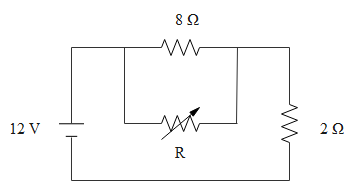
The value of the resistance R in the figure is adjusted such that power dissipated in the resistor\[2\,\Omega \] is maximum. Under this condition
A. \[R=0\]
B. \[R=8\Omega \]
C. Power dissipated in the resistor \[2\,\Omega \]is 72 W.
D. Power dissipated in the resistor \[2\,\Omega \]is 8 W.
Answer
 Verified
567.6k+ views
Hint: The equivalent resistance in the case of the resistors arranged in parallel will be less than the resistance of the smallest resistor, thus, the power dissipation will be maximum. The formula for computing the power dissipated is the square of the voltage by the resistance.
Formula used:
\[P=\dfrac{{{V}^{2}}}{R}\]
Complete answer:
From the given information, we have the data as follows.
The equivalent resistance in the case of the resistors arranged in parallel will be less than the resistance of the smallest resistor, thus, the power dissipation will be maximum. Similarly, the equivalent resistance in the case of the resistors arranged in series will be the sum of the resistance of the resistors, thus, the power dissipation will be minimal.
Thus, to avoid the maximum power dissipation in the parallel circuit R must be equal to zero. So, the equivalent resistance of the parallel resistors will be,
\[\begin{align}
& {{R}_{p}}=\dfrac{0\times 8}{0+8} \\
& \therefore {{R}_{p}}=0\Omega \\
\end{align}\]
As the equivalent resistance equals zero, thus, the power dissipated in the resistor \[2\Omega \] is given as follows.
The formula for computing the power dissipated in terms of the voltage and the resistance is given as follows.
\[P=\dfrac{{{V}^{2}}}{R}\]
Substitute the values in the above formula.
\[\begin{align}
& P=\dfrac{{{12}^{2}}}{2} \\
& \therefore P=72\,W \\
\end{align}\]
\[\therefore \] The value of the power dissipated in the resistor \[2\,\Omega \] is 72 W.
Thus, option (C) is correct.
Note:
The equivalent resistance in the case of the resistors arranged in parallel will be less than the resistance of the smallest resistor, thus, the power dissipation will be maximum. Similarly, the equivalent resistance in the case of the resistors arranged in series will be the sum of the resistance of the resistors, thus, the power dissipation will be minimal.
Formula used:
\[P=\dfrac{{{V}^{2}}}{R}\]
Complete answer:
From the given information, we have the data as follows.
The equivalent resistance in the case of the resistors arranged in parallel will be less than the resistance of the smallest resistor, thus, the power dissipation will be maximum. Similarly, the equivalent resistance in the case of the resistors arranged in series will be the sum of the resistance of the resistors, thus, the power dissipation will be minimal.
Thus, to avoid the maximum power dissipation in the parallel circuit R must be equal to zero. So, the equivalent resistance of the parallel resistors will be,
\[\begin{align}
& {{R}_{p}}=\dfrac{0\times 8}{0+8} \\
& \therefore {{R}_{p}}=0\Omega \\
\end{align}\]
As the equivalent resistance equals zero, thus, the power dissipated in the resistor \[2\Omega \] is given as follows.
The formula for computing the power dissipated in terms of the voltage and the resistance is given as follows.
\[P=\dfrac{{{V}^{2}}}{R}\]
Substitute the values in the above formula.
\[\begin{align}
& P=\dfrac{{{12}^{2}}}{2} \\
& \therefore P=72\,W \\
\end{align}\]
\[\therefore \] The value of the power dissipated in the resistor \[2\,\Omega \] is 72 W.
Thus, option (C) is correct.
Note:
The equivalent resistance in the case of the resistors arranged in parallel will be less than the resistance of the smallest resistor, thus, the power dissipation will be maximum. Similarly, the equivalent resistance in the case of the resistors arranged in series will be the sum of the resistance of the resistors, thus, the power dissipation will be minimal.
Recently Updated Pages
Master Class 11 Social Science: Engaging Questions & Answers for Success

Master Class 11 English: Engaging Questions & Answers for Success
Master Class 11 Maths: Engaging Questions & Answers for Success
Master Class 11 Chemistry: Engaging Questions & Answers for Success
Master Class 11 Biology: Engaging Questions & Answers for Success
Class 11 Question and Answer - Your Ultimate Solutions Guide
Trending doubts
One Metric ton is equal to kg A 10000 B 1000 C 100 class 11 physics CBSE
Difference Between Prokaryotic Cells and Eukaryotic Cells
Find the value of the expression given below sin 30circ class 11 maths CBSE
1 ton equals to A 100 kg B 1000 kg C 10 kg D 10000 class 11 physics CBSE
Two of the body parts which do not appear in MRI are class 11 biology CBSE
Draw a diagram of nephron and explain its structur class 11 biology CBSE