




The value of $\sec {{90}^{o}}$ is equal to:
(A). 1
(B). $\dfrac{2}{\sqrt{3}}$
(C). $\sqrt{2}$
(D). None of these
Answer
 Verified
635.4k+ views
Hint: The given problem is related to trigonometric ratios. Use the relation between cosine and secant of an angle, then use the value of \[\cos {{90}^{o}}=0\] to find the value of $\sec {{90}^{o}}$ .
Complete step-by-step solution -
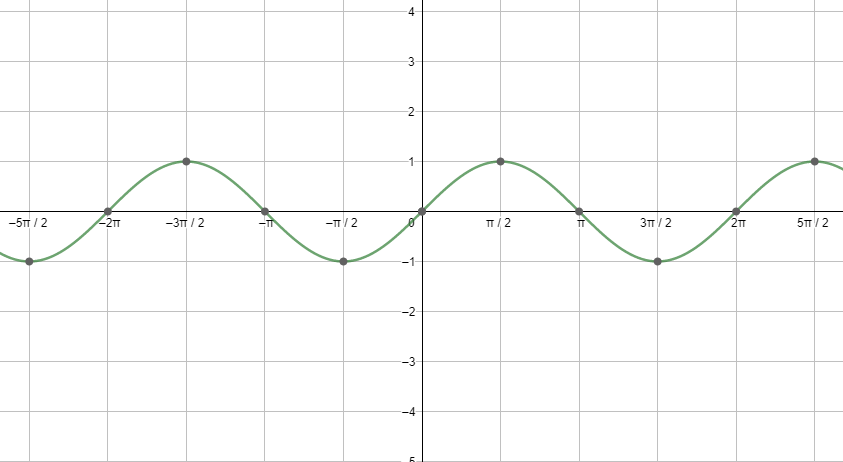
Before moving to the solution, let us discuss the periodicity of sine and cosine function, which we would be using in the solution. All the trigonometric ratios, including sine and cosine, are periodic functions. We can better understand this using the graph of sine and cosine.
First, let us start with the graph of sinx.
Next, let us see the graph of cosx.
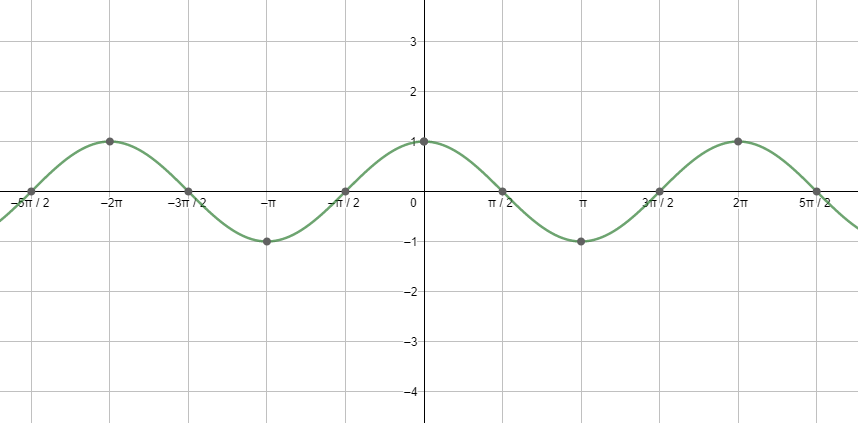
Looking at both the graphs, we can say that the graphs are repeating after a fixed period i.e. $2{{\pi }^{c}}$ . So, we can say that the fundamental period of the cosine function and the sine function is $2{{\pi }^{c}}=360{}^\circ $
Now, from the graph of cosine function, we can see that the value of $\cos {{90}^{o}}$ is equal to 0.
Now, we know that the relation between the cosine and the secant of an angle (say $\theta $ ) is given as $\sec \theta =\dfrac{1}{\cos \theta }$ . So, we can say that the value of $\sec {{90}^{o}}$ is given as $\sec {{90}^{o}}=\dfrac{1}{\cos {{90}^{o}}}$ .
But we know that the value of $\cos {{90}^{o}}$ is equal to 0.
$\Rightarrow \sec {{90}^{o}}=\dfrac{1}{0}$
We know that, when any number (except 0) when divided by 0 gives an infinite value. So, we can say that the value of $\dfrac{1}{0}$ will be equal to infinity.
$\Rightarrow \sec {{90}^{o}}=\infty $
On checking the options, we can see that none of the first three options has the value $\infty $ . Hence, option D is the correct option.
Note: It is useful to remember the graph of the trigonometric ratios along with the signs of their values in different quadrants. For example: sine is always positive in the first and the second quadrant while negative in the other two.
Complete step-by-step solution -
Before moving to the solution, let us discuss the periodicity of sine and cosine function, which we would be using in the solution. All the trigonometric ratios, including sine and cosine, are periodic functions. We can better understand this using the graph of sine and cosine.
First, let us start with the graph of sinx.
Next, let us see the graph of cosx.
Looking at both the graphs, we can say that the graphs are repeating after a fixed period i.e. $2{{\pi }^{c}}$ . So, we can say that the fundamental period of the cosine function and the sine function is $2{{\pi }^{c}}=360{}^\circ $
Now, from the graph of cosine function, we can see that the value of $\cos {{90}^{o}}$ is equal to 0.
Now, we know that the relation between the cosine and the secant of an angle (say $\theta $ ) is given as $\sec \theta =\dfrac{1}{\cos \theta }$ . So, we can say that the value of $\sec {{90}^{o}}$ is given as $\sec {{90}^{o}}=\dfrac{1}{\cos {{90}^{o}}}$ .
But we know that the value of $\cos {{90}^{o}}$ is equal to 0.
$\Rightarrow \sec {{90}^{o}}=\dfrac{1}{0}$
We know that, when any number (except 0) when divided by 0 gives an infinite value. So, we can say that the value of $\dfrac{1}{0}$ will be equal to infinity.
$\Rightarrow \sec {{90}^{o}}=\infty $
On checking the options, we can see that none of the first three options has the value $\infty $ . Hence, option D is the correct option.
Note: It is useful to remember the graph of the trigonometric ratios along with the signs of their values in different quadrants. For example: sine is always positive in the first and the second quadrant while negative in the other two.
Recently Updated Pages
Master Class 12 Business Studies: Engaging Questions & Answers for Success

Master Class 12 Biology: Engaging Questions & Answers for Success
Master Class 12 Chemistry: Engaging Questions & Answers for Success
Class 12 Question and Answer - Your Ultimate Solutions Guide
Master Class 11 Social Science: Engaging Questions & Answers for Success
Master Class 11 English: Engaging Questions & Answers for Success
Trending doubts
Explain the Treaty of Vienna of 1815 class 10 social science CBSE
Who Won 36 Oscar Awards? Record Holder Revealed
What is the median of the first 10 natural numbers class 10 maths CBSE
Why is it 530 pm in india when it is 1200 afternoon class 10 social science CBSE
Why is there a time difference of about 5 hours between class 10 social science CBSE
What is the full form of POSCO class 10 social science CBSE