




The value of phase at maximum displacement from the mean position of a particle in S.H.M is
A) $\dfrac{\pi }{2}$
B) $\pi$
C) Zero
D) $2\pi $
Answer
 Verified
608.4k+ views
Hint:Phase of a point in SHM is the angle made by the point, in uniform circular motion whose projection is that simple harmonic motion, with the initial point of motion at the centre of the circular motion or the mean position of the simple harmonic motion.Phase simply means an angular term which represents situation of a particle in SHM at a certain instant.
Complete step by step answer:Let us consider a particle is performing simple harmonic motion. The following figure illustrates the motion of the particle under consideration.
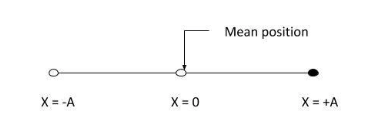
Let, X be the position of the particle at any instant of time t, A be the maximum displacement of the particle from its mean position. Also, consider that the angular frequency of the particle is $\omega $ and the phase difference is $\phi$ . Therefore, the mathematical expression for the position (X) of the particle performing simple harmonic motion at any instant of time (t) is given by,
$X = A\operatorname{Sin} (\omega t + \phi )$.......(1)
Where, $(\omega t + \phi )$ is called the phase of the particle in SHM. Now, consider the particle to be at a maximum displacement from its mean position ${\text{X }} = {\text{ + A}}$, from mean position ${\text{X }} = {\text{ 0 }}$ at time t, the mathematical expression for the same can be obtained by substituting ${\text{X }} = {\text{ + A}}$ in equation (1) . Therefore we have,
$A = A\operatorname{Sin} (\omega t + \phi )$
$\operatorname{Sin} (\omega t + \phi ) = 1$
$(\omega t + \phi ) = 2n\pi + \dfrac{\pi }{2}$.....(2)
Where, n = 0, 1, 2, 3, …..
Hence, from equation (2) we have,
$(\omega t + \phi ) = \dfrac{\pi }{2},\dfrac{{5\pi }}{2},\dfrac{{9\pi }}{2},.......$
From the above expression, we can say that $\dfrac{\pi }{2}$, is the only option answer that fits in the range of possible values of phase of a particle in SHM. Therefore, option A is the right choice.
Note:A periodic motion in which the restoring force on the moving object is directly proportional to the magnitude of the displacement of the moving object and is always directed towards the equilibrium position of the object is known as simple harmonic motion (SHM).
Complete step by step answer:Let us consider a particle is performing simple harmonic motion. The following figure illustrates the motion of the particle under consideration.
Let, X be the position of the particle at any instant of time t, A be the maximum displacement of the particle from its mean position. Also, consider that the angular frequency of the particle is $\omega $ and the phase difference is $\phi$ . Therefore, the mathematical expression for the position (X) of the particle performing simple harmonic motion at any instant of time (t) is given by,
$X = A\operatorname{Sin} (\omega t + \phi )$.......(1)
Where, $(\omega t + \phi )$ is called the phase of the particle in SHM. Now, consider the particle to be at a maximum displacement from its mean position ${\text{X }} = {\text{ + A}}$, from mean position ${\text{X }} = {\text{ 0 }}$ at time t, the mathematical expression for the same can be obtained by substituting ${\text{X }} = {\text{ + A}}$ in equation (1) . Therefore we have,
$A = A\operatorname{Sin} (\omega t + \phi )$
$\operatorname{Sin} (\omega t + \phi ) = 1$
$(\omega t + \phi ) = 2n\pi + \dfrac{\pi }{2}$.....(2)
Where, n = 0, 1, 2, 3, …..
Hence, from equation (2) we have,
$(\omega t + \phi ) = \dfrac{\pi }{2},\dfrac{{5\pi }}{2},\dfrac{{9\pi }}{2},.......$
From the above expression, we can say that $\dfrac{\pi }{2}$, is the only option answer that fits in the range of possible values of phase of a particle in SHM. Therefore, option A is the right choice.
Note:A periodic motion in which the restoring force on the moving object is directly proportional to the magnitude of the displacement of the moving object and is always directed towards the equilibrium position of the object is known as simple harmonic motion (SHM).
Recently Updated Pages
Master Class 12 Economics: Engaging Questions & Answers for Success

Master Class 12 English: Engaging Questions & Answers for Success
Master Class 12 Social Science: Engaging Questions & Answers for Success
Master Class 12 Maths: Engaging Questions & Answers for Success
Master Class 12 Physics: Engaging Questions & Answers for Success
Master Class 9 General Knowledge: Engaging Questions & Answers for Success
Trending doubts
One Metric ton is equal to kg A 10000 B 1000 C 100 class 11 physics CBSE
Difference Between Prokaryotic Cells and Eukaryotic Cells
Two of the body parts which do not appear in MRI are class 11 biology CBSE
1 ton equals to A 100 kg B 1000 kg C 10 kg D 10000 class 11 physics CBSE
10 examples of friction in our daily life
DNA is not present in A Nucleus B Mitochondria C Chloroplast class 11 biology CBSE