




The value of Peltier coefficient of a thermocouple
(A) does not vary with absolute temperature of the junction
(B) varies with absolute temperature of the junction
(C) does not depend on the two different metals forming the junction
(D) varies with the direction of current.
Answer
 Verified
608.7k+ views
Hint
In a thermocouple a junction of two dissimilar metals is present. Due to the flow of current heat energy is absorbed or evolved, according to the direction of the current, and its amount depends on the Peltier coefficient. So the Peltier coefficient depends on the junction of the two metals but doesn’t depend on absolute temperature.
Complete step by step answer
A thermocouple is an electrical device which has two dissimilar electrical conductors which are joined together to form an electrical junction. So when $ 1 $ ampere current flows through the junction for a time of 1 second, then the heat energy gets absorbed or is evolved depending on the polarity of the current. This phenomenon is known as the Peltier effect. The amount of heat energy that is absorbed or evolved is called the Peltier coefficient. It is denoted by $ \pi $ and the unit is volt. When the amount of heat energy absorbed is $ H $ then the coefficient is given by, $ H = \pi It $ , where $ I $ is the current and $ t $ is the time.
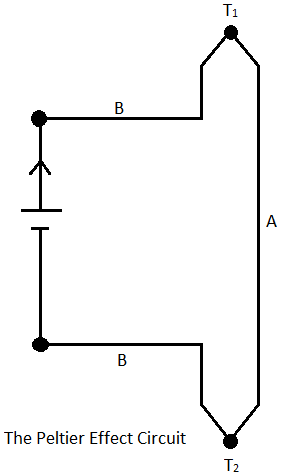
In this given figure, let us consider, there are two metals $ A $ and $ B $ which are joined together at the junctions. From the image, we can see the direction of the flow of current from the battery. So the upper junction gets heated first and acquires a temperature of $ {T_2} $ and the lower junction remains at a temperature $ {T_1} $ , where $ {T_1} < {T_2} $ .
So the heat energy absorbed is given by,
$\Rightarrow H = {\pi _{AB}}It $
where $ {\pi _{AB}} = {\pi _A} - {\pi _B} $ is the Peltier coefficient of the whole circuit and $ {\pi _A},{\pi _B} $ are Peltier coefficient of $ A $ and $ B $ .
So from here, we can see that the Peltier coefficient is independent of the direction of current but depends on the two metals that form the junction and it is independent of the absolute temperature.
So the correct answer will be option (A).
Note
The phenomenon of the Peltier effect is normally seen in small commercial thermoelectric refrigerators, as well as in the inverse devices and the thermoelectric generator. Materials having a very large Peltier coefficient have been of much use in designing many systems.
In a thermocouple a junction of two dissimilar metals is present. Due to the flow of current heat energy is absorbed or evolved, according to the direction of the current, and its amount depends on the Peltier coefficient. So the Peltier coefficient depends on the junction of the two metals but doesn’t depend on absolute temperature.
Complete step by step answer
A thermocouple is an electrical device which has two dissimilar electrical conductors which are joined together to form an electrical junction. So when $ 1 $ ampere current flows through the junction for a time of 1 second, then the heat energy gets absorbed or is evolved depending on the polarity of the current. This phenomenon is known as the Peltier effect. The amount of heat energy that is absorbed or evolved is called the Peltier coefficient. It is denoted by $ \pi $ and the unit is volt. When the amount of heat energy absorbed is $ H $ then the coefficient is given by, $ H = \pi It $ , where $ I $ is the current and $ t $ is the time.
In this given figure, let us consider, there are two metals $ A $ and $ B $ which are joined together at the junctions. From the image, we can see the direction of the flow of current from the battery. So the upper junction gets heated first and acquires a temperature of $ {T_2} $ and the lower junction remains at a temperature $ {T_1} $ , where $ {T_1} < {T_2} $ .
So the heat energy absorbed is given by,
$\Rightarrow H = {\pi _{AB}}It $
where $ {\pi _{AB}} = {\pi _A} - {\pi _B} $ is the Peltier coefficient of the whole circuit and $ {\pi _A},{\pi _B} $ are Peltier coefficient of $ A $ and $ B $ .
So from here, we can see that the Peltier coefficient is independent of the direction of current but depends on the two metals that form the junction and it is independent of the absolute temperature.
So the correct answer will be option (A).
Note
The phenomenon of the Peltier effect is normally seen in small commercial thermoelectric refrigerators, as well as in the inverse devices and the thermoelectric generator. Materials having a very large Peltier coefficient have been of much use in designing many systems.
Recently Updated Pages
Master Class 11 Social Science: Engaging Questions & Answers for Success

Master Class 11 English: Engaging Questions & Answers for Success
Master Class 11 Maths: Engaging Questions & Answers for Success
Master Class 11 Chemistry: Engaging Questions & Answers for Success
Master Class 11 Biology: Engaging Questions & Answers for Success
Master Class 11 Physics: Engaging Questions & Answers for Success
Trending doubts
One Metric ton is equal to kg A 10000 B 1000 C 100 class 11 physics CBSE
Difference Between Prokaryotic Cells and Eukaryotic Cells
How many of the following diseases can be studied with class 11 biology CBSE
Which of the following enzymes is used for carboxylation class 11 biology CBSE
Draw a diagram of a plant cell and label at least eight class 11 biology CBSE
Two of the body parts which do not appear in MRI are class 11 biology CBSE