




The value of \[m\], in order that \[{x^2} - mx - 2\] is the quotient when \[{x^3} + 3{x^2} - 4\] is divided by \[x + 2\], is
(a) \[ - 1\]
(b) 1
(c) 0
(d) \[ - 2\]
Answer
 Verified
609.6k+ views
Hint: Here, we have to find the value of \[m\]. We will use a long division method to divide \[{x^3} + 3{x^2} - 4\] by \[x + 2\] and obtain the quotient. Then, we will compare the coefficients of the two quotients to find the value of \[m\].
Complete step-by-step answer:
Let us use a long division method to divide \[{x^3} + 3{x^2} - 4\] by \[x + 2\].
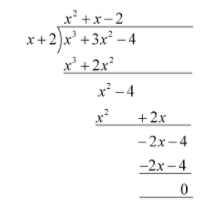
We can observe that when \[{x^3} + 3{x^2} - 4\] is divided by \[x + 2\] using a long division method, the quotient is \[{x^2} + x - 2\].
It is given that \[{x^2} - mx - 2\] is the quotient when \[{x^3} + 3{x^2} - 4\] is divided by \[x + 2\].
Thus, we will compare the two quotients.
Comparing the coefficients in the quotients \[{x^2} - mx - 2\] and \[{x^2} + x - 2\], we get
\[ - m = 1\]
Multiplying both the sides by \[ - 1\], we get
\[ \Rightarrow - m\left( { - 1} \right) = 1\left( { - 1} \right)\]
Therefore, we get
\[ \Rightarrow m = - 1\]
Thus, we found out that the value of \[m\] is \[ - 1\].
\[\therefore \] The correct option is option (a).
Note: We need to be careful while doing the long division. When multiplying \[x + 2\] by \[x\], the product of \[2\] and \[x\] is \[2x\]. Since the dividend has no term from which \[2x\] can be subtracted, we have placed the term at the end of the dividend.
If \[g\left( x \right)\] is a factor of a polynomial \[p\left( x \right)\], then \[p\left( x \right)\] is exactly divisible by \[g\left( x \right)\]. This means that when \[p\left( x \right)\] is divided by \[g\left( x \right)\], the remainder should be equal to 0.
We can see that when \[{x^3} + 3{x^2} - 4\] is divided by \[x + 2\], the remainder is 0.
Therefore, the polynomial \[x + 2\] is a factor of the polynomial \[{x^3} + 3{x^2} - 4\].
Complete step-by-step answer:
Let us use a long division method to divide \[{x^3} + 3{x^2} - 4\] by \[x + 2\].
We can observe that when \[{x^3} + 3{x^2} - 4\] is divided by \[x + 2\] using a long division method, the quotient is \[{x^2} + x - 2\].
It is given that \[{x^2} - mx - 2\] is the quotient when \[{x^3} + 3{x^2} - 4\] is divided by \[x + 2\].
Thus, we will compare the two quotients.
Comparing the coefficients in the quotients \[{x^2} - mx - 2\] and \[{x^2} + x - 2\], we get
\[ - m = 1\]
Multiplying both the sides by \[ - 1\], we get
\[ \Rightarrow - m\left( { - 1} \right) = 1\left( { - 1} \right)\]
Therefore, we get
\[ \Rightarrow m = - 1\]
Thus, we found out that the value of \[m\] is \[ - 1\].
\[\therefore \] The correct option is option (a).
Note: We need to be careful while doing the long division. When multiplying \[x + 2\] by \[x\], the product of \[2\] and \[x\] is \[2x\]. Since the dividend has no term from which \[2x\] can be subtracted, we have placed the term at the end of the dividend.
If \[g\left( x \right)\] is a factor of a polynomial \[p\left( x \right)\], then \[p\left( x \right)\] is exactly divisible by \[g\left( x \right)\]. This means that when \[p\left( x \right)\] is divided by \[g\left( x \right)\], the remainder should be equal to 0.
We can see that when \[{x^3} + 3{x^2} - 4\] is divided by \[x + 2\], the remainder is 0.
Therefore, the polynomial \[x + 2\] is a factor of the polynomial \[{x^3} + 3{x^2} - 4\].
Recently Updated Pages
Master Class 11 English: Engaging Questions & Answers for Success

Master Class 11 Social Science: Engaging Questions & Answers for Success
Master Class 11 Maths: Engaging Questions & Answers for Success
Master Class 11 Biology: Engaging Questions & Answers for Success
Master Class 11 Physics: Engaging Questions & Answers for Success
Master Class 11 Chemistry: Engaging Questions & Answers for Success
Trending doubts
Explain the Treaty of Vienna of 1815 class 10 social science CBSE
What is the Total Duration of Football Match?
The shortest day of the year in India
In which year voting age was reduced from 21 to 18?
10 examples of evaporation in daily life with explanations
What planets have no moons Which one has only one moon class 10 physics CBSE