




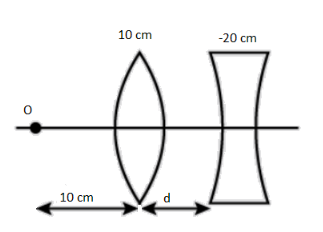
What should be the value of distance \[d\] so that the final image is formed on the object itself. (Focal lengths of the lenses are written on the lenses.)
Answer
 Verified
616.2k+ views
Hint:In this question, we can use the lens formula. In this question, two images are formed. We can calculate the distance of the first image for the convex lens. Then we can calculate the distance of the second image/final image for the concave lens.
Complete step by step solution: -
According to the question, we have two lenses. First one is a convex lens and the second one is a concave lens.
The first image will be formed by the first lens convex lens. Let the image be formed at a distance ${v_1}$ when the object is at point \[O\] at the distance ${u_1} = - 10cm$. We know that the focal length of the convex lens is ${f_1} = 10cm$. So, we can use lens formula for the convex lens which is given as-
$\dfrac{1}{v} + \dfrac{1}{u} = \dfrac{1}{f}$
So, substituting the values for convex lens in the lens formula, we get-
$
\dfrac{1}{{{v_1}}} - \dfrac{1}{{ - 10}} = \dfrac{1}{{10}} \\
\Rightarrow \dfrac{1}{{{v_1}}} + \dfrac{1}{{10}} = \dfrac{1}{{10}} \\
\Rightarrow \dfrac{1}{{{v_1}}} = \dfrac{1}{{10}} - \dfrac{1}{{10}} \\
\Rightarrow \dfrac{1}{{{v_1}}} = 0 \\
\Rightarrow {v_1} = \dfrac{1}{0} \\
\Rightarrow {v_1} = \infty \\
$
Now, the image from the convex lens will become the object for the second lens which is a concave lens.
Now, according to the question, the focal length of the concave lens ${f_2} = - 20cm$ and from the above calculation, we have the distance of object \[{u_2} = {v_1} = \infty \]. Let the distance of the image is ${v_2}$, then using the lens formula, we get-
$
\dfrac{1}{{{v_2}}} - \dfrac{1}{\infty } = \dfrac{1}{{ - 20}} \\
\Rightarrow \dfrac{1}{{{v_2}}} - 0 = \dfrac{1}{{ - 20}} \\
\Rightarrow {v_2} = - 20cm \\
$
So, the final image which is formed by the concave lens is at $ - 20cm$.
Negative sign gives the position of the final image which is formed at the left side of both lenses.
So, the final image is formed at $20cm$.
Now, from the figure, we have-
${v_{_2}} = d + 10cm$
From the above calculations, we have $\left| {{v_2}} \right| = 20cm$. So,
$
\Rightarrow 20 = d + 10 \\
\Rightarrow d = 20 - 10 \\
\Rightarrow d = 10cm \\
$
Hence, the distance between both the lenses $d = 10cm$.
Note: - In this question, we have to remember that there are two images formed by two lenses. The image from the first lens i.s. convex lens will become the object for the second lens i.e. concave lens.
Complete step by step solution: -
According to the question, we have two lenses. First one is a convex lens and the second one is a concave lens.
The first image will be formed by the first lens convex lens. Let the image be formed at a distance ${v_1}$ when the object is at point \[O\] at the distance ${u_1} = - 10cm$. We know that the focal length of the convex lens is ${f_1} = 10cm$. So, we can use lens formula for the convex lens which is given as-
$\dfrac{1}{v} + \dfrac{1}{u} = \dfrac{1}{f}$
So, substituting the values for convex lens in the lens formula, we get-
$
\dfrac{1}{{{v_1}}} - \dfrac{1}{{ - 10}} = \dfrac{1}{{10}} \\
\Rightarrow \dfrac{1}{{{v_1}}} + \dfrac{1}{{10}} = \dfrac{1}{{10}} \\
\Rightarrow \dfrac{1}{{{v_1}}} = \dfrac{1}{{10}} - \dfrac{1}{{10}} \\
\Rightarrow \dfrac{1}{{{v_1}}} = 0 \\
\Rightarrow {v_1} = \dfrac{1}{0} \\
\Rightarrow {v_1} = \infty \\
$
Now, the image from the convex lens will become the object for the second lens which is a concave lens.
Now, according to the question, the focal length of the concave lens ${f_2} = - 20cm$ and from the above calculation, we have the distance of object \[{u_2} = {v_1} = \infty \]. Let the distance of the image is ${v_2}$, then using the lens formula, we get-
$
\dfrac{1}{{{v_2}}} - \dfrac{1}{\infty } = \dfrac{1}{{ - 20}} \\
\Rightarrow \dfrac{1}{{{v_2}}} - 0 = \dfrac{1}{{ - 20}} \\
\Rightarrow {v_2} = - 20cm \\
$
So, the final image which is formed by the concave lens is at $ - 20cm$.
Negative sign gives the position of the final image which is formed at the left side of both lenses.
So, the final image is formed at $20cm$.
Now, from the figure, we have-
${v_{_2}} = d + 10cm$
From the above calculations, we have $\left| {{v_2}} \right| = 20cm$. So,
$
\Rightarrow 20 = d + 10 \\
\Rightarrow d = 20 - 10 \\
\Rightarrow d = 10cm \\
$
Hence, the distance between both the lenses $d = 10cm$.
Note: - In this question, we have to remember that there are two images formed by two lenses. The image from the first lens i.s. convex lens will become the object for the second lens i.e. concave lens.
Recently Updated Pages
Master Class 12 Economics: Engaging Questions & Answers for Success

Master Class 12 English: Engaging Questions & Answers for Success
Master Class 12 Social Science: Engaging Questions & Answers for Success
Master Class 12 Maths: Engaging Questions & Answers for Success
Master Class 12 Physics: Engaging Questions & Answers for Success
Master Class 12 Business Studies: Engaging Questions & Answers for Success
Trending doubts
Which are the Top 10 Largest Countries of the World?
Draw a labelled sketch of the human eye class 12 physics CBSE
Differentiate between homogeneous and heterogeneous class 12 chemistry CBSE
Why is the cell called the structural and functional class 12 biology CBSE
Draw ray diagrams each showing i myopic eye and ii class 12 physics CBSE
Which is the correct genotypic ratio of mendel dihybrid class 12 biology CBSE