




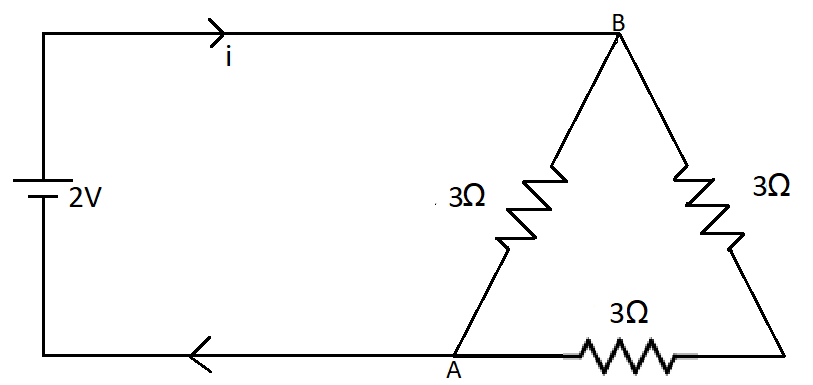
The value of current $i$ in the network shown in figure given below is
(A) $\left( {\dfrac{1}{9}} \right)A$
(B) $\left( {\dfrac{2}{9}} \right)A$
(C) $\left( {\dfrac{3}{9}} \right)A$
(D) $1A$
Answer
 Verified
611.1k+ views
Hint
To find the current in the circuit we need to find the equivalent resistance that is present in the circuit. Then by using Ohm's law with the given cell of e.m.f. of 2V and the calculated equivalent resistance we can find the current in the circuit.
In this solution, we will be using the following formula,
$\Rightarrow {R_{eq}} = {R_1} + {R_2} + {R_3} + ....$ where ${R_{eq}}$ is the equivalent resistance when the resistances are placed in series.
and $\dfrac{1}{{{R_{eq}}}} = \dfrac{1}{{{R_1}}} + \dfrac{1}{{{R_2}}} + \dfrac{1}{{{R_3}}} + ....$ where ${R_{eq}}$ is the equivalent resistance when the resistances are placed in a parallel circuit.
And from Ohm’s law,
$\Rightarrow V = IR$ where $V$ is the potential of the cell and $R$ is the equivalent resistance.
Complete step by step answer
To solve the given problem we need to first find the equivalent resistances in the given circuit between the points A and B.
So we can simplify the circuit as,
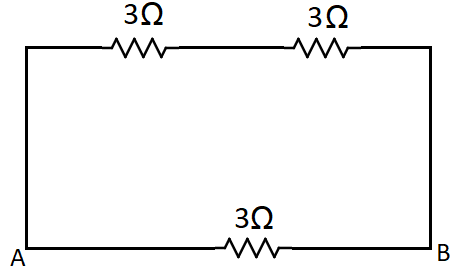
So on the top wire 2 resistances are in series, so the equivalent resistance is given by the formula
$\Rightarrow {R_{eq}} = {R_1} + {R_2} + {R_3} + ....$
Therefore, ${R_{eq}} = \left( {3 + 3} \right)\Omega $
$\Rightarrow {R_{eq}} = 6\Omega $
Now the resistances in the top and bottom wire are in parallel, so we get the equivalent resistance from the formula,
$\Rightarrow \dfrac{1}{{{R_{eq}}}} = \dfrac{1}{{{R_1}}} + \dfrac{1}{{{R_2}}} + \dfrac{1}{{{R_3}}} + ....$
So substituting ${R_1} = {R_{eq}} = 6\Omega $ and ${R_2} = 3\Omega $ we get
$\Rightarrow \dfrac{1}{R} = \dfrac{1}{{{R_1}}} + \dfrac{1}{{{R_2}}}$
$\Rightarrow \dfrac{1}{R} = \dfrac{1}{6} + \dfrac{1}{3}$
On doing LCM of the denominator,
$\Rightarrow \dfrac{1}{R} = \dfrac{{1 + 2}}{6} = \dfrac{3}{6}$
So on taking the reciprocal we get the value of the equivalent resistance as
$\Rightarrow R = \dfrac{6}{3} = 2\Omega $
So now in the given circuit, the resistance is $R = 2\Omega $ and the potential across the cell is given in the figure, $V = 2V$. So from Ohm’s law, the current in the circuit is,
$\Rightarrow i = \dfrac{V}{R}$
So substituting the values we get
$\Rightarrow i = \dfrac{2}{2}$
Cancelling 2 from numerator and denominator we have,
$\Rightarrow i = 1A$
Therefore the correct answer is (D).
Note
In the given circuit the resistances are in parallel. So the current passing gets divided into the two streams and the current in a particular stream is found by dividing the potential drop of the resistance by the resistance value. But the potential across the resistances in the two wires will be the same, which is the potential drop across the cell 2V.
To find the current in the circuit we need to find the equivalent resistance that is present in the circuit. Then by using Ohm's law with the given cell of e.m.f. of 2V and the calculated equivalent resistance we can find the current in the circuit.
In this solution, we will be using the following formula,
$\Rightarrow {R_{eq}} = {R_1} + {R_2} + {R_3} + ....$ where ${R_{eq}}$ is the equivalent resistance when the resistances are placed in series.
and $\dfrac{1}{{{R_{eq}}}} = \dfrac{1}{{{R_1}}} + \dfrac{1}{{{R_2}}} + \dfrac{1}{{{R_3}}} + ....$ where ${R_{eq}}$ is the equivalent resistance when the resistances are placed in a parallel circuit.
And from Ohm’s law,
$\Rightarrow V = IR$ where $V$ is the potential of the cell and $R$ is the equivalent resistance.
Complete step by step answer
To solve the given problem we need to first find the equivalent resistances in the given circuit between the points A and B.
So we can simplify the circuit as,
So on the top wire 2 resistances are in series, so the equivalent resistance is given by the formula
$\Rightarrow {R_{eq}} = {R_1} + {R_2} + {R_3} + ....$
Therefore, ${R_{eq}} = \left( {3 + 3} \right)\Omega $
$\Rightarrow {R_{eq}} = 6\Omega $
Now the resistances in the top and bottom wire are in parallel, so we get the equivalent resistance from the formula,
$\Rightarrow \dfrac{1}{{{R_{eq}}}} = \dfrac{1}{{{R_1}}} + \dfrac{1}{{{R_2}}} + \dfrac{1}{{{R_3}}} + ....$
So substituting ${R_1} = {R_{eq}} = 6\Omega $ and ${R_2} = 3\Omega $ we get
$\Rightarrow \dfrac{1}{R} = \dfrac{1}{{{R_1}}} + \dfrac{1}{{{R_2}}}$
$\Rightarrow \dfrac{1}{R} = \dfrac{1}{6} + \dfrac{1}{3}$
On doing LCM of the denominator,
$\Rightarrow \dfrac{1}{R} = \dfrac{{1 + 2}}{6} = \dfrac{3}{6}$
So on taking the reciprocal we get the value of the equivalent resistance as
$\Rightarrow R = \dfrac{6}{3} = 2\Omega $
So now in the given circuit, the resistance is $R = 2\Omega $ and the potential across the cell is given in the figure, $V = 2V$. So from Ohm’s law, the current in the circuit is,
$\Rightarrow i = \dfrac{V}{R}$
So substituting the values we get
$\Rightarrow i = \dfrac{2}{2}$
Cancelling 2 from numerator and denominator we have,
$\Rightarrow i = 1A$
Therefore the correct answer is (D).
Note
In the given circuit the resistances are in parallel. So the current passing gets divided into the two streams and the current in a particular stream is found by dividing the potential drop of the resistance by the resistance value. But the potential across the resistances in the two wires will be the same, which is the potential drop across the cell 2V.
Recently Updated Pages
Master Class 12 Business Studies: Engaging Questions & Answers for Success

Master Class 12 Chemistry: Engaging Questions & Answers for Success
Master Class 12 Biology: Engaging Questions & Answers for Success
Class 12 Question and Answer - Your Ultimate Solutions Guide
Master Class 9 General Knowledge: Engaging Questions & Answers for Success
Master Class 9 Maths: Engaging Questions & Answers for Success
Trending doubts
Which are the Top 10 Largest Countries of the World?
Draw a labelled sketch of the human eye class 12 physics CBSE
Name the crygenes that control cotton bollworm and class 12 biology CBSE
Differentiate between homogeneous and heterogeneous class 12 chemistry CBSE
In a transcription unit the promoter is said to be class 12 biology CBSE
Sulphuric acid is known as the king of acids State class 12 chemistry CBSE