




The value of \[\arg \left( x \right)\] when $x < 0$ is:
A.0
B.$\dfrac{\pi }{2}$
C.$\pi $
D.None of these
Answer
 Verified
596.1k+ views
Hint: Represent the given complex number on the plane, where the real part corresponds to the $x$ coordinate and the imaginary part corresponds to the $y$ axis. Take $x < 0$. The argument of the angle is the angle in radians, inclined from real axis $\left( {x - axis} \right)$ in the direction of complex number, when complex number is represented on the complex plane
Complete step-by-step answer:
A complex number is of the form $a + ib$, where $a$ is the real part and $b$ represents the imaginary part.
In polar form, a complex number is written as $r\left( {\cos \theta + i\sin \theta } \right)$, where $r$is the modulus of the complex number and $\theta $ is the argument of the complex number.
The argument of the angle is the angle in radians, inclined from the real axis $\left( {x - axis} \right)$ in the direction of complex number, when complex number is represented on the complex plane.
In the given complex number, $z = x$, the real part is $x$ and it has no imaginary part.
Represent the given complex number on the plane.
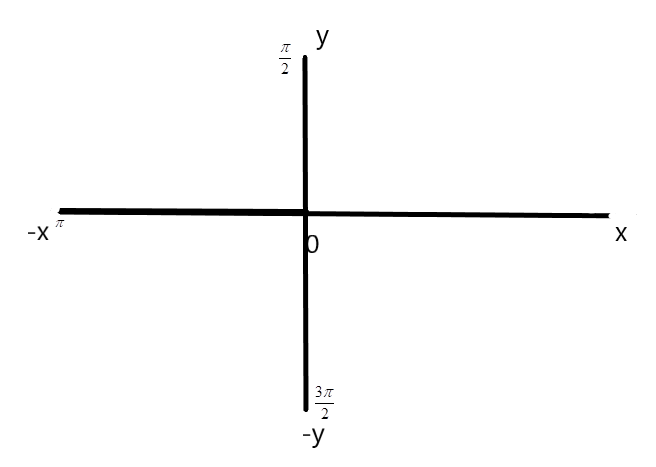
From the figure, the complex number represents the negative $x$ axis.
We have to find the angle inclined from $x - axis$ to the complex number in the direction of the complex number. Since, the value of $x < 0$, we can see from the graph that the value of the argument is $\pi $.
Thus, the value of \[\arg \left( x \right)\] when $x < 0$ is $\pi $.
Hence, option C is correct.
Note: The argument of the complex number is the angle in radians measured from the $x$ axis in an anticlockwise direction. $x$ axis represents the real part and $y$ axis represents the complex part of a complex number.
Complete step-by-step answer:
A complex number is of the form $a + ib$, where $a$ is the real part and $b$ represents the imaginary part.
In polar form, a complex number is written as $r\left( {\cos \theta + i\sin \theta } \right)$, where $r$is the modulus of the complex number and $\theta $ is the argument of the complex number.
The argument of the angle is the angle in radians, inclined from the real axis $\left( {x - axis} \right)$ in the direction of complex number, when complex number is represented on the complex plane.
In the given complex number, $z = x$, the real part is $x$ and it has no imaginary part.
Represent the given complex number on the plane.
From the figure, the complex number represents the negative $x$ axis.
We have to find the angle inclined from $x - axis$ to the complex number in the direction of the complex number. Since, the value of $x < 0$, we can see from the graph that the value of the argument is $\pi $.
Thus, the value of \[\arg \left( x \right)\] when $x < 0$ is $\pi $.
Hence, option C is correct.
Note: The argument of the complex number is the angle in radians measured from the $x$ axis in an anticlockwise direction. $x$ axis represents the real part and $y$ axis represents the complex part of a complex number.
Recently Updated Pages
Master Class 11 English: Engaging Questions & Answers for Success

Master Class 11 Maths: Engaging Questions & Answers for Success
Master Class 11 Biology: Engaging Questions & Answers for Success
Master Class 11 Social Science: Engaging Questions & Answers for Success
Master Class 11 Physics: Engaging Questions & Answers for Success
Master Class 11 Accountancy: Engaging Questions & Answers for Success
Trending doubts
One Metric ton is equal to kg A 10000 B 1000 C 100 class 11 physics CBSE
Discuss the various forms of bacteria class 11 biology CBSE
Draw a diagram of a plant cell and label at least eight class 11 biology CBSE
State the laws of reflection of light
Explain zero factorial class 11 maths CBSE
10 examples of friction in our daily life