




The valency of iron in \[FeC{{l}_{3}}\] is 1.
A.True
B.False
Answer
 Verified
639.3k+ views
Hint: We should know that valency is determined by valence electrons which are those electrons that are present in the outermost orbit of the atom. And we should know that the number of bonds that an atom can form as part of a compound is expressed by the valency of the element.
Step by step answer:
We all know the arrangement of electrons in an atom in shells and orbitals. We should know that valency is determined by the valence electrons which are determined by electrons which are present in the outermost orbit of the atom. We should know that noble gases have a completely filled outermost shell and that’s why they are least reactive. Other element’s reactivity depends upon their ability to attain the noble gas configuration.
If we want to find out the valency of iron in \[FeC{{l}_{3}}\], then we can find it by writing electronic configuration. We can also say that the valency of iron also depends on the number of chloride ions present in ferric chloride. Based on that, the valency of the iron in the ferric chloride is 3.
Let us verify our answer by writing electronic configuration of chlorine.
Electronic configuration of chlorine:
Atomic number of chlorine=17= 2, 8, 7.
According to noble gas theory, it states that chlorine will attain noble gas configuration of argon only if chlorine accepts one electron. So, the valency of chlorine is one.
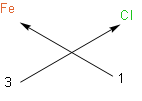
From the above figure it states that the valency of iron is 3. So, the above represented statement is incorrect and is false.
Note: We should know that valency is different from the oxidation number, and we should note valency has no sign. Thus, the valency of nitrogen is 3, whereas it can have oxidation numbers from -3 to +5. We should note that the oxidation number is the hypothetical charge of an atom in a molecule or ion, and it is a measure of its apparent capacity to gain or lose electrons within that species.
Step by step answer:
We all know the arrangement of electrons in an atom in shells and orbitals. We should know that valency is determined by the valence electrons which are determined by electrons which are present in the outermost orbit of the atom. We should know that noble gases have a completely filled outermost shell and that’s why they are least reactive. Other element’s reactivity depends upon their ability to attain the noble gas configuration.
If we want to find out the valency of iron in \[FeC{{l}_{3}}\], then we can find it by writing electronic configuration. We can also say that the valency of iron also depends on the number of chloride ions present in ferric chloride. Based on that, the valency of the iron in the ferric chloride is 3.
Let us verify our answer by writing electronic configuration of chlorine.
Electronic configuration of chlorine:
Atomic number of chlorine=17= 2, 8, 7.
According to noble gas theory, it states that chlorine will attain noble gas configuration of argon only if chlorine accepts one electron. So, the valency of chlorine is one.
From the above figure it states that the valency of iron is 3. So, the above represented statement is incorrect and is false.
Note: We should know that valency is different from the oxidation number, and we should note valency has no sign. Thus, the valency of nitrogen is 3, whereas it can have oxidation numbers from -3 to +5. We should note that the oxidation number is the hypothetical charge of an atom in a molecule or ion, and it is a measure of its apparent capacity to gain or lose electrons within that species.
Recently Updated Pages
Master Class 11 English: Engaging Questions & Answers for Success

Master Class 11 Social Science: Engaging Questions & Answers for Success
Master Class 11 Maths: Engaging Questions & Answers for Success
Master Class 11 Biology: Engaging Questions & Answers for Success
Master Class 11 Physics: Engaging Questions & Answers for Success
Master Class 11 Chemistry: Engaging Questions & Answers for Success
Trending doubts
Explain the Treaty of Vienna of 1815 class 10 social science CBSE
What is the full form of POSCO class 10 social science CBSE
Define Potential, Developed, Stock and Reserved resources
The diagonals of a rhombus are 10cm and 24cm Find the class 10 maths CBSE
Fill the blanks with proper collective nouns 1 A of class 10 english CBSE
What planets have no moons Which one has only one moon class 10 physics CBSE