




The V I graph for a series combination, as well as a parallel combination of two combinations of resistors, is shown in the figure. Out of A and B, which one refers to the parallel combination?
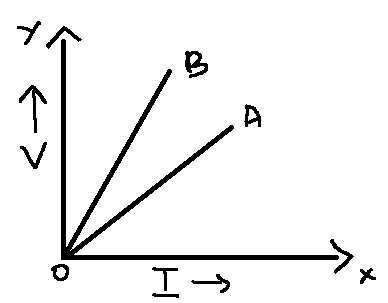
So we can define resistance $\text{(R)}$ as the ratio of voltage across the conductor to the value of current flowing through it. In a V I graph the slope of the curve gives us the resistance of the material. Also, in parallel and series configuration, the minimum resistance is present for the parallel combination of resistors.
Answer
 Verified
645k+ views
Hint: According to Ohm's law, the current flowing through a conductor is directly proportional to the potential difference across it. We write it mathematically as,
$\text{V}=\text{RI}$ …. Equation (1)
Complete Step-by-Step solution:
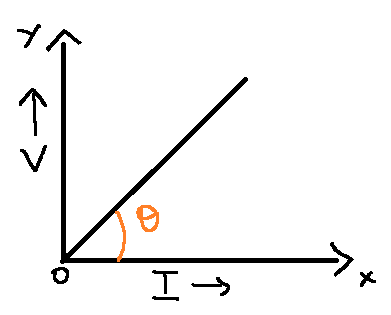
So if we try to plot the VI characteristics of a material, with the current along the x-axis and the voltage along the y-axis. We will get a graph similar to the straight-line equation $y=mx$, where m is the slope of the graph.
Comparing the straight-line equation with the equation (1) above, we can conclude that the slope of the V-I graph gives the resistance of a material. $(m=R)$.
We know that the slope of a straight line graph is given by,
$m=\tan \theta $….. equation (2), where $\text{ }\!\!\theta\!\!\text{ }$ is the angle made by the straight line with the positive current axis.
From equation (1) and (2), we can write,
$R=\tan \theta $
So, if the angle subtended is more, the resistance of that particular material is more.
In the case of a series or a parallel combination of resistors, the parallel combination will have the least resistance. For example, take two resistors of resistance ‘$\text{R}$’ each and connect it in series as well as in parallel, the series resistance of the two resistors will be $2R$ and the parallel resistance of the two resistors will be $\dfrac{R}{2}$.
Since the parallel combination of resistors has the least resistance, the angle $\text{ }\!\!\theta\!\!\text{ }$ subtended in the V-I graph by this combination will be less than the angle subtended by the resistors in series combination.
From the graph, the straight line A subtends a lower angle as compared with the straight line B. So the parallel combination which has a lower resistance hence a lower angle subtended will be the straight line A.
So the answer to the question is the straight-line A which represents the parallel combination of resistors.
Note: If the V-I characteristics of a material is a straight line through the origin, we can say that the material shows a linear property. Linear in the sense that the resistance of the material is constant for different sets of voltage and current. Example- Carbon Resistor
The V-I characteristics of a material is said to be non-linear if the resistance is not constant and varies as a function of current or voltage. Example- Diode, Transistor.
If $\text{n}$ number of resistors having the same resistance $\text{ }\!\!'\!\!\text{ R }\!\!'\!\!\text{ }$ is connected in series. Then the total resistance given by the combination is , ${{R}_{tot}}=nR$.
If $\text{n}$ number of resistors having the same resistance $\text{ }\!\!'\!\!\text{ R }\!\!'\!\!\text{ }$ is connected in parallel. Then the total resistance is given by the combination is , ${{R}_{tot}}=\dfrac{R}{n}$.
$\text{V}=\text{RI}$ …. Equation (1)
Complete Step-by-Step solution:
So if we try to plot the VI characteristics of a material, with the current along the x-axis and the voltage along the y-axis. We will get a graph similar to the straight-line equation $y=mx$, where m is the slope of the graph.
Comparing the straight-line equation with the equation (1) above, we can conclude that the slope of the V-I graph gives the resistance of a material. $(m=R)$.
We know that the slope of a straight line graph is given by,
$m=\tan \theta $….. equation (2), where $\text{ }\!\!\theta\!\!\text{ }$ is the angle made by the straight line with the positive current axis.
From equation (1) and (2), we can write,
$R=\tan \theta $
So, if the angle subtended is more, the resistance of that particular material is more.
In the case of a series or a parallel combination of resistors, the parallel combination will have the least resistance. For example, take two resistors of resistance ‘$\text{R}$’ each and connect it in series as well as in parallel, the series resistance of the two resistors will be $2R$ and the parallel resistance of the two resistors will be $\dfrac{R}{2}$.
Since the parallel combination of resistors has the least resistance, the angle $\text{ }\!\!\theta\!\!\text{ }$ subtended in the V-I graph by this combination will be less than the angle subtended by the resistors in series combination.
From the graph, the straight line A subtends a lower angle as compared with the straight line B. So the parallel combination which has a lower resistance hence a lower angle subtended will be the straight line A.
So the answer to the question is the straight-line A which represents the parallel combination of resistors.
Note: If the V-I characteristics of a material is a straight line through the origin, we can say that the material shows a linear property. Linear in the sense that the resistance of the material is constant for different sets of voltage and current. Example- Carbon Resistor
The V-I characteristics of a material is said to be non-linear if the resistance is not constant and varies as a function of current or voltage. Example- Diode, Transistor.
If $\text{n}$ number of resistors having the same resistance $\text{ }\!\!'\!\!\text{ R }\!\!'\!\!\text{ }$ is connected in series. Then the total resistance given by the combination is , ${{R}_{tot}}=nR$.
If $\text{n}$ number of resistors having the same resistance $\text{ }\!\!'\!\!\text{ R }\!\!'\!\!\text{ }$ is connected in parallel. Then the total resistance is given by the combination is , ${{R}_{tot}}=\dfrac{R}{n}$.
Recently Updated Pages
Master Class 11 English: Engaging Questions & Answers for Success

Master Class 11 Social Science: Engaging Questions & Answers for Success
Master Class 11 Maths: Engaging Questions & Answers for Success
Master Class 11 Biology: Engaging Questions & Answers for Success
Master Class 11 Physics: Engaging Questions & Answers for Success
Master Class 11 Chemistry: Engaging Questions & Answers for Success