




The urinary bladder is muscular and is under control.
A. Muscular
B. Mechanical
C. Nervous
D. Hormonal
Answer
 Verified
600k+ views
Hint: The discharge of urine stored in the bladder by the urethra can be controlled by specialized sphincters. The urinary bladder is an organ of the urinary system which has two primary functions: It stores the urine temporarily and also assists in the expulsion of urine when necessary.
Complete answer:The structure of the bladder varies largely depending on the amount of urine getting stored. When the bladder is full, it exhibits a characteristic oval shape, and when it becomes empty it appears to be flattened by the overlying bowel. Urine enters the bladder through the help of two tubes i.e. the left and the right ureters and exits the bladder through a structure called the urethra. In order to aid the discharge of the urine (a process called micturition), the bladder wall is made up of highly specialized smooth muscles, called ‘detrusor muscle’. The fibres of these muscles remain orientated in multiple directions, in order to retain the structure built even when the bladder is stretched. It receives signals from both the sympathetic and parasympathetic nervous systems. Additionally, there are also two separate muscular sphincters located in the urethra namely:
-Internal urethral sphincter: In males, it is made of smooth circular fibres, which remain under autonomic control. This prevents seminal regurgitation during male ejaculation. In females it is formed by the anatomy of the bladder neck and proximal urethra.
-External urethral sphincter: It has the same structure in both males and females. It is essentially made up of skeletal muscles and therefore is under voluntary control.
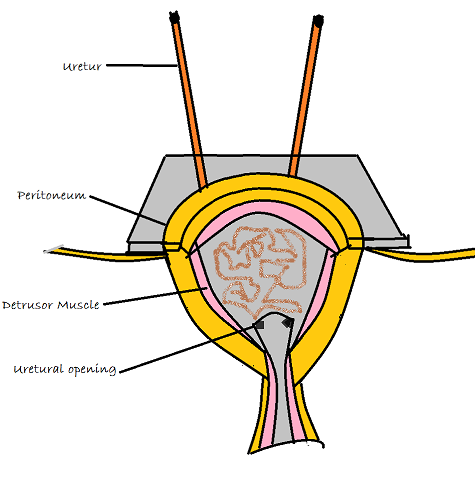
So, the correct answer is C, i.e., Nervous.
Note: Normally, the range of the amount of urine that the urinary bladder can store is approximately 400 to 600 mL. The entire musculature of the bladder plays a crucial role in proper functioning.
Complete answer:The structure of the bladder varies largely depending on the amount of urine getting stored. When the bladder is full, it exhibits a characteristic oval shape, and when it becomes empty it appears to be flattened by the overlying bowel. Urine enters the bladder through the help of two tubes i.e. the left and the right ureters and exits the bladder through a structure called the urethra. In order to aid the discharge of the urine (a process called micturition), the bladder wall is made up of highly specialized smooth muscles, called ‘detrusor muscle’. The fibres of these muscles remain orientated in multiple directions, in order to retain the structure built even when the bladder is stretched. It receives signals from both the sympathetic and parasympathetic nervous systems. Additionally, there are also two separate muscular sphincters located in the urethra namely:
-Internal urethral sphincter: In males, it is made of smooth circular fibres, which remain under autonomic control. This prevents seminal regurgitation during male ejaculation. In females it is formed by the anatomy of the bladder neck and proximal urethra.
-External urethral sphincter: It has the same structure in both males and females. It is essentially made up of skeletal muscles and therefore is under voluntary control.
So, the correct answer is C, i.e., Nervous.
Note: Normally, the range of the amount of urine that the urinary bladder can store is approximately 400 to 600 mL. The entire musculature of the bladder plays a crucial role in proper functioning.
Recently Updated Pages
Three beakers labelled as A B and C each containing 25 mL of water were taken A small amount of NaOH anhydrous CuSO4 and NaCl were added to the beakers A B and C respectively It was observed that there was an increase in the temperature of the solutions contained in beakers A and B whereas in case of beaker C the temperature of the solution falls Which one of the following statements isarecorrect i In beakers A and B exothermic process has occurred ii In beakers A and B endothermic process has occurred iii In beaker C exothermic process has occurred iv In beaker C endothermic process has occurred

Master Class 11 Social Science: Engaging Questions & Answers for Success
Master Class 11 Physics: Engaging Questions & Answers for Success
Master Class 11 Maths: Engaging Questions & Answers for Success
Master Class 11 Economics: Engaging Questions & Answers for Success
Master Class 11 Computer Science: Engaging Questions & Answers for Success
Three beakers labelled as A B and C each containing 25 mL of water were taken A small amount of NaOH anhydrous CuSO4 and NaCl were added to the beakers A B and C respectively It was observed that there was an increase in the temperature of the solutions contained in beakers A and B whereas in case of beaker C the temperature of the solution falls Which one of the following statements isarecorrect i In beakers A and B exothermic process has occurred ii In beakers A and B endothermic process has occurred iii In beaker C exothermic process has occurred iv In beaker C endothermic process has occurred
Master Class 11 Social Science: Engaging Questions & Answers for Success
Master Class 11 Physics: Engaging Questions & Answers for Success
Trending doubts
One Metric ton is equal to kg A 10000 B 1000 C 100 class 11 physics CBSE
There are 720 permutations of the digits 1 2 3 4 5 class 11 maths CBSE
State and prove Bernoullis theorem class 11 physics CBSE
Draw a diagram of a plant cell and label at least eight class 11 biology CBSE
Difference Between Prokaryotic Cells and Eukaryotic Cells
1 Quintal is equal to a 110 kg b 10 kg c 100kg d 1000 class 11 physics CBSE