




The upper part of the tree broken over by the wind makes an angle of ${{30}^{\circ }}$ with the ground, and the distance from the root to the point where the top of the tree meets the ground is 15m. The present height of the tree is
(a) $15m$
(b) $10\sqrt{3}m$
(c) $20m$
(d) None of these
Answer
 Verified
533.4k+ views
Hint: In a right-angled triangle $\Delta ABC$,
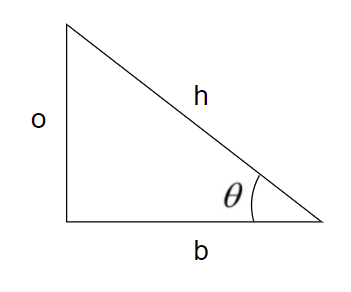
$\sin \theta =\dfrac{opposite}{hypotenuse}=\dfrac{o}{h}$
$\begin{align}
& \cos \theta =\dfrac{base}{hypotenuse}=\dfrac{b}{h} \\
& \tan \theta =\dfrac{\sin \theta }{\cos \theta }=\dfrac{o}{b} \\
\end{align}$
Some important trigonometric angles are:
$\begin{align}
& \sin {{30}^{\circ }}=\dfrac{1}{2} \\
& \tan {{30}^{\circ }}=\dfrac{1}{\sqrt{3}} \\
& \sin {{45}^{\circ }}=\dfrac{1}{\sqrt{2}} \\
& \tan {{45}^{\circ }}=1 \\
& \sin {{60}^{\circ }}=\dfrac{\sqrt{3}}{2} \\
& \tan {{60}^{\circ }}=\sqrt{3} \\
& \\
\end{align}$
Complete step by step solution:
Here, the question says that the top of the tree broke and fell on the ground making an angle of ${{30}^{\circ }}$ with the ground. Also, the distance of the top of the tree touching the ground to the root of the tree is $15m$. So, the required figure would be
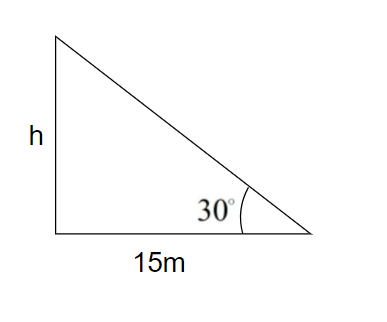
Now, to calculate the present height(h) of the tree, we will use trigonometric ratios and their values at an angle of ${{30}^{\circ }}$.
Considering this figure,
$\begin{align}
& \tan {{30}^{\circ }}=\dfrac{h}{15} \\
& \Rightarrow h=15\tan {{30}^{\circ }} \\
\end{align}$
As we know that the value of $\tan {{30}^{\circ }}=\dfrac{1}{\sqrt{3}}$, we get
$\begin{align}
& h=15\times \dfrac{1}{\sqrt{3}} \\
& \Rightarrow h=\dfrac{15}{\sqrt{3}} \\
& \Rightarrow h=\dfrac{5\times \sqrt{3}\times \sqrt{3}}{\sqrt{3}} \\
& \therefore h=5\sqrt{3}m \\
& \\
\end{align}$
So, the correct answer is “Option d”.
Note: In these types of questions, the tricky part is to draw the correct diagram displaying all the values of angles and lengths as mentioned in the question. Always assume that any object standing vertically upright on the ground will always make a right angle with the ground. This allows us to apply the trigonometric ratios applicable on a right-angled triangle. If the diagram drawn is correct and there is no mistake in taking the correct values of trigonometric angles and their corresponding ratios, then you cannot go wrong in obtaining the correct answer.
$\sin \theta =\dfrac{opposite}{hypotenuse}=\dfrac{o}{h}$
$\begin{align}
& \cos \theta =\dfrac{base}{hypotenuse}=\dfrac{b}{h} \\
& \tan \theta =\dfrac{\sin \theta }{\cos \theta }=\dfrac{o}{b} \\
\end{align}$
Some important trigonometric angles are:
$\begin{align}
& \sin {{30}^{\circ }}=\dfrac{1}{2} \\
& \tan {{30}^{\circ }}=\dfrac{1}{\sqrt{3}} \\
& \sin {{45}^{\circ }}=\dfrac{1}{\sqrt{2}} \\
& \tan {{45}^{\circ }}=1 \\
& \sin {{60}^{\circ }}=\dfrac{\sqrt{3}}{2} \\
& \tan {{60}^{\circ }}=\sqrt{3} \\
& \\
\end{align}$
Complete step by step solution:
Here, the question says that the top of the tree broke and fell on the ground making an angle of ${{30}^{\circ }}$ with the ground. Also, the distance of the top of the tree touching the ground to the root of the tree is $15m$. So, the required figure would be
Now, to calculate the present height(h) of the tree, we will use trigonometric ratios and their values at an angle of ${{30}^{\circ }}$.
Considering this figure,
$\begin{align}
& \tan {{30}^{\circ }}=\dfrac{h}{15} \\
& \Rightarrow h=15\tan {{30}^{\circ }} \\
\end{align}$
As we know that the value of $\tan {{30}^{\circ }}=\dfrac{1}{\sqrt{3}}$, we get
$\begin{align}
& h=15\times \dfrac{1}{\sqrt{3}} \\
& \Rightarrow h=\dfrac{15}{\sqrt{3}} \\
& \Rightarrow h=\dfrac{5\times \sqrt{3}\times \sqrt{3}}{\sqrt{3}} \\
& \therefore h=5\sqrt{3}m \\
& \\
\end{align}$
So, the correct answer is “Option d”.
Note: In these types of questions, the tricky part is to draw the correct diagram displaying all the values of angles and lengths as mentioned in the question. Always assume that any object standing vertically upright on the ground will always make a right angle with the ground. This allows us to apply the trigonometric ratios applicable on a right-angled triangle. If the diagram drawn is correct and there is no mistake in taking the correct values of trigonometric angles and their corresponding ratios, then you cannot go wrong in obtaining the correct answer.
Recently Updated Pages
Master Class 10 Computer Science: Engaging Questions & Answers for Success

Master Class 10 General Knowledge: Engaging Questions & Answers for Success
Master Class 10 English: Engaging Questions & Answers for Success
Master Class 10 Social Science: Engaging Questions & Answers for Success
Master Class 10 Maths: Engaging Questions & Answers for Success
Master Class 10 Science: Engaging Questions & Answers for Success
Trending doubts
What is the median of the first 10 natural numbers class 10 maths CBSE
Which women's tennis player has 24 Grand Slam singles titles?
Who is the Brand Ambassador of Incredible India?
Why is there a time difference of about 5 hours between class 10 social science CBSE
Write a letter to the principal requesting him to grant class 10 english CBSE
A moving boat is observed from the top of a 150 m high class 10 maths CBSE