




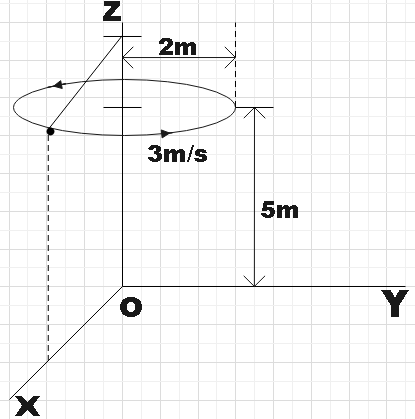
The upper end of the string of a simple pendulum is fixed to a vertical z-axis and set in motion such that the bob moves along a horizontal circular path of radius 2m, parallel to the xy plane, 5m above the origin. The bob has a speed of 3m/s. The string breaks when the bob is vertically above the x-axis, then it lands on the xy plane at a point (x,y).
A. x=2m
B. $x\rangle 2m$
C. y=3m
D. y=5m
Answer
 Verified
611.4k+ views
Hint: As a very step, you could read the question very carefully and thus find the coordinate of the bob at the moment that the string broke. From there you will get the x coordinate. Now consider the projectile motion that the bob undergoes after that and use the equation of motion to find the horizontal range (y) accordingly.
Formula used:
Equation of motion,
$s=ut+\dfrac{1}{2}a{{t}^{2}}$
Complete answer:
In the question, we are given a simple pendulum that is fixed to a vertical z-axis undergoing circular motion as shown in the figure. The speed of the bob is given as 3m/s. As per the given conditions we could say that the coordinates of the given simple pendulum when the string breaks would be (2,0,5) and the initial vertical velocity would be zero. So for vertical motion,
$s=ut+\dfrac{1}{2}a{{t}^{2}}$
$\Rightarrow 5=0-\dfrac{1}{2}g{{t}^{2}}$
$\Rightarrow {{t}^{2}}=1$
$\Rightarrow t=\pm 1$
So, the time taken for the ball to fall to the xy plane would be 1 second.
Now the horizontal distance travelled by the bob which is otherwise called the range of the projectile motion would be,
$s=ut$
Here, u is the horizontal initial velocity 3m/s.
$\therefore s=3\times 1=3m$
So the projectile motion could be depicted as,
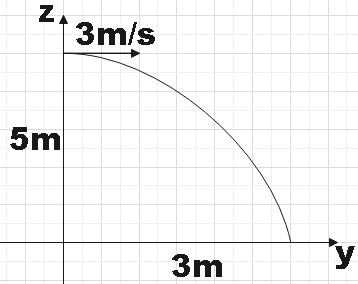
We found the (x,y) to be (2,3).
Hence A and C are correct options.
Note:
In questions like these where you are dealing with coordinates chances there that you get confused between axes. So, one should get help by making a neat diagram that depicts the exact situation and thereby avoid such unnecessary confusions. Also, make sure to assign the signs for parameters correctly.
Formula used:
Equation of motion,
$s=ut+\dfrac{1}{2}a{{t}^{2}}$
Complete answer:
In the question, we are given a simple pendulum that is fixed to a vertical z-axis undergoing circular motion as shown in the figure. The speed of the bob is given as 3m/s. As per the given conditions we could say that the coordinates of the given simple pendulum when the string breaks would be (2,0,5) and the initial vertical velocity would be zero. So for vertical motion,
$s=ut+\dfrac{1}{2}a{{t}^{2}}$
$\Rightarrow 5=0-\dfrac{1}{2}g{{t}^{2}}$
$\Rightarrow {{t}^{2}}=1$
$\Rightarrow t=\pm 1$
So, the time taken for the ball to fall to the xy plane would be 1 second.
Now the horizontal distance travelled by the bob which is otherwise called the range of the projectile motion would be,
$s=ut$
Here, u is the horizontal initial velocity 3m/s.
$\therefore s=3\times 1=3m$
So the projectile motion could be depicted as,
We found the (x,y) to be (2,3).
Hence A and C are correct options.
Note:
In questions like these where you are dealing with coordinates chances there that you get confused between axes. So, one should get help by making a neat diagram that depicts the exact situation and thereby avoid such unnecessary confusions. Also, make sure to assign the signs for parameters correctly.
Recently Updated Pages
Which will be the least stable resonating structure class 11 chemistry CBSE

How many 5 digit telephone numbers can be construc-class-11-maths-CBSE
How do you find the angle of the resultant vector class 11 physics CBSE
Draw labelled diagram of the following i Gram seed class 11 biology CBSE
1 Quintal is equal to a 110 kg b 10 kg c 100kg d 1000 class 11 physics CBSE
What is the need and importance of classification class 11 biology CBSE
Trending doubts
One Metric ton is equal to kg A 10000 B 1000 C 100 class 11 physics CBSE
Find the value of the expression given below sin 30circ class 11 maths CBSE
10 examples of friction in our daily life
Draw a diagram of a plant cell and label at least eight class 11 biology CBSE
Difference between physical and chemical change class 11 chemistry CBSE
Proton was discovered by A Thomson B Rutherford C Chadwick class 11 chemistry CBSE