




The unit of mobility is:
$A.\quad Cskg$
$B.\quad {{m}^{2}}{{V}^{-1}}{{s}^{-1}}$
$C.\quad Csk{{g}^{-1}}$
$D.\quad {{m}^{2}}{{V}^{-1}}s$
Answer
 Verified
674.4k+ views
Hint:
Knowledge of the charge transport phenomenon in conductors is vital to solve this problem. Making a circuit diagram of the charge transport phenomenon will assist in solving this problem easily. Drift velocity $'{{v}_{d}}'$ is given by, ${{v}_{d}}={{\mu }_{e}}E$, where ‘${{\mu }_{e}}$’ is the electron mobility of the conductor and ‘E’ is the magnitude of the externally applied electric field. Finding units of drift velocity and the Electric field will let us find the electron mobility.
Step by step solution:
Let’s make a diagram of current flowing through a conductor to get an idea for the charge transport phenomenon in a conductor.
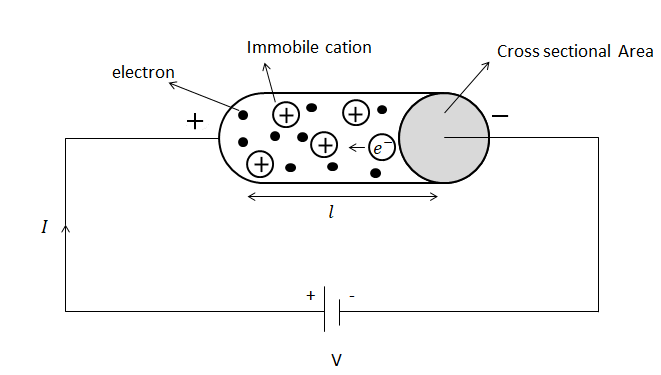
It is important to know as to why; we call the movement of electrons in the conductor from the negative end towards the positive end in the presence of an externally applied electric field as drift velocity and not just velocity of the electrons. It is known as drift velocity, because in the presence of no externally applied electric field, the electrons would still be randomly moving at high velocities, however upon the application of the electric field, the electrons start to get aligned as per the electric field, and the these electrons start to gain speed due to the applied field itself. These electrons hit with other electrons to transfer the momentum being generated, hence, giving an overall picture of the electron drifting through the conductor, leading to the name drift velocity. This whole phenomenon is known as charge transport phenomenon.
When a potential difference ‘V’ is applied as shown in the diagram, an electric field ‘E’ will be produced across the conductor from the positive terminal towards the negative terminal. The free electrons of the conductor travel in the opposite direction of the applied electric field. Hence, the electrons travel from the negative end of the conductor (as marked in the diagram) towards the positive end of the conductor (as marked in the diagram). The velocity with which these electrons travel is known as drift velocity of the electrons or just drift velocity of the conductor.
The actual definition of drift velocity $'{{v}_{d}}'$ is as follows: The average velocity with which the electrons drift towards the positive end of the conductor under the influence of an applied external electric field.
$\therefore {{v}_{d}}=\dfrac{l}{t}$, that is the length of the conductor taken to cover that distance. Therefore the unit of drift velocity is $m{{s}^{-1}}$.
The velocity gained by these electrons is dependent only upon the externally applied Electric field (E). That is: ${{v}_{d}}\propto E\Rightarrow {{v}_{d}}={{\mu }_{e}}E$ and (${{\mu }_{e}}$) is the constant of proportionality known as the electron mobility.
Since, the Electric field (E) is given by: $E=-\dfrac{dV}{dR}$. Therefore, the unit of electric field (E) is $V{{m}^{-1}}$.
Hence, the unit of electron mobility will be: ${{v}_{d}}\propto E\Rightarrow {{v}_{d}}={{\mu }_{e}}E\Rightarrow m{{s}^{-1}}={{\mu }_{e}}(V{{m}^{-1}})\Rightarrow {{\mu }_{e}}={{m}^{2}}{{V}^{-1}}{{s}^{-1}}$.
Therefore, the Option (B) is the solution.
Note:
In the following solution, we consider the mobility to be called electron mobility denoted as ${{\mu }_{e}}$, because the major charge carriers of the conductor in this case are the electrons. If the charge carriers of the conductor are holes, then the mobility will be given by ${{\mu }_{h}}$, known as hole mobility.
Further, these two values of mobility will always be positive, for both the electron and holes as major charge carriers of the conductor.
Knowledge of the charge transport phenomenon in conductors is vital to solve this problem. Making a circuit diagram of the charge transport phenomenon will assist in solving this problem easily. Drift velocity $'{{v}_{d}}'$ is given by, ${{v}_{d}}={{\mu }_{e}}E$, where ‘${{\mu }_{e}}$’ is the electron mobility of the conductor and ‘E’ is the magnitude of the externally applied electric field. Finding units of drift velocity and the Electric field will let us find the electron mobility.
Step by step solution:
Let’s make a diagram of current flowing through a conductor to get an idea for the charge transport phenomenon in a conductor.
It is important to know as to why; we call the movement of electrons in the conductor from the negative end towards the positive end in the presence of an externally applied electric field as drift velocity and not just velocity of the electrons. It is known as drift velocity, because in the presence of no externally applied electric field, the electrons would still be randomly moving at high velocities, however upon the application of the electric field, the electrons start to get aligned as per the electric field, and the these electrons start to gain speed due to the applied field itself. These electrons hit with other electrons to transfer the momentum being generated, hence, giving an overall picture of the electron drifting through the conductor, leading to the name drift velocity. This whole phenomenon is known as charge transport phenomenon.
When a potential difference ‘V’ is applied as shown in the diagram, an electric field ‘E’ will be produced across the conductor from the positive terminal towards the negative terminal. The free electrons of the conductor travel in the opposite direction of the applied electric field. Hence, the electrons travel from the negative end of the conductor (as marked in the diagram) towards the positive end of the conductor (as marked in the diagram). The velocity with which these electrons travel is known as drift velocity of the electrons or just drift velocity of the conductor.
The actual definition of drift velocity $'{{v}_{d}}'$ is as follows: The average velocity with which the electrons drift towards the positive end of the conductor under the influence of an applied external electric field.
$\therefore {{v}_{d}}=\dfrac{l}{t}$, that is the length of the conductor taken to cover that distance. Therefore the unit of drift velocity is $m{{s}^{-1}}$.
The velocity gained by these electrons is dependent only upon the externally applied Electric field (E). That is: ${{v}_{d}}\propto E\Rightarrow {{v}_{d}}={{\mu }_{e}}E$ and (${{\mu }_{e}}$) is the constant of proportionality known as the electron mobility.
Since, the Electric field (E) is given by: $E=-\dfrac{dV}{dR}$. Therefore, the unit of electric field (E) is $V{{m}^{-1}}$.
Hence, the unit of electron mobility will be: ${{v}_{d}}\propto E\Rightarrow {{v}_{d}}={{\mu }_{e}}E\Rightarrow m{{s}^{-1}}={{\mu }_{e}}(V{{m}^{-1}})\Rightarrow {{\mu }_{e}}={{m}^{2}}{{V}^{-1}}{{s}^{-1}}$.
Therefore, the Option (B) is the solution.
Note:
In the following solution, we consider the mobility to be called electron mobility denoted as ${{\mu }_{e}}$, because the major charge carriers of the conductor in this case are the electrons. If the charge carriers of the conductor are holes, then the mobility will be given by ${{\mu }_{h}}$, known as hole mobility.
Further, these two values of mobility will always be positive, for both the electron and holes as major charge carriers of the conductor.
Recently Updated Pages
Explain the structure of megasporangium class 12 biology CBSE

Why is chloroform kept in dark coloured bottles class 12 chemistry CBSE
Derive the balancing condition of a Wheatstone bri class 12 physics CBSE
Draw VI characteristics of a pn junction diode Explain class 12 physics CBSE
Is it possible to carry pride in ones language too class 12 english CBSE
In a population at Hardy Weinberg equilibrium the allele class 12 biology CBSE
Trending doubts
Draw a labelled sketch of the human eye class 12 physics CBSE
Which are the Top 10 Largest Countries of the World?
Draw ray diagrams each showing i myopic eye and ii class 12 physics CBSE
One megawatt is equal to how many units of electri class 12 physics CBSE
Which is the correct genotypic ratio of mendel dihybrid class 12 biology CBSE
Give 10 examples of unisexual and bisexual flowers