




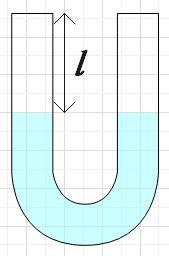
The U tube having identical limbs contains mercury (density ${{\rho }_{m}}$ ) to a level as shown in the figure. If the left limb is filled to the top with water $\left( {{\rho }_{w}} \right)$, then the rise of mercury level in the right limb will be
A. $\dfrac{l}{2{{\rho }_{m}}}$
B. $\dfrac{l{{\rho }_{w}}}{2{{\rho }_{m}}+{{\rho }_{w}}}$
C.$\dfrac{{{\rho }_{m}}l}{{{\rho }_{w}}}$
D.$\dfrac{l{{\rho }_{w}}}{2{{\rho }_{m}}-{{\rho }_{w}}}$
Answer
 Verified
642k+ views
Hint: We know that the rise in mercury in the right limb and the fall in mercury in the left limb due to the filling of water in that limb will be the same. Now you may recall Pascal’s law and thus find that the pressure at the same height is the same. Now keeping that in mind find the expression for gauge pressure for arbitrary points in both limbs and thus find the required rise.
Formula used:
Gauge pressure,
$P-{{P}_{0}}=\rho gh$
Complete step-by-step solution
We are given a U tube that has identical limbs and the U tube has mercury of density ${{\rho }_{m}}$ up to a level. Now we are filling the left limb with water of density ${{\rho }_{w}}$ and we are asked to find the rise in mercury on the right limb.
We know that when we fill water in the left limb up to the brim, there will be a fall in mercury in that limb. Let them fall in mercury in the left limb be given by x, then the rise in mercury in the right limb will be also x as U tube has identical limbs.

Let us consider two points A and B, in the left limb up to the level of point A, water is filled.
We know from Pascal’s law that the pressure at the same height in a liquid is the same. Let the pressure at point A be ${{P}_{A}}$ and that at point B be ${{P}_{B}}$. Now we have the gauge pressure which is given by,
$P-{{P}_{0}}=\rho gh$
Where ‘${{P}_{0}}$’ is the atmospheric pressure.
For point A,
${{P}_{A}}-{{P}_{0}}={{\rho }_{w}}g\left( l+x \right)$ …………………………. (1)
For point B,
${{P}_{B}}-{{P}_{0}}={{\rho }_{m}}g\left( 2x \right)$ …………………………………. (2)
But, ${{P}_{A}}={{P}_{B}}$
Equating RHS of (1) and (2),
${{\rho }_{w}}g\left( l+x \right)={{\rho }_{m}}g\left( 2x \right)$
$\Rightarrow {{\rho }_{w}}l+{{\rho }_{w}}x=2x{{\rho }_{m}}$
$\Rightarrow x\left( 2{{\rho }_{m}}-{{\rho }_{w}} \right)={{\rho }_{w}}l$
$\therefore x=\dfrac{{{\rho }_{w}}l}{2{{\rho }_{m}}-{{\rho }_{w}}}$
Therefore, we find the rise of mercury level in the right limb as,
$x=\dfrac{l{{\rho }_{w}}}{2{{\rho }_{m}}-{{\rho }_{w}}}$
Hence, option D is the correct answer.
Note: The pressure P below the surface of a liquid that is open to the atmosphere is known to be greater than the atmospheric pressure by an amount $\rho gh$. This excess pressure is called gauge pressure. Also, note that the pressure at point A on the interface of water and mercury is due to the water column of height $\left( l+x \right)$ above it and that at the other limb is due to $\left( 2x \right)$ height of mercury above it.
Formula used:
Gauge pressure,
$P-{{P}_{0}}=\rho gh$
Complete step-by-step solution
We are given a U tube that has identical limbs and the U tube has mercury of density ${{\rho }_{m}}$ up to a level. Now we are filling the left limb with water of density ${{\rho }_{w}}$ and we are asked to find the rise in mercury on the right limb.
We know that when we fill water in the left limb up to the brim, there will be a fall in mercury in that limb. Let them fall in mercury in the left limb be given by x, then the rise in mercury in the right limb will be also x as U tube has identical limbs.
Let us consider two points A and B, in the left limb up to the level of point A, water is filled.
We know from Pascal’s law that the pressure at the same height in a liquid is the same. Let the pressure at point A be ${{P}_{A}}$ and that at point B be ${{P}_{B}}$. Now we have the gauge pressure which is given by,
$P-{{P}_{0}}=\rho gh$
Where ‘${{P}_{0}}$’ is the atmospheric pressure.
For point A,
${{P}_{A}}-{{P}_{0}}={{\rho }_{w}}g\left( l+x \right)$ …………………………. (1)
For point B,
${{P}_{B}}-{{P}_{0}}={{\rho }_{m}}g\left( 2x \right)$ …………………………………. (2)
But, ${{P}_{A}}={{P}_{B}}$
Equating RHS of (1) and (2),
${{\rho }_{w}}g\left( l+x \right)={{\rho }_{m}}g\left( 2x \right)$
$\Rightarrow {{\rho }_{w}}l+{{\rho }_{w}}x=2x{{\rho }_{m}}$
$\Rightarrow x\left( 2{{\rho }_{m}}-{{\rho }_{w}} \right)={{\rho }_{w}}l$
$\therefore x=\dfrac{{{\rho }_{w}}l}{2{{\rho }_{m}}-{{\rho }_{w}}}$
Therefore, we find the rise of mercury level in the right limb as,
$x=\dfrac{l{{\rho }_{w}}}{2{{\rho }_{m}}-{{\rho }_{w}}}$
Hence, option D is the correct answer.
Note: The pressure P below the surface of a liquid that is open to the atmosphere is known to be greater than the atmospheric pressure by an amount $\rho gh$. This excess pressure is called gauge pressure. Also, note that the pressure at point A on the interface of water and mercury is due to the water column of height $\left( l+x \right)$ above it and that at the other limb is due to $\left( 2x \right)$ height of mercury above it.
Recently Updated Pages
If x a + bt + ct2 where x is in meters and t is in class 11 physics CBSE

A car covers the first half distance between two places class 11 physics CBSE
The resultant of two vectors overrightarrow P and overrightarrow class 11 physics CBSE
Find the value of cos 135 class 11 maths CBSE
A mass M is held in place by an applied force F and class 11 physics CBSE
A solution of glucose in water is labelled as 10 dfracwv class 11 chemistry CBSE
Trending doubts
One Metric ton is equal to kg A 10000 B 1000 C 100 class 11 physics CBSE
Find the value of the expression given below sin 30circ class 11 maths CBSE
What do you mean by retardation What is its SI uni class 11 physics CBSE
Draw a diagram of nephron and explain its structur class 11 biology CBSE
10 examples of friction in our daily life
Difference between physical and chemical change class 11 chemistry CBSE