




The two legs of a right triangle are equal and the square of its hypotenuse is 50. Find the length of each leg.
Answer
 Verified
620.1k+ views
Hint: Let x be the length of two legs which are equal in length.
It is given that the square of the hypotenuse is 50. $\therefore {H^2} = 50$ .
Thus, find the length of two legs using Pythagoras’ theorem.
Complete step-by-step answer:
It is given that the legs of a right triangle are equal and the square of its hypotenuse is 50.
Let the length of the same legs of the right triangle be x.
So, by using the Pythagoras’ theorem, we can find the length of the same two legs.
The Pythagoras’ theorem is stated as, the square of hypotenuse is the sum of squares of the remaining two sides of the triangle.
$\therefore {H^2} = {a^2} + {b^2}$
It is given that the square of the hypotenuse is 50. $\therefore {H^2} = 50$ and \[a = b = x\] .
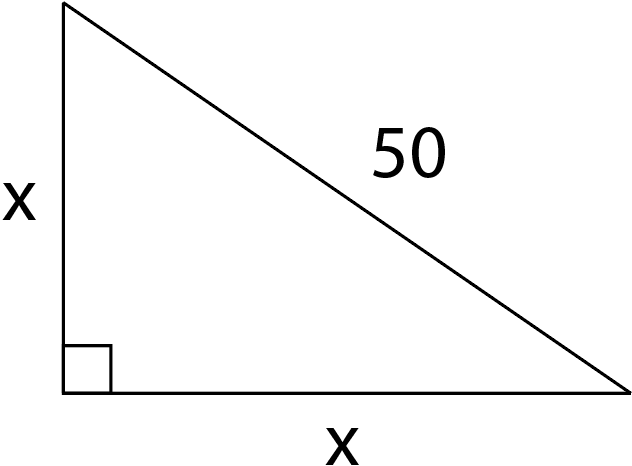
$
\therefore 50 = {x^2} + {x^2} \\
\therefore 2{x^2} = 50 \\
\therefore {x^2} = 25 \\
\therefore x = \pm 5 \\
$
Here, x = -5 is not possible because x is the length of a side and length of a side cannot be negative.
Thus, \[x = 5\] .
Therefore, the length of each leg is 5 units.
Note: Pythagoras’ Theorem:
In a right angle triangle, the square of the hypotenuse is the sum of the squares of the remaining two sides.
Here, hypotenuse is the longest side of the triangle.
For example,
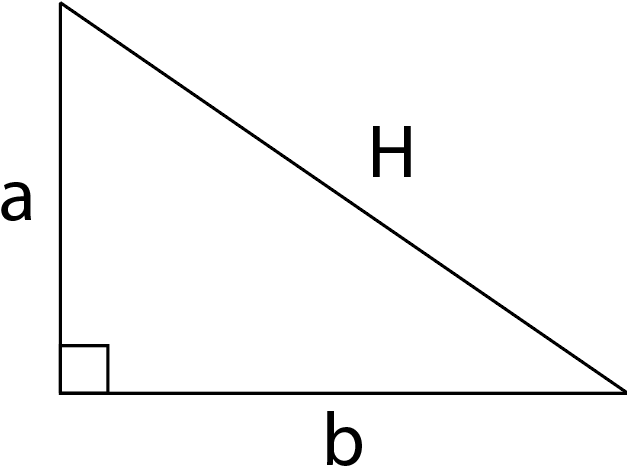
The Pythagoras’ theorem for the above diagram will be ${H^2} = {a^2} + {b^2}$ .
It is given that the square of the hypotenuse is 50. $\therefore {H^2} = 50$ .
Thus, find the length of two legs using Pythagoras’ theorem.
Complete step-by-step answer:
It is given that the legs of a right triangle are equal and the square of its hypotenuse is 50.
Let the length of the same legs of the right triangle be x.
So, by using the Pythagoras’ theorem, we can find the length of the same two legs.
The Pythagoras’ theorem is stated as, the square of hypotenuse is the sum of squares of the remaining two sides of the triangle.
$\therefore {H^2} = {a^2} + {b^2}$
It is given that the square of the hypotenuse is 50. $\therefore {H^2} = 50$ and \[a = b = x\] .
$
\therefore 50 = {x^2} + {x^2} \\
\therefore 2{x^2} = 50 \\
\therefore {x^2} = 25 \\
\therefore x = \pm 5 \\
$
Here, x = -5 is not possible because x is the length of a side and length of a side cannot be negative.
Thus, \[x = 5\] .
Therefore, the length of each leg is 5 units.
Note: Pythagoras’ Theorem:
In a right angle triangle, the square of the hypotenuse is the sum of the squares of the remaining two sides.
Here, hypotenuse is the longest side of the triangle.
For example,
The Pythagoras’ theorem for the above diagram will be ${H^2} = {a^2} + {b^2}$ .

Recently Updated Pages
Master Class 11 English: Engaging Questions & Answers for Success

Master Class 11 Social Science: Engaging Questions & Answers for Success
Master Class 11 Maths: Engaging Questions & Answers for Success
Master Class 11 Chemistry: Engaging Questions & Answers for Success
Master Class 11 Biology: Engaging Questions & Answers for Success
Master Class 11 Physics: Engaging Questions & Answers for Success
Trending doubts
100 million is equal to begingathered A 1 crore B -class-7-maths-CBSE
Full Form of IASDMIPSIFSIRSPOLICE class 7 social science CBSE
Write in numerals Ten lakh ninety thousand nine hundred class 7 maths CBSE
How many crores make 10 million class 7 maths CBSE
List of coprime numbers from 1 to 100 class 7 maths CBSE
What is a subcontinent class 7 social science CBSE