




The two diagonals are not necessarily equal in a
\[\begin{align}
& \text{a) rectangle} \\
& \text{b) square} \\
& \text{c) rhombus} \\
& \text{d) isosceles trapezium} \\
\end{align}\]
Answer
 Verified
608.7k+ views
Hint: Now we will consider each given quadrilateral to check if the diagonals are equal. Now consider a rectangle we can use Pythagoras theorem. To work on isosceles triangles we will use to prove the triangles formed with diagonals are congruent. Hence we can prove the diagonals are equal for some quadrilaterals.
Complete step by step answer:
Now let us first consider a rectangle ABCD.
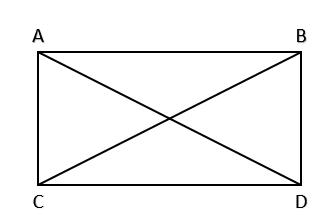
Now since ABCD is a rectangle we know that AB = CD and AC = BD and $\angle A=\angle B=\angle C=\angle D={{90}^{\circ }}$
Now in triangle ACD by Pythagoras theorem we get,
$A{{C}^{2}}+C{{D}^{2}}=A{{D}^{2}}$
But we have AC = BD and CD = AB, Hence substituting the values we get,
$B{{D}^{2}}+A{{B}^{2}}=A{{D}^{2}}$
Now in triangle ABD, using Pythagoras theorem we get $A{{B}^{2}}+B{{D}^{2}}=B{{C}^{2}}$
$B{{C}^{2}}=A{{D}^{2}}$
Now we have BC = AD.
Hence we can say that the diagonals of a rectangle are equal.
Now we know that every square is a rectangle hence we can also say that the diagonals of a square are also equal.
Now let us consider an isosceles trapezium ABCD.
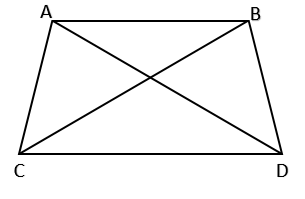
Now we know that base angles of isosceles triangles are equal $\angle ACD=\angle BDC$
And also for the isosceles triangle we have AC = BD.
Now in triangle ACD and triangle BDC we have,
AC = BD
$\angle ACD=\angle BDC$
And DC = DC.
Hence by SAS test of congruence we get, $\Delta ACD\cong \Delta BDC$
Now by congruent parts of congruent triangles we get AD = BC.
Hence again the diagonals of the isosceles triangle are equal.
Now consider a Rhombus ABCD.
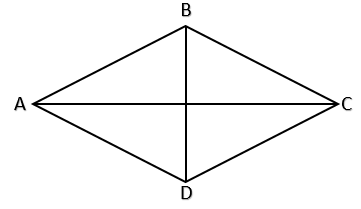
Now in a rhombus we have AB = CD = BD = AC.
But the angles need not be the same hence we can form a rhombus with unequal diagonals.
In the figure we can say that $AC\ne BD$ .
Hence in a rhombus the diagonals need not be the same.
So, the correct answer is “Option C”.
Note: Now the opposite angles of rhombus are equal. The only case when the rhombus will have equal diagonals is when all the angles are equal. Hence in that case a Rhombus will be a square.
Complete step by step answer:
Now let us first consider a rectangle ABCD.
Now since ABCD is a rectangle we know that AB = CD and AC = BD and $\angle A=\angle B=\angle C=\angle D={{90}^{\circ }}$
Now in triangle ACD by Pythagoras theorem we get,
$A{{C}^{2}}+C{{D}^{2}}=A{{D}^{2}}$
But we have AC = BD and CD = AB, Hence substituting the values we get,
$B{{D}^{2}}+A{{B}^{2}}=A{{D}^{2}}$
Now in triangle ABD, using Pythagoras theorem we get $A{{B}^{2}}+B{{D}^{2}}=B{{C}^{2}}$
$B{{C}^{2}}=A{{D}^{2}}$
Now we have BC = AD.
Hence we can say that the diagonals of a rectangle are equal.
Now we know that every square is a rectangle hence we can also say that the diagonals of a square are also equal.
Now let us consider an isosceles trapezium ABCD.
Now we know that base angles of isosceles triangles are equal $\angle ACD=\angle BDC$
And also for the isosceles triangle we have AC = BD.
Now in triangle ACD and triangle BDC we have,
AC = BD
$\angle ACD=\angle BDC$
And DC = DC.
Hence by SAS test of congruence we get, $\Delta ACD\cong \Delta BDC$
Now by congruent parts of congruent triangles we get AD = BC.
Hence again the diagonals of the isosceles triangle are equal.
Now consider a Rhombus ABCD.
Now in a rhombus we have AB = CD = BD = AC.
But the angles need not be the same hence we can form a rhombus with unequal diagonals.
In the figure we can say that $AC\ne BD$ .
Hence in a rhombus the diagonals need not be the same.
So, the correct answer is “Option C”.
Note: Now the opposite angles of rhombus are equal. The only case when the rhombus will have equal diagonals is when all the angles are equal. Hence in that case a Rhombus will be a square.
Recently Updated Pages
Master Class 9 General Knowledge: Engaging Questions & Answers for Success

Master Class 9 Maths: Engaging Questions & Answers for Success
Master Class 9 Science: Engaging Questions & Answers for Success
Master Class 9 English: Engaging Questions & Answers for Success
Master Class 9 Social Science: Engaging Questions & Answers for Success
Class 9 Question and Answer - Your Ultimate Solutions Guide
Trending doubts
Find the sum of series 1 + 2 + 3 + 4 + 5 + + 100 class 9 maths CBSE
Difference Between Plant Cell and Animal Cell
Fill the blanks with the suitable prepositions 1 The class 9 english CBSE
What is pollution? How many types of pollution? Define it
What is the Full Form of ICSE / ISC ?
Name 10 Living and Non living things class 9 biology CBSE