




The tricycle weighing 20kg has a small wheel symmetrically placed 1m behind the two large wheels, which are also 1m apart. If the centre of gravity of the machine is at a horizontal distance 25cm behind the front wheels and the rider whose weight is 40kg, be 10cm behind the front wheels. The thrust on each front wheel is:
A) 255N
B) 90N
C) 200N
D) 400N
Answer
 Verified
600k+ views
Hint: We can find the torque of the whole system including the rider and the tricycle wheels using the given information on the position of center of gravities and the masses. From the torques we can calculate the force or the thrust acting on the wheels A and B.
Complete step by step answer:
We are given a tricycle with two horizontally placed front wheels and a rear wheel, such that the positions of center of gravity of the rider is \[{{F}_{R}}\] and that of the tricycle is \[{{F}_{G}}\] as given in the below figure.
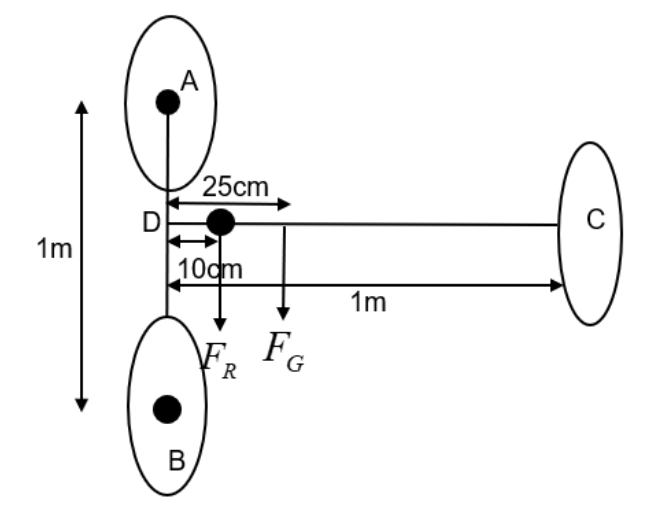
From the figure, it is clear that wheels A and B are placed on the same line 1m apart. From the mid-point of their separation, let us say D, the third wheel C is placed 1m away. Along this line CD is the position of the centre of gravities \[{{F}_{R}}\] and \[{{F}_{G}}\], which are 10cm and 25cm from D.
We can use this information on the forces and the perpendicular distance from D to calculate the torque about point D as –
\[\begin{align}
& \tau =F.\bot r \\
& {{\tau }_{D}}={{F}_{R}}.\bot {{r}_{R}}+{{F}_{G}}.\bot {{r}_{G}} \\
\end{align}\]
Now, we can substitute the values in the above equation to get the total torque about point D.
\[\begin{align}
& {{\tau }_{D}}={{m}_{R}}g.{{r}_{R}}+{{m}_{G}}g.{{r}_{G}} \\
& \Rightarrow \text{ }{{\tau }_{D}}=(40kg\times10m{{s}^{-2}}\times 0.10m)+(20kg\times10m{{s}^{-2}}\times0.25m) \\
& \Rightarrow \text{ }{{\tau }_{D}}=40Nm+50Nm \\
& \Rightarrow \text{ }{{\tau }_{D}}=90Nm \\
\end{align}\]
Now, we have to find the thrust acting on the two wheels A and B using the information on torque acting about their mid away. For that we have to consider the total forces acting on the wheels of the bicycle as –
\[F={{F}_{A}}+{{F}_{B}}+{{F}_{C}}\]
We know that the forces acting on A and B are the same, also C can be found from the torque as –
\[{{F}_{C}}=\dfrac{\tau }{r}=\dfrac{90}{1}=90N\]
Also, the total force acting F is the total weight of the system including the tricycle and the rider, i.e., 600N. So, we can find the thrusts on each of the front wheel as –
\[\begin{align}
& \Rightarrow \text{ }F=2{{F}_{A}}+{{F}_{C}} \\
& \Rightarrow \text{ 2}{{F}_{A}}=F-{{F}_{C}} \\
& \Rightarrow \text{ }{{F}_{A}}={{F}_{B}}=\dfrac{F-{{F}_{C}}}{2} \\
& \therefore \text{ }{{F}_{A}}={{F}_{B}}=\dfrac{600N-90N}{2}=255N \\
\end{align}\]
The thrust acting on each front wheel is 255N.
The correct answer is option A.
Note:
We can calculate the torque about a point if the perpendicular distance from the point and the force acting at that distances are given by directly multiplying. This is because \[\sin {{90}^{0}}=1\] and the cross product reduces to the products of the two given values.
Complete step by step answer:
We are given a tricycle with two horizontally placed front wheels and a rear wheel, such that the positions of center of gravity of the rider is \[{{F}_{R}}\] and that of the tricycle is \[{{F}_{G}}\] as given in the below figure.
From the figure, it is clear that wheels A and B are placed on the same line 1m apart. From the mid-point of their separation, let us say D, the third wheel C is placed 1m away. Along this line CD is the position of the centre of gravities \[{{F}_{R}}\] and \[{{F}_{G}}\], which are 10cm and 25cm from D.
We can use this information on the forces and the perpendicular distance from D to calculate the torque about point D as –
\[\begin{align}
& \tau =F.\bot r \\
& {{\tau }_{D}}={{F}_{R}}.\bot {{r}_{R}}+{{F}_{G}}.\bot {{r}_{G}} \\
\end{align}\]
Now, we can substitute the values in the above equation to get the total torque about point D.
\[\begin{align}
& {{\tau }_{D}}={{m}_{R}}g.{{r}_{R}}+{{m}_{G}}g.{{r}_{G}} \\
& \Rightarrow \text{ }{{\tau }_{D}}=(40kg\times10m{{s}^{-2}}\times 0.10m)+(20kg\times10m{{s}^{-2}}\times0.25m) \\
& \Rightarrow \text{ }{{\tau }_{D}}=40Nm+50Nm \\
& \Rightarrow \text{ }{{\tau }_{D}}=90Nm \\
\end{align}\]
Now, we have to find the thrust acting on the two wheels A and B using the information on torque acting about their mid away. For that we have to consider the total forces acting on the wheels of the bicycle as –
\[F={{F}_{A}}+{{F}_{B}}+{{F}_{C}}\]
We know that the forces acting on A and B are the same, also C can be found from the torque as –
\[{{F}_{C}}=\dfrac{\tau }{r}=\dfrac{90}{1}=90N\]
Also, the total force acting F is the total weight of the system including the tricycle and the rider, i.e., 600N. So, we can find the thrusts on each of the front wheel as –
\[\begin{align}
& \Rightarrow \text{ }F=2{{F}_{A}}+{{F}_{C}} \\
& \Rightarrow \text{ 2}{{F}_{A}}=F-{{F}_{C}} \\
& \Rightarrow \text{ }{{F}_{A}}={{F}_{B}}=\dfrac{F-{{F}_{C}}}{2} \\
& \therefore \text{ }{{F}_{A}}={{F}_{B}}=\dfrac{600N-90N}{2}=255N \\
\end{align}\]
The thrust acting on each front wheel is 255N.
The correct answer is option A.
Note:
We can calculate the torque about a point if the perpendicular distance from the point and the force acting at that distances are given by directly multiplying. This is because \[\sin {{90}^{0}}=1\] and the cross product reduces to the products of the two given values.
Recently Updated Pages
Three beakers labelled as A B and C each containing 25 mL of water were taken A small amount of NaOH anhydrous CuSO4 and NaCl were added to the beakers A B and C respectively It was observed that there was an increase in the temperature of the solutions contained in beakers A and B whereas in case of beaker C the temperature of the solution falls Which one of the following statements isarecorrect i In beakers A and B exothermic process has occurred ii In beakers A and B endothermic process has occurred iii In beaker C exothermic process has occurred iv In beaker C endothermic process has occurred

Master Class 11 Social Science: Engaging Questions & Answers for Success
Master Class 11 Physics: Engaging Questions & Answers for Success
Master Class 11 Maths: Engaging Questions & Answers for Success
Master Class 11 Economics: Engaging Questions & Answers for Success
Master Class 11 Computer Science: Engaging Questions & Answers for Success
Three beakers labelled as A B and C each containing 25 mL of water were taken A small amount of NaOH anhydrous CuSO4 and NaCl were added to the beakers A B and C respectively It was observed that there was an increase in the temperature of the solutions contained in beakers A and B whereas in case of beaker C the temperature of the solution falls Which one of the following statements isarecorrect i In beakers A and B exothermic process has occurred ii In beakers A and B endothermic process has occurred iii In beaker C exothermic process has occurred iv In beaker C endothermic process has occurred
Master Class 11 Social Science: Engaging Questions & Answers for Success
Master Class 11 Physics: Engaging Questions & Answers for Success
Trending doubts
One Metric ton is equal to kg A 10000 B 1000 C 100 class 11 physics CBSE
There are 720 permutations of the digits 1 2 3 4 5 class 11 maths CBSE
State and prove Bernoullis theorem class 11 physics CBSE
Draw a diagram of a plant cell and label at least eight class 11 biology CBSE
Difference Between Prokaryotic Cells and Eukaryotic Cells
Discuss the various forms of bacteria class 11 biology CBSE