




The treatment of alcohol of alkyl chlorides with aqueous $KOH$ leads to the formation of alcohols but in the presence of alcoholic $KOH$, alkenes are major products. Explain.
Answer
 Verified
627.3k+ views
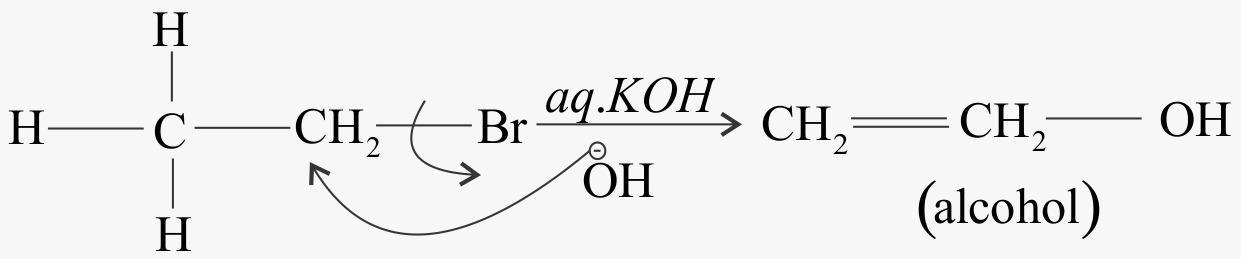
Hint: When alkyl chlorides are treated with aqueous $KOH$ the $KOH$ releases its. $\mathop {OH}\nolimits^ - $ ion only. This ion acts as a strong nucleophile. Due to this causes hydrolysis of alkyl chloride to their corresponding alcohols . Substitution reaction takes place.
\[\mathop {RCL}\nolimits_{} + \mathop {\mathop {OH}\nolimits^ - }\nolimits^{} \xrightarrow{{hydrolysis}}\mathop {ROH}\nolimits_{} + \mathop {Cl}\nolimits^ - \]
Complete step by step answer: Now when $KOH$ is alcoholic is doesn’t have $\mathop {OH}\nolimits^ - $ion rather it has ethoxide ion\[\mathop C\nolimits_2 \mathop H\nolimits_5 \mathop O\nolimits^ - \]. This ion is more basic than hydroxide ions. The ethoxide ion causes dehydrohalogenation to form alkenes. The ethoxide ion abstracts the beta hydrogen from alkyl chloride. Now a molecule of $KCl$ gets eliminated and alkene is formed. This reaction is an elimination reaction.
When alkyl chloride reacts with aqueous $KOH$
When alkyl chloride reacts with alcoholic $KOH$
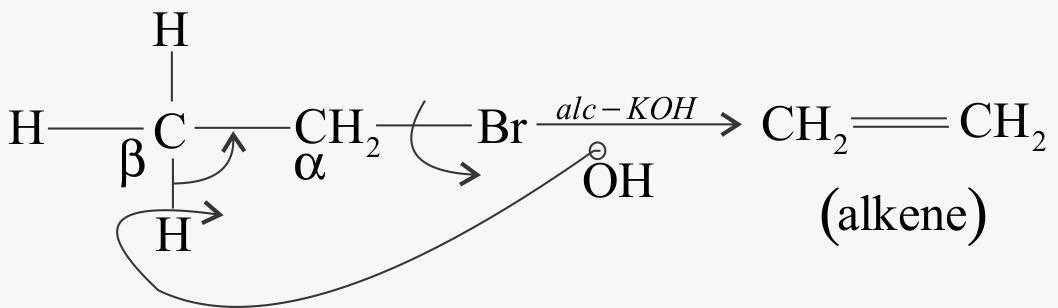
The type of elimination is beta elimination.
$\mathop {CH}\nolimits_3 - \mathop {CHCl}\nolimits_{} - \mathop {CH}\nolimits_3 + \mathop {KOH}\nolimits_{} \to \mathop {CH}\nolimits_3 - \mathop {CH}\nolimits_{} \doteq \mathop {CH}\nolimits_2 + \mathop {KCl}\nolimits_{} + \mathop H\nolimits_2 \mathop O\nolimits_{} $
It is a single step bimolecular elimination reaction
Note: Haloalkanes having two or more types of beta hydrogen atoms on dehydrohalogenation gives more than one alkene. Major product is decided by Saytzeff’s rule which states that haloalkanes on heating with alcoholic $KOH$ give more substituted alkene as a major product.
When a bulky base like propoxide ion is used then less substituted alkene is the major product because bulky groups find it easier to remove protons from less sterically hindered beta carbon atoms.
\[\mathop {RCL}\nolimits_{} + \mathop {\mathop {OH}\nolimits^ - }\nolimits^{} \xrightarrow{{hydrolysis}}\mathop {ROH}\nolimits_{} + \mathop {Cl}\nolimits^ - \]
Complete step by step answer: Now when $KOH$ is alcoholic is doesn’t have $\mathop {OH}\nolimits^ - $ion rather it has ethoxide ion\[\mathop C\nolimits_2 \mathop H\nolimits_5 \mathop O\nolimits^ - \]. This ion is more basic than hydroxide ions. The ethoxide ion causes dehydrohalogenation to form alkenes. The ethoxide ion abstracts the beta hydrogen from alkyl chloride. Now a molecule of $KCl$ gets eliminated and alkene is formed. This reaction is an elimination reaction.
When alkyl chloride reacts with aqueous $KOH$
When alkyl chloride reacts with alcoholic $KOH$
The type of elimination is beta elimination.
$\mathop {CH}\nolimits_3 - \mathop {CHCl}\nolimits_{} - \mathop {CH}\nolimits_3 + \mathop {KOH}\nolimits_{} \to \mathop {CH}\nolimits_3 - \mathop {CH}\nolimits_{} \doteq \mathop {CH}\nolimits_2 + \mathop {KCl}\nolimits_{} + \mathop H\nolimits_2 \mathop O\nolimits_{} $
It is a single step bimolecular elimination reaction
Note: Haloalkanes having two or more types of beta hydrogen atoms on dehydrohalogenation gives more than one alkene. Major product is decided by Saytzeff’s rule which states that haloalkanes on heating with alcoholic $KOH$ give more substituted alkene as a major product.
When a bulky base like propoxide ion is used then less substituted alkene is the major product because bulky groups find it easier to remove protons from less sterically hindered beta carbon atoms.
Recently Updated Pages
Master Class 5 English: Engaging Questions & Answers for Success

Master Class 5 Maths: Engaging Questions & Answers for Success
Master Class 5 Social Science: Engaging Questions & Answers for Success
Master Class 5 Science: Engaging Questions & Answers for Success
Class 5 Question and Answer - Your Ultimate Solutions Guide
Master Class 9 General Knowledge: Engaging Questions & Answers for Success
Trending doubts
One Metric ton is equal to kg A 10000 B 1000 C 100 class 11 physics CBSE
What is cell theory Who formulated it class 11 biology CBSE
Phyllotaxy is the arrangement of ALeaflets BLeaves class 11 biology CBSE
Difference Between Prokaryotic Cells and Eukaryotic Cells
The symbiotic association of fungi and algae is called class 11 biology CBSE
Cell theory was formulated by A Schleiden and Schwann class 11 biology CBSE