




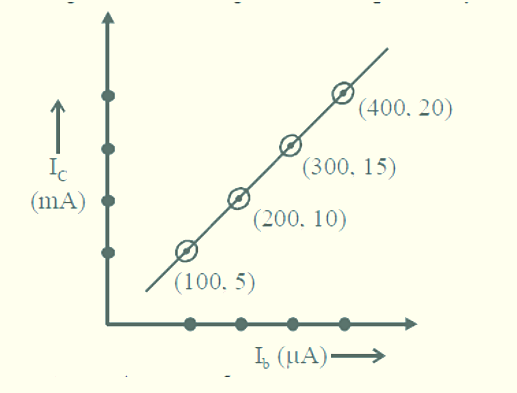
The transfer acceleration curve of a transistor, having input and output resistance 100 ohm and 100 kilo ohm respectively, is shown in figure. The voltage and power gain, are respectively:
$A){\text{ 5}} \times {\text{1}}{{\text{0}}^4},{\text{ 5}} \times {\text{1}}{{\text{0}}^5} \\$
$B){\text{ 5}} \times {\text{1}}{{\text{0}}^4},{\text{ 5}} \times {\text{1}}{{\text{0}}^6} \\$
$C){\text{ 5}} \times {\text{1}}{{\text{0}}^4},{\text{ 2}}{\text{.5}} \times {\text{1}}{{\text{0}}^6} \\$
$D){\text{ 2}}{\text{.5}} \times {\text{1}}{{\text{0}}^4},{\text{ 2}}{\text{.5}} \times {\text{1}}{{\text{0}}^6} \\ $
Answer
 Verified
579k+ views
Hint: The term gain, basically it is a ratio of the output magnitude to the input magnitude. It is represented by A. Its SI unit is dB (decibel). The expression:
$Gain\; = \;\dfrac{{Output}}{{Input}}$
Complete answer:
So, here the given condition is,
Output resistance is 100 kilo ohm = 100000 ohm
Input resistance is 100 ohm
So, we have to calculate the change in collector current is because it is the output current
$\Delta {I_C} = 10mA - 5mA \\$
$\Delta {I_C} = 5mA \\$
$\Delta {I_C} = 5 \times {10^{ - 3}}A \\ $
So, we have to calculate the change in base current is because it is the input current
$\Delta {I_B} = 200\mu A - 100\mu A \\$
$\Delta {I_B} = 100\mu A \\$
$\Delta {I_B} = 100 \times {10^{ - 6}}A \\ $
We have to calculate the voltage gain,
So, the voltage gain, it is the ratio of voltage out to the voltage in. It is represented by AV. The expression for this:
$Voltage\;Gain = \dfrac{{Voltage\;Out}}{{Voltage\;In}} \\$
${A_V} = \dfrac{{{V_{Out}}}}{{{V_{In}}}} \\ $
So, we can also calculate the voltage gain with the help of ohm’s law
V = IR -- (1)
So, we have to find voltage gain, so we change the expression as a gain
So, the expression is
${V_{gain}} = {I_{gain}} \times {R_{gain}} \\$
${A_V} = \dfrac{{\Delta {I_C}}}{{\Delta {I_B}}} \times \dfrac{{{R_{out}}}}{{{R_{in}}}} \\$
${A_V} = \dfrac{{5 \times {{10}^{ - 3}}}}{{100 \times {{10}^{ - 6}}}} \times \dfrac{{100000}}{{100}} \\$
${A_V} = \;\dfrac{{5 \times {{10}^2}}}{{100 \times {{10}^{ - 4}}}} \\$
${A_V} = 5 \times {10^2} \times {10^2} \\$
${A_V} = 5 \times {10^4} \\ $
We have to calculate the power gain,
So, the power gain, it is the ratio of power out to the power in. It is represented by AP. The expression for this:
$Power\;Gain = \dfrac{{Power\;Out}}{{Power\;In}} \\$
${A_P} = \dfrac{{{P_{Out}}}}{{{P_{In}}}} \\ $
So, we can also calculate the power gain with the help of the expression of the power dissipation in terms of current and the voltage
$Power = Voltage \times Current$
So, we have to find power gain, so we change the expression as a gain
So, the expression is
${P_{gain}} = {V_{gain}} \times {I_{gain}} \\$
${A_P} = {A_V} \times \dfrac{{\Delta {I_C}}}{{\Delta {I_B}}} \\$
${A_P} = 5 \times {10^4} \times \dfrac{{5 \times {{10}^{ - 3}}}}{{100 \times {{10}^{ - 6}}}} \\$
${A_P} = \dfrac{{25 \times {{10}^{ - 1}}}}{{100 \times {{10}^{ - 6}}}} \\$
${A_P} = 25 \times {10^5} \\ $
So, the voltage gain is $5 \times {10^4}$ and, the power gain is $25 \times {10^5}$ we can also write as $2.5 \times {10^6}$
So, the option (C) is correct.
Note:
Here, the current gain, it is the ratio of current out to the current in. It is represented by AI. The expression for this:
$Current\;Gain = \dfrac{{Current\;Out}}{{Current\;In}} \\$
${A_I} = \dfrac{{{I_{Out}}}}{{{I_{In}}}} \\ $
Here, the resistance gain, it is the ratio of resistance out to the resistance in. It is represented by AR. The expression for this:
$\operatorname{Resistance}\;Gain = \dfrac{{\operatorname{Resitan ce}\;Out}}{{\operatorname{Resistance}\;In}} \\$
${A_R} = \dfrac{{{R_{Out}}}}{{{R_{In}}}} \\ $
We can also calculate the power in terms of resistance and current as well as in terms of voltage and resistance because we have an expression of power dissipation.
$Gain\; = \;\dfrac{{Output}}{{Input}}$
Complete answer:
So, here the given condition is,
Output resistance is 100 kilo ohm = 100000 ohm
Input resistance is 100 ohm
So, we have to calculate the change in collector current is because it is the output current
$\Delta {I_C} = 10mA - 5mA \\$
$\Delta {I_C} = 5mA \\$
$\Delta {I_C} = 5 \times {10^{ - 3}}A \\ $
So, we have to calculate the change in base current is because it is the input current
$\Delta {I_B} = 200\mu A - 100\mu A \\$
$\Delta {I_B} = 100\mu A \\$
$\Delta {I_B} = 100 \times {10^{ - 6}}A \\ $
We have to calculate the voltage gain,
So, the voltage gain, it is the ratio of voltage out to the voltage in. It is represented by AV. The expression for this:
$Voltage\;Gain = \dfrac{{Voltage\;Out}}{{Voltage\;In}} \\$
${A_V} = \dfrac{{{V_{Out}}}}{{{V_{In}}}} \\ $
So, we can also calculate the voltage gain with the help of ohm’s law
V = IR -- (1)
So, we have to find voltage gain, so we change the expression as a gain
So, the expression is
${V_{gain}} = {I_{gain}} \times {R_{gain}} \\$
${A_V} = \dfrac{{\Delta {I_C}}}{{\Delta {I_B}}} \times \dfrac{{{R_{out}}}}{{{R_{in}}}} \\$
${A_V} = \dfrac{{5 \times {{10}^{ - 3}}}}{{100 \times {{10}^{ - 6}}}} \times \dfrac{{100000}}{{100}} \\$
${A_V} = \;\dfrac{{5 \times {{10}^2}}}{{100 \times {{10}^{ - 4}}}} \\$
${A_V} = 5 \times {10^2} \times {10^2} \\$
${A_V} = 5 \times {10^4} \\ $
We have to calculate the power gain,
So, the power gain, it is the ratio of power out to the power in. It is represented by AP. The expression for this:
$Power\;Gain = \dfrac{{Power\;Out}}{{Power\;In}} \\$
${A_P} = \dfrac{{{P_{Out}}}}{{{P_{In}}}} \\ $
So, we can also calculate the power gain with the help of the expression of the power dissipation in terms of current and the voltage
$Power = Voltage \times Current$
So, we have to find power gain, so we change the expression as a gain
So, the expression is
${P_{gain}} = {V_{gain}} \times {I_{gain}} \\$
${A_P} = {A_V} \times \dfrac{{\Delta {I_C}}}{{\Delta {I_B}}} \\$
${A_P} = 5 \times {10^4} \times \dfrac{{5 \times {{10}^{ - 3}}}}{{100 \times {{10}^{ - 6}}}} \\$
${A_P} = \dfrac{{25 \times {{10}^{ - 1}}}}{{100 \times {{10}^{ - 6}}}} \\$
${A_P} = 25 \times {10^5} \\ $
So, the voltage gain is $5 \times {10^4}$ and, the power gain is $25 \times {10^5}$ we can also write as $2.5 \times {10^6}$
So, the option (C) is correct.
Note:
Here, the current gain, it is the ratio of current out to the current in. It is represented by AI. The expression for this:
$Current\;Gain = \dfrac{{Current\;Out}}{{Current\;In}} \\$
${A_I} = \dfrac{{{I_{Out}}}}{{{I_{In}}}} \\ $
Here, the resistance gain, it is the ratio of resistance out to the resistance in. It is represented by AR. The expression for this:
$\operatorname{Resistance}\;Gain = \dfrac{{\operatorname{Resitan ce}\;Out}}{{\operatorname{Resistance}\;In}} \\$
${A_R} = \dfrac{{{R_{Out}}}}{{{R_{In}}}} \\ $
We can also calculate the power in terms of resistance and current as well as in terms of voltage and resistance because we have an expression of power dissipation.
Recently Updated Pages
Master Class 12 Business Studies: Engaging Questions & Answers for Success

Master Class 12 Chemistry: Engaging Questions & Answers for Success
Master Class 12 Biology: Engaging Questions & Answers for Success
Class 12 Question and Answer - Your Ultimate Solutions Guide
Master Class 11 English: Engaging Questions & Answers for Success
Master Class 11 Social Science: Engaging Questions & Answers for Success
Trending doubts
Which are the Top 10 Largest Countries of the World?
Draw a labelled sketch of the human eye class 12 physics CBSE
Differentiate between homogeneous and heterogeneous class 12 chemistry CBSE
Differentiate between Pyramid of energy and pyramid class 12 biology CBSE
Why is the cell called the structural and functional class 12 biology CBSE
Draw the diagram of the pyramid of energy Explain In class 12 biology CBSE