




The total tangential and normal accelerations of the balloon.
Answer
 Verified
586.2k+ views
Hint: The balloon is rising upwards as well as it is moving horizontally. First we need to consider the individual velocities i.e. along the vertical a constant and along the horizontal a function of y. Hence further obtaining the components of acceleration along the y and x direction will enable us to determine the total, normal and the tangential acceleration of the balloon.
Formula used:
$V=\sqrt{{{\left( {{V}_{x}} \right)}^{2}}+{{\left( {{V}_{y}} \right)}^{2}}}$
Complete answer:
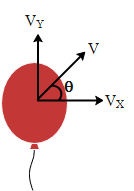
From the above diagram we can see that the balloon has a component of velocity along the vertical as well as the horizontal. Let the velocity along the vertical be a constant i.e. ${{V}_{y}}={{V}_{\circ }}$ and the velocity along the horizontal be a function of y i.e.${{V}_{x}}=ky$ . Hence the resultant of the velocity (V) using laws of vector addition we get,
$\begin{align}
& V=\sqrt{{{\left( {{V}_{x}} \right)}^{2}}+{{\left( {{V}_{y}} \right)}^{2}}} \\
& \Rightarrow V=\sqrt{{{\left( ky \right)}^{2}}+{{\left( {{V}_{o}} \right)}^{2}}} \\
\end{align}$
The acceleration of a particle is defined as the rate of change of speed with respect to time. Hence using the laws of vector addition, if ${{a}_{x}}$ is the component of acceleration along x direction and ${{a}_{y}}$ is the component along y direction than the total acceleration (${{a}_{T}}$) is,
$\begin{align}
& {{a}_{T}}=\sqrt{{{\left( {{a}_{x}} \right)}^{2}}+{{\left( {{a}_{y}} \right)}^{2}}} \\
& \because {{a}_{y}}=\dfrac{d{{V}_{\circ }}}{dt}=0,\text{ }{{a}_{x}}=\dfrac{d(ky)}{dt}=k\dfrac{dy}{dt}=k{{V}_{\circ }} \\
& {{a}_{T}}=\sqrt{{{\left( k{{V}_{\circ }} \right)}^{2}}+{{\left( 0 \right)}^{2}}} \\
& \therefore {{a}_{T}}=\sqrt{{{\left( k{{V}_{\circ }} \right)}^{2}}}=k{{V}_{\circ }} \\
\end{align}$
From the above expression it can be interpreted that the acceleration is clearly in the x direction. Let us say the angle between ‘V’ and ${{V}_{x}}$ is $\theta $ .The component of acceleration in the direction of ‘V’ is the tangential acceleration i.e. acceleration in the direction of motion. Hence the tangential acceleration ${{a}_{t}}$ is,
$\begin{align}
& {{a}_{t}}={{a}_{T}}\cos \theta \\
& \because \cos \theta =\dfrac{{{V}_{x}}}{V}=\dfrac{ky}{\sqrt{{{\left( ky \right)}^{2}}+{{\left( {{V}_{o}} \right)}^{2}}}} \\
& \Rightarrow {{a}_{t}}=k{{V}_{\circ }}\dfrac{ky}{\sqrt{{{\left( ky \right)}^{2}}+{{\left( {{V}_{o}} \right)}^{2}}}} \\
& \therefore {{a}_{t}}=\dfrac{{{k}^{2}}y{{V}_{\circ }}}{\sqrt{{{\left( ky \right)}^{2}}+{{\left( {{V}_{o}} \right)}^{2}}}} \\
\end{align}$
Similarly, the normal component of acceleration ${{a}_{N}}$ is,
$\begin{align}
& {{a}_{N}}={{a}_{T}}\sin \theta \\
& \because \sin \theta =\dfrac{{{V}_{y}}}{V}=\dfrac{{{V}_{\circ }}}{\sqrt{{{\left( ky \right)}^{2}}+{{\left( {{V}_{o}} \right)}^{2}}}} \\
& \Rightarrow {{a}_{N}}=k{{V}_{\circ }}\dfrac{{{V}_{\circ }}}{\sqrt{{{\left( ky \right)}^{2}}+{{\left( {{V}_{o}} \right)}^{2}}}} \\
& \therefore {{a}_{N}}=\dfrac{k{{V}_{\circ }}^{2}}{\sqrt{{{\left( ky \right)}^{2}}+{{\left( {{V}_{o}} \right)}^{2}}}} \\
\end{align}$
Therefore the total acceleration is $k{{V}_{\circ }}$, tangential acceleration is $\dfrac{{{k}^{2}}y{{V}_{\circ }}}{\sqrt{{{\left( ky \right)}^{2}}+{{\left( {{V}_{o}} \right)}^{2}}}}$ and normal component of acceleration is $\dfrac{k{{V}_{\circ }}^{2}}{\sqrt{{{\left( ky \right)}^{2}}+{{\left( {{V}_{o}} \right)}^{2}}}}$
Note:
It is to be noted that the normal component of acceleration is not in the y direction. It is in the downward direction making an angle theta with the horizontal component of velocity. If there was a component of acceleration along the y direction, then the balloon would have had the acceleration vertically as well. Hence we took the velocity as a function of y in horizontal.
Formula used:
$V=\sqrt{{{\left( {{V}_{x}} \right)}^{2}}+{{\left( {{V}_{y}} \right)}^{2}}}$
Complete answer:
From the above diagram we can see that the balloon has a component of velocity along the vertical as well as the horizontal. Let the velocity along the vertical be a constant i.e. ${{V}_{y}}={{V}_{\circ }}$ and the velocity along the horizontal be a function of y i.e.${{V}_{x}}=ky$ . Hence the resultant of the velocity (V) using laws of vector addition we get,
$\begin{align}
& V=\sqrt{{{\left( {{V}_{x}} \right)}^{2}}+{{\left( {{V}_{y}} \right)}^{2}}} \\
& \Rightarrow V=\sqrt{{{\left( ky \right)}^{2}}+{{\left( {{V}_{o}} \right)}^{2}}} \\
\end{align}$
The acceleration of a particle is defined as the rate of change of speed with respect to time. Hence using the laws of vector addition, if ${{a}_{x}}$ is the component of acceleration along x direction and ${{a}_{y}}$ is the component along y direction than the total acceleration (${{a}_{T}}$) is,
$\begin{align}
& {{a}_{T}}=\sqrt{{{\left( {{a}_{x}} \right)}^{2}}+{{\left( {{a}_{y}} \right)}^{2}}} \\
& \because {{a}_{y}}=\dfrac{d{{V}_{\circ }}}{dt}=0,\text{ }{{a}_{x}}=\dfrac{d(ky)}{dt}=k\dfrac{dy}{dt}=k{{V}_{\circ }} \\
& {{a}_{T}}=\sqrt{{{\left( k{{V}_{\circ }} \right)}^{2}}+{{\left( 0 \right)}^{2}}} \\
& \therefore {{a}_{T}}=\sqrt{{{\left( k{{V}_{\circ }} \right)}^{2}}}=k{{V}_{\circ }} \\
\end{align}$
From the above expression it can be interpreted that the acceleration is clearly in the x direction. Let us say the angle between ‘V’ and ${{V}_{x}}$ is $\theta $ .The component of acceleration in the direction of ‘V’ is the tangential acceleration i.e. acceleration in the direction of motion. Hence the tangential acceleration ${{a}_{t}}$ is,
$\begin{align}
& {{a}_{t}}={{a}_{T}}\cos \theta \\
& \because \cos \theta =\dfrac{{{V}_{x}}}{V}=\dfrac{ky}{\sqrt{{{\left( ky \right)}^{2}}+{{\left( {{V}_{o}} \right)}^{2}}}} \\
& \Rightarrow {{a}_{t}}=k{{V}_{\circ }}\dfrac{ky}{\sqrt{{{\left( ky \right)}^{2}}+{{\left( {{V}_{o}} \right)}^{2}}}} \\
& \therefore {{a}_{t}}=\dfrac{{{k}^{2}}y{{V}_{\circ }}}{\sqrt{{{\left( ky \right)}^{2}}+{{\left( {{V}_{o}} \right)}^{2}}}} \\
\end{align}$
Similarly, the normal component of acceleration ${{a}_{N}}$ is,
$\begin{align}
& {{a}_{N}}={{a}_{T}}\sin \theta \\
& \because \sin \theta =\dfrac{{{V}_{y}}}{V}=\dfrac{{{V}_{\circ }}}{\sqrt{{{\left( ky \right)}^{2}}+{{\left( {{V}_{o}} \right)}^{2}}}} \\
& \Rightarrow {{a}_{N}}=k{{V}_{\circ }}\dfrac{{{V}_{\circ }}}{\sqrt{{{\left( ky \right)}^{2}}+{{\left( {{V}_{o}} \right)}^{2}}}} \\
& \therefore {{a}_{N}}=\dfrac{k{{V}_{\circ }}^{2}}{\sqrt{{{\left( ky \right)}^{2}}+{{\left( {{V}_{o}} \right)}^{2}}}} \\
\end{align}$
Therefore the total acceleration is $k{{V}_{\circ }}$, tangential acceleration is $\dfrac{{{k}^{2}}y{{V}_{\circ }}}{\sqrt{{{\left( ky \right)}^{2}}+{{\left( {{V}_{o}} \right)}^{2}}}}$ and normal component of acceleration is $\dfrac{k{{V}_{\circ }}^{2}}{\sqrt{{{\left( ky \right)}^{2}}+{{\left( {{V}_{o}} \right)}^{2}}}}$
Note:
It is to be noted that the normal component of acceleration is not in the y direction. It is in the downward direction making an angle theta with the horizontal component of velocity. If there was a component of acceleration along the y direction, then the balloon would have had the acceleration vertically as well. Hence we took the velocity as a function of y in horizontal.
Recently Updated Pages
Master Class 11 English: Engaging Questions & Answers for Success

Master Class 11 Physics: Engaging Questions & Answers for Success
Master Class 11 Computer Science: Engaging Questions & Answers for Success
Master Class 11 Chemistry: Engaging Questions & Answers for Success
Master Class 11 Social Science: Engaging Questions & Answers for Success
Master Class 11 Accountancy: Engaging Questions & Answers for Success
Trending doubts
One Metric ton is equal to kg A 10000 B 1000 C 100 class 11 physics CBSE
Draw a diagram of nephron and explain its structur class 11 biology CBSE
Draw a diagram of a plant cell and label at least eight class 11 biology CBSE
Proton was discovered by A Thomson B Rutherford C Chadwick class 11 chemistry CBSE
1L of CO2 is passed red hot coke The volume becomes class 11 chemistry CBSE
What is the purity of pure gold in carat class 11 chemistry CBSE