




The total surface area of a right circular cylinder is $165\pi c{{m}^{2}}$. If the radius of its base is 5 cm; find its height and volume.
Answer
 Verified
646.2k+ views
Hint: Total surface area of the cylinder is given as $2\pi rh+2\pi {{r}^{2}}$, where ‘r’ is the radius of the base and ‘h’ is the height of the cylinder and value of $\pi $ is 3.14. Volume of the cylinder is given as $\pi {{r}^{2}}h$. Find the volume by calculating the height from the given total surface area in the problem and use the above mentioned formulae.
Complete step by step answer:
We have a right circular cylinder with a total surface area of $165\pi c{{m}^{2}}$ and radius of base as 5 cm and hence, we need to determine the value of height and volume of the cylinder.
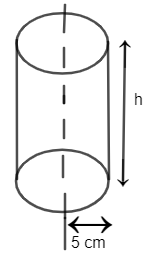
Let the height of the cylinder be h cm.
As we know the total surface area of the cylinder can be given as $2\pi rh+2\pi {{r}^{2}}$ which includes $2\pi rh$ for the curved surface area and $2\pi {{r}^{2}}$ for the areas of both the circles of the bases (upper and lower circle).
Hence, we have
Total surface area $=2\pi rh+2\pi {{r}^{2}}$
And we have a total surface area as $165\pi c{{m}^{2}}$ from the problem. So, we get
$2\pi rh+2\pi {{r}^{2}}=165\pi $
$\Rightarrow 2\pi r\left( h+r \right)=165\pi $
$2r\left( h+r \right)=165$
We have $r=5cm$ from the question (radius of cylinder). Hence, we can get the above equation as
$2\times 5\left( h+5 \right)=165$
$10\left( h+5 \right)=165$
$10h+50=165$
$10h=165-50=115$
$h=\dfrac{115}{10}=11.5cm$
Now, we can calculate volume of the cylinder with the help of the relation given as
Volume of cylinder $=\pi {{r}^{2}}h$
Where r= radius
h=height
and $\pi =\dfrac{22}{7}=3.14$
So, we get
Volume of the cylinder given $=\pi \times {{\left( 5 \right)}^{2}}\times 11.5$
$=\pi \times 25\times 11.5$
$=3.14\times 25\times 11.5$
$=902.75c{{m}^{3}}$
Hence, height and volume of the right circular cylinder are 11.5 cm and $902.75c{{m}^{3}}$ respectively.
Note: Don’t put the total surface of the cylinder as $2\pi rh$ . It is the curved surface area of the cylinder, we need to include the area of circles with the bases (upper and lower circles). So, total surface area can be given as
$TSA=CSA+$ Area of bases
$TSA=2\pi rh+2\pi {{r}^{2}}$
And don’t confuse between total surface area and volume as well.
Volume of the cylinder is given as $\pi {{r}^{2}}h$.
Put the values of ‘r’ and ‘h’ carefully in the identities of volume and surface area. Don’t change the place of them while putting the value of radius and height. Be careful with it as well.
Complete step by step answer:
We have a right circular cylinder with a total surface area of $165\pi c{{m}^{2}}$ and radius of base as 5 cm and hence, we need to determine the value of height and volume of the cylinder.
Let the height of the cylinder be h cm.
As we know the total surface area of the cylinder can be given as $2\pi rh+2\pi {{r}^{2}}$ which includes $2\pi rh$ for the curved surface area and $2\pi {{r}^{2}}$ for the areas of both the circles of the bases (upper and lower circle).
Hence, we have
Total surface area $=2\pi rh+2\pi {{r}^{2}}$
And we have a total surface area as $165\pi c{{m}^{2}}$ from the problem. So, we get
$2\pi rh+2\pi {{r}^{2}}=165\pi $
$\Rightarrow 2\pi r\left( h+r \right)=165\pi $
$2r\left( h+r \right)=165$
We have $r=5cm$ from the question (radius of cylinder). Hence, we can get the above equation as
$2\times 5\left( h+5 \right)=165$
$10\left( h+5 \right)=165$
$10h+50=165$
$10h=165-50=115$
$h=\dfrac{115}{10}=11.5cm$
Now, we can calculate volume of the cylinder with the help of the relation given as
Volume of cylinder $=\pi {{r}^{2}}h$
Where r= radius
h=height
and $\pi =\dfrac{22}{7}=3.14$
So, we get
Volume of the cylinder given $=\pi \times {{\left( 5 \right)}^{2}}\times 11.5$
$=\pi \times 25\times 11.5$
$=3.14\times 25\times 11.5$
$=902.75c{{m}^{3}}$
Hence, height and volume of the right circular cylinder are 11.5 cm and $902.75c{{m}^{3}}$ respectively.
Note: Don’t put the total surface of the cylinder as $2\pi rh$ . It is the curved surface area of the cylinder, we need to include the area of circles with the bases (upper and lower circles). So, total surface area can be given as
$TSA=CSA+$ Area of bases
$TSA=2\pi rh+2\pi {{r}^{2}}$
And don’t confuse between total surface area and volume as well.
Volume of the cylinder is given as $\pi {{r}^{2}}h$.
Put the values of ‘r’ and ‘h’ carefully in the identities of volume and surface area. Don’t change the place of them while putting the value of radius and height. Be careful with it as well.
Recently Updated Pages
Master Class 9 General Knowledge: Engaging Questions & Answers for Success

Master Class 9 Maths: Engaging Questions & Answers for Success
Master Class 9 Science: Engaging Questions & Answers for Success
Master Class 9 English: Engaging Questions & Answers for Success
Master Class 9 Social Science: Engaging Questions & Answers for Success
Class 9 Question and Answer - Your Ultimate Solutions Guide
Trending doubts
What is the situation called when no party gets the class 9 social science CBSE
Find the sum of series 1 + 2 + 3 + 4 + 5 + + 100 class 9 maths CBSE
Difference Between Plant Cell and Animal Cell
Fill the blanks with the suitable prepositions 1 The class 9 english CBSE
What is pollution? How many types of pollution? Define it
What is the Full Form of ICSE / ISC ?