




The total number(s) of stable conformers with non-zero dipole moment for the following compound is (are):
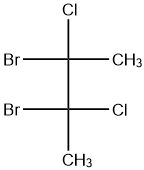
(A) 1
(B) 2
(C) 3
(D) none of these
Answer
 Verified
567.6k+ views
Hint: Any two arrangements of atoms in a molecule that differ by rotation about single bonds can be referred to as different conformations, conformations that correspond to local minima on the energy surface are specifically called conformational isomers or conformers.
Complete step by step answer:
Conformational isomerism is a form of stereoisomerism in which the isomers can be interconverted just by rotations about formally single bonds (refer to figure on single bond rotation).
A dipole moment arises in any system in which there is a separation of charge. They can, therefore, arise in ionic bonds as well as in covalent bonds. Dipole moments occur due to the difference in electronegativity between two chemically bonded atoms.
The three conformers of the compound given are as follows:
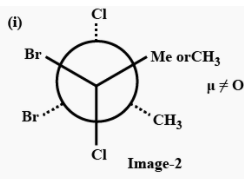
In (i), Chlorine atoms are present trans to each other so there will be no dipole moment because of chlorine but bromine atoms are present cis to each other, so there will be a net dipole moment, because of bromine atoms, therefore conformer (i) has a non zero dipole moment.
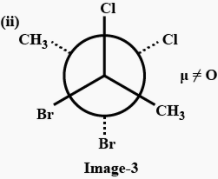
In (ii), Chlorine atoms are present cis to each other, and bromine atoms are present cis to each other, so both of them will generate dipole moment, and since chlorine is more electronegative so the net dipole moment will be directed towards the chlorine atom. Therefore conformer (ii) has a non-zero dipole moment.
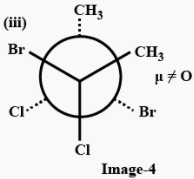
In (i), bromine atoms are present trans to each other so there will be no dipole moment because of bromine but chlorine atoms are present cis to each other, so there will be a net dipole moment, because of chlorine atoms, therefore conformer (i) has a non zero dipole moment.
So, the correct answer is “Option C”.
Note: A bond dipole moment is a measure of the polarity of a chemical bond between two atoms in a molecule. It involves the concept of electric dipole moment, which is a measure of the separation of negative and positive charges in a system.
Complete step by step answer:
Conformational isomerism is a form of stereoisomerism in which the isomers can be interconverted just by rotations about formally single bonds (refer to figure on single bond rotation).
A dipole moment arises in any system in which there is a separation of charge. They can, therefore, arise in ionic bonds as well as in covalent bonds. Dipole moments occur due to the difference in electronegativity between two chemically bonded atoms.
The three conformers of the compound given are as follows:
In (i), Chlorine atoms are present trans to each other so there will be no dipole moment because of chlorine but bromine atoms are present cis to each other, so there will be a net dipole moment, because of bromine atoms, therefore conformer (i) has a non zero dipole moment.
In (ii), Chlorine atoms are present cis to each other, and bromine atoms are present cis to each other, so both of them will generate dipole moment, and since chlorine is more electronegative so the net dipole moment will be directed towards the chlorine atom. Therefore conformer (ii) has a non-zero dipole moment.
In (i), bromine atoms are present trans to each other so there will be no dipole moment because of bromine but chlorine atoms are present cis to each other, so there will be a net dipole moment, because of chlorine atoms, therefore conformer (i) has a non zero dipole moment.
So, the correct answer is “Option C”.
Note: A bond dipole moment is a measure of the polarity of a chemical bond between two atoms in a molecule. It involves the concept of electric dipole moment, which is a measure of the separation of negative and positive charges in a system.
Recently Updated Pages
Master Class 12 Social Science: Engaging Questions & Answers for Success

Master Class 12 Physics: Engaging Questions & Answers for Success
Master Class 12 Maths: Engaging Questions & Answers for Success
Master Class 12 Economics: Engaging Questions & Answers for Success
Master Class 12 Chemistry: Engaging Questions & Answers for Success
Master Class 12 Business Studies: Engaging Questions & Answers for Success
Trending doubts
Which are the Top 10 Largest Countries of the World?
Draw a labelled sketch of the human eye class 12 physics CBSE
Explain the structure of megasporangium class 12 biology CBSE
What are the major means of transport Explain each class 12 social science CBSE
How many chromosomes are found in human ovum a 46 b class 12 biology CBSE
The diagram of the section of a maize grain is given class 12 biology CBSE