




The total number of \[\angle {\text{FIF}}\] angles in \[{\text{I}}{{\text{F}}_7}\] having the bond angle value of \[90^\circ \] is
Answer
 Verified
599.4k+ views
Hint:
All the angles are the same in case of \[{\text{I}}{{\text{F}}_7}\]. Its geometry is pentagonal bipyramidal. There are 7 electrons in the valence shell and all electrons have been used in geometry.
Complete step by step solution:
The structure of \[{\text{I}}{{\text{F}}_7}\] is:
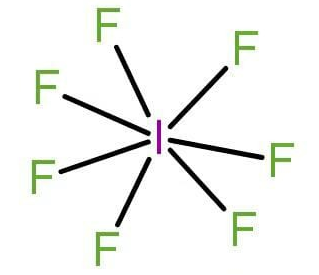
There are a total 7 iodine – fluorine bonds. There are 10 ninety degree bonds in iodine fluoride bond angles. There are 4 fluorines in the plane of which makes 4 angles of ninety degrees. Then 2 angels are made by each bond that is perpendicular to the plane. This makes 6 angles. Hence total angles are 10 in between iodine and fluorine.
Additional information:
Both iodine and fluorine are group number 17 elements. The atomic number of iodine is 53. The atomic number of fluorine is 9. They have 7 electrons in its valence shell. The fluorine is the most electronegative element in the periodic table. It has a very strong tendency to gain electrons and readily accepts electrons. As we know down, the group size increases, so the atomic size of iodine is quite large. That is why the iodine has the ability to form seven bonds and accommodate 7 electrons. Due to low electronegativity of iodine and high electronegativity of fluorine makes the bond feasible because generally the same group elements do not react with each other.
Note:
The \[{\text{I}}{{\text{F}}_7}\] types of compounds belong to the class of compounds known as interhalogen compounds. They are the binary compounds made up of two halogens. The general formula for interhalogen compound is \[{\text{X}}{{\text{Y}}_{\text{n}}}\] where both X and Y are halogens and X is less electronegative than Y.
All the angles are the same in case of \[{\text{I}}{{\text{F}}_7}\]. Its geometry is pentagonal bipyramidal. There are 7 electrons in the valence shell and all electrons have been used in geometry.
Complete step by step solution:
The structure of \[{\text{I}}{{\text{F}}_7}\] is:
There are a total 7 iodine – fluorine bonds. There are 10 ninety degree bonds in iodine fluoride bond angles. There are 4 fluorines in the plane of which makes 4 angles of ninety degrees. Then 2 angels are made by each bond that is perpendicular to the plane. This makes 6 angles. Hence total angles are 10 in between iodine and fluorine.
Additional information:
Both iodine and fluorine are group number 17 elements. The atomic number of iodine is 53. The atomic number of fluorine is 9. They have 7 electrons in its valence shell. The fluorine is the most electronegative element in the periodic table. It has a very strong tendency to gain electrons and readily accepts electrons. As we know down, the group size increases, so the atomic size of iodine is quite large. That is why the iodine has the ability to form seven bonds and accommodate 7 electrons. Due to low electronegativity of iodine and high electronegativity of fluorine makes the bond feasible because generally the same group elements do not react with each other.
Note:
The \[{\text{I}}{{\text{F}}_7}\] types of compounds belong to the class of compounds known as interhalogen compounds. They are the binary compounds made up of two halogens. The general formula for interhalogen compound is \[{\text{X}}{{\text{Y}}_{\text{n}}}\] where both X and Y are halogens and X is less electronegative than Y.
Recently Updated Pages
Basicity of sulphurous acid and sulphuric acid are

Master Class 11 English: Engaging Questions & Answers for Success
Master Class 11 Physics: Engaging Questions & Answers for Success
Master Class 11 Computer Science: Engaging Questions & Answers for Success
Master Class 11 Chemistry: Engaging Questions & Answers for Success
Master Class 11 Social Science: Engaging Questions & Answers for Success
Trending doubts
Difference Between Prokaryotic Cells and Eukaryotic Cells
Two of the body parts which do not appear in MRI are class 11 biology CBSE
One Metric ton is equal to kg A 10000 B 1000 C 100 class 11 physics CBSE
10 examples of friction in our daily life
Draw a diagram of nephron and explain its structur class 11 biology CBSE
What will happen if the mucus is not secreted by the class 11 biology CBSE