




The total length of the edges of a cube is \[96{\text{ cm}}\]. What is the difference in the numbers denoting its total surface area and volume?
(A) \[128\]
(B) \[512\]
(C) \[384\]
(D) \[896\]
Answer
 Verified
555.3k+ views
Hint: To solve this problem, we have to find the total surface area and volume of the given cube. For this, we will find the length of each edge of the given cube by equating the given sum of all edges to the formula for finding the sum of edges of a cube i.e., \[12 \times \left( {edge} \right)\]. Then we will find the total surface area and volume of the given cube using the formula of total surface area i.e., \[6 \times {\left( {edge} \right)^2}\] and volume i.e., \[{\left( {edge} \right)^3}\] of a cube. Subtracting the obtained total surface area of the cube from the volume of the cube will give the difference in the numbers denoting its total surface area and volume.
Complete step by step answer:
Basic structure of a cube is shown below:
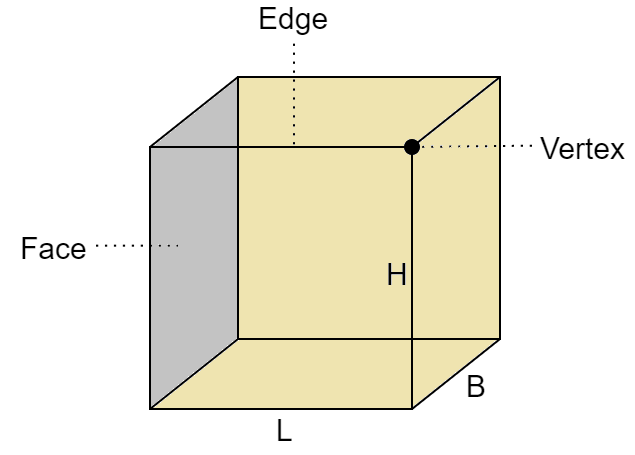
As we know, a cube is made up of \[6\] square faces, \[8\] vertices and $12$ edges.
For a cube, Length \[ = \] Breadth\[ = \] Height i.e., \[L = B = H\]. Therefore, all the edges are of equal length.
Let, length of the edge be \[a\] .
Given, sum of all the edges \[ = 96{\text{ cm}}\]
Since we have considered the length of one edge to be \[a\] , we can write
\[ \Rightarrow 12a = 96{\text{ cm}}\]
On solving,
\[ \Rightarrow a = 8{\text{ cm}}\]
\[\therefore {\text{Length of the edge}} = 8{\text{ cm}}\]
For a cube, total surface area\[ = 6 \times {\left( {edge} \right)^2}\]
\[ = 6 \times {\left( a \right)^2}\]
Putting the value of \[a\] ,
\[ \Rightarrow {\text{Total surface area}} = 6 \times {\left( 8 \right)^2}\]
On solving,
\[ \Rightarrow {\text{Total surface area}} = 384{\text{ c}}{{\text{m}}^2}\]
Now, as volume of the cube\[ = {\left( {edge} \right)^3}\]
\[ = {\left( a \right)^3}\]
On putting the value of \[a\] we get
\[ \Rightarrow {\text{Volume of the cube}} = {\left( 8 \right)^3}\]
On solving,
\[ \Rightarrow {\text{Volume of the cube}} = 512{\text{ c}}{{\text{m}}^3}\]
Therefore, we get
Total surface area of the cube\[ = 384{\text{ c}}{{\text{m}}^2}\] and Volume of the cube\[ = 512{\text{ c}}{{\text{m}}^3}\]
The difference in the numbers denoting its total surface area and volume \[ = 512 - 384\]
\[ = 128\]
Therefore, the difference in numbers denoting its total surface area and volume is 128. Hence, option (A) is correct.
Note:
We have to keep in mind whether we require the total surface area or lateral surface area of the cube. If we require lateral surface area then it will be the sum of all faces except the top and bottom face of the cube. For this, the formula that we will use to find the lateral surface area will be \[\left( {6{a^2} - 2{a^2}} \right)\] i.e., \[4{a^2}\].
Complete step by step answer:
Basic structure of a cube is shown below:
As we know, a cube is made up of \[6\] square faces, \[8\] vertices and $12$ edges.
For a cube, Length \[ = \] Breadth\[ = \] Height i.e., \[L = B = H\]. Therefore, all the edges are of equal length.
Let, length of the edge be \[a\] .
Given, sum of all the edges \[ = 96{\text{ cm}}\]
Since we have considered the length of one edge to be \[a\] , we can write
\[ \Rightarrow 12a = 96{\text{ cm}}\]
On solving,
\[ \Rightarrow a = 8{\text{ cm}}\]
\[\therefore {\text{Length of the edge}} = 8{\text{ cm}}\]
For a cube, total surface area\[ = 6 \times {\left( {edge} \right)^2}\]
\[ = 6 \times {\left( a \right)^2}\]
Putting the value of \[a\] ,
\[ \Rightarrow {\text{Total surface area}} = 6 \times {\left( 8 \right)^2}\]
On solving,
\[ \Rightarrow {\text{Total surface area}} = 384{\text{ c}}{{\text{m}}^2}\]
Now, as volume of the cube\[ = {\left( {edge} \right)^3}\]
\[ = {\left( a \right)^3}\]
On putting the value of \[a\] we get
\[ \Rightarrow {\text{Volume of the cube}} = {\left( 8 \right)^3}\]
On solving,
\[ \Rightarrow {\text{Volume of the cube}} = 512{\text{ c}}{{\text{m}}^3}\]
Therefore, we get
Total surface area of the cube\[ = 384{\text{ c}}{{\text{m}}^2}\] and Volume of the cube\[ = 512{\text{ c}}{{\text{m}}^3}\]
The difference in the numbers denoting its total surface area and volume \[ = 512 - 384\]
\[ = 128\]
Therefore, the difference in numbers denoting its total surface area and volume is 128. Hence, option (A) is correct.
Note:
We have to keep in mind whether we require the total surface area or lateral surface area of the cube. If we require lateral surface area then it will be the sum of all faces except the top and bottom face of the cube. For this, the formula that we will use to find the lateral surface area will be \[\left( {6{a^2} - 2{a^2}} \right)\] i.e., \[4{a^2}\].

Recently Updated Pages
Which will be the least stable resonating structure class 11 chemistry CBSE

Explain the structure of megasporangium class 12 biology CBSE
Differentiate between voluntary action and reflex class 10 biology CBSE
How many 5 digit telephone numbers can be construc-class-11-maths-CBSE
How do you find the angle of the resultant vector class 11 physics CBSE
Why is chloroform kept in dark coloured bottles class 12 chemistry CBSE
Trending doubts
The common name of Rheo leaf is A Oyster plant B Boat class 9 biology CBSE
Difference Between Plant Cell and Animal Cell
Fill the blanks with the suitable prepositions 1 The class 9 english CBSE
What is the full form of pH?
Any five important events between the years 1930 to class 9 social science CBSE
On an outline map of India show its neighbouring c class 9 social science CBSE