




The time interval of the appearance of fever in malarial patients depends on the types of malaria. The research evidence suggests that such time intervals are- (1) 36 to 48 hours, (2) 48 hours, and (3) 72 hours. If any such patient experiences fever at an interval of 48 hours, then the said patient suffers from
(a) Only benign tertian malaria
(b) Quartan malaria or mild tertian malaria
(c) Malignant tertian malaria or benign tertian malaria
(d) Mild tertian malaria or benign tertian malaria
Answer
 Verified
551.4k+ views
Hint: Malaria is a parasite-stricken disease. The parasite is transmitted to humans through infected mosquito bites. Merozoite release and their invasion of new red blood corpuscles cause fever. If the patient gets a fever every 48 hours, they experience a not so fatal malaria disease that happens every third day. This type of fever is caused by two species of Plasmodium such as Plasmodium vivax and Plasmodium ovale.
Three specific forms of malaria exist. They are:
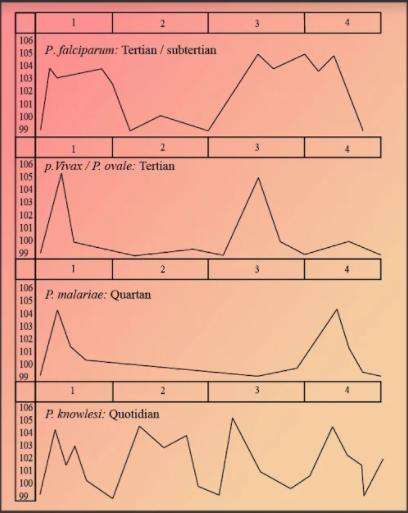
1. Benign tertian (caused by Plasmodium vivax and Plasmodium ovale) with fever every 3rd day at an interval of 48 hours ( e.g. Monday; fever, Tuesday; no fever, Wednesday; fever).
2. Benign quartan (caused by Plasmodium malariae) with fever every 4th day (e.g., Monday; fever, Tuesday; no fever, Wednesday; no fever, Thursday; fever).
3. Malignant tertian (caused by Plasmodium falciparum), in which the cold stage is less severe and the fever stage is more prolonged and exacerbated (if there is a recurrence of fever every second day). The fever is generally constant, however, or only momentarily remittent. There's no wet stage. This form of malaria is more severe due to complications caused by capillary blockage (i.e., seizures, coma, acute lung insufficiency, and heart failure). Large numbers of erythrocytes are parasitized and killed, leading to dark-colored urine (blackwater fever; hemolysis intravascular, hemoglobinuria, and kidney failure).
So, the correct answer is ‘Mild tertian malaria or benign tertian malaria’.
Note:
Mixed infections of Plasmodium malariae with the other parasites will lead to double quartan fever, with 2 consecutive days of paroxysms followed by one day of remission. Malaria is known for its paroxysm of fever, beginning with chills, rigors, high-grade fever, accompanied by sweating as the fever decreases. However, in many patients, this classical pattern can not be seen, particularly during the initial days of clinical malaria. Patients do not feel any fever despite the parasitemia in the initial 48 hours of the infection's erythrocytic process but there may be prodromal symptoms such as headache and body ache. The image shows how the cycle is if bitten by the following species.
Three specific forms of malaria exist. They are:
1. Benign tertian (caused by Plasmodium vivax and Plasmodium ovale) with fever every 3rd day at an interval of 48 hours ( e.g. Monday; fever, Tuesday; no fever, Wednesday; fever).
2. Benign quartan (caused by Plasmodium malariae) with fever every 4th day (e.g., Monday; fever, Tuesday; no fever, Wednesday; no fever, Thursday; fever).
3. Malignant tertian (caused by Plasmodium falciparum), in which the cold stage is less severe and the fever stage is more prolonged and exacerbated (if there is a recurrence of fever every second day). The fever is generally constant, however, or only momentarily remittent. There's no wet stage. This form of malaria is more severe due to complications caused by capillary blockage (i.e., seizures, coma, acute lung insufficiency, and heart failure). Large numbers of erythrocytes are parasitized and killed, leading to dark-colored urine (blackwater fever; hemolysis intravascular, hemoglobinuria, and kidney failure).
So, the correct answer is ‘Mild tertian malaria or benign tertian malaria’.
Note:
Mixed infections of Plasmodium malariae with the other parasites will lead to double quartan fever, with 2 consecutive days of paroxysms followed by one day of remission. Malaria is known for its paroxysm of fever, beginning with chills, rigors, high-grade fever, accompanied by sweating as the fever decreases. However, in many patients, this classical pattern can not be seen, particularly during the initial days of clinical malaria. Patients do not feel any fever despite the parasitemia in the initial 48 hours of the infection's erythrocytic process but there may be prodromal symptoms such as headache and body ache. The image shows how the cycle is if bitten by the following species.
Recently Updated Pages
Master Class 12 Business Studies: Engaging Questions & Answers for Success

Master Class 12 Chemistry: Engaging Questions & Answers for Success
Master Class 12 Biology: Engaging Questions & Answers for Success
Class 12 Question and Answer - Your Ultimate Solutions Guide
Master Class 11 English: Engaging Questions & Answers for Success
Master Class 11 Social Science: Engaging Questions & Answers for Success
Trending doubts
Which are the Top 10 Largest Countries of the World?
Draw a labelled sketch of the human eye class 12 physics CBSE
Differentiate between homogeneous and heterogeneous class 12 chemistry CBSE
Differentiate between Pyramid of energy and pyramid class 12 biology CBSE
Why is the cell called the structural and functional class 12 biology CBSE
Draw the diagram of the pyramid of energy Explain In class 12 biology CBSE