




The term bacteriophage was coined by
A. Pasteur
B. Ivanowski
C. Saffarman and Morris
D. De Herelle
Answer
 Verified
641.7k+ views
Hint: The term was coined by a French Canadian microbiologist, who discovered bacteriophages and also performed experiments related to the phage theory.
Complete answer:
The Bacteriophage term was coined by microbiologist Felix De Herelle. He is well known for the discovery of bacteriophage in 1917. The phi ×174 is a bacteriophage virus which is a single-stranded DNA (ssDNA) virus.
Additional Information:
-A bacteriophage is the group of a virus that infects the bacteria.
-The term bacteriophage was derived from “bacteria” and the Greek word phagein meaning “to devour“.
-The bacteriophage was first sequenced by Fred Sanger and his team in 1977.
-The physical structure of this virus was demonstrated by Walter Fiers and Robert Sinsheimer in 1962.
-It was the first virus used as a model to prove that DNA can be synthesized in a test tube by Arthur Kornberg, a Nobel Prize winner.
-The transcription of bacteriophage was generated in 2020 with a series of four weak promoters and four Rho-independent terminators and one Rho-dependent terminator.
-Bacteriophage virus encodes a total of 11 proteins.
-It has been used in many evolution experiments as a model organism.
-It infects Escherichia coli, and it was the first virus having a DNA-based genome sequence.
-They have a positive circular DNA genome which consists of 44% GC-content and 95% nucleotides to code genes.
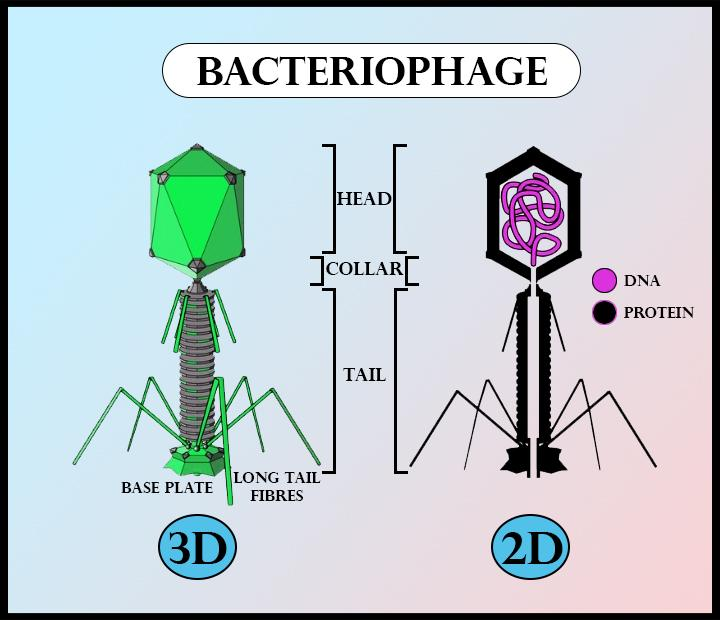
So, the correct answer is ‘De Herelle'.
Note: Virus is an infectious agent that multiplies only on the living cells of the animals. The TMV (Tobacco Mosaic Virus) is a positive single-stranded RNA virus. The poliovirus is also a positive single-stranded RNA. The smallpox virus is a single linear double-stranded DNA.
Complete answer:
The Bacteriophage term was coined by microbiologist Felix De Herelle. He is well known for the discovery of bacteriophage in 1917. The phi ×174 is a bacteriophage virus which is a single-stranded DNA (ssDNA) virus.
Additional Information:
-A bacteriophage is the group of a virus that infects the bacteria.
-The term bacteriophage was derived from “bacteria” and the Greek word phagein meaning “to devour“.
-The bacteriophage was first sequenced by Fred Sanger and his team in 1977.
-The physical structure of this virus was demonstrated by Walter Fiers and Robert Sinsheimer in 1962.
-It was the first virus used as a model to prove that DNA can be synthesized in a test tube by Arthur Kornberg, a Nobel Prize winner.
-The transcription of bacteriophage was generated in 2020 with a series of four weak promoters and four Rho-independent terminators and one Rho-dependent terminator.
-Bacteriophage virus encodes a total of 11 proteins.
-It has been used in many evolution experiments as a model organism.
-It infects Escherichia coli, and it was the first virus having a DNA-based genome sequence.
-They have a positive circular DNA genome which consists of 44% GC-content and 95% nucleotides to code genes.
So, the correct answer is ‘De Herelle'.
Note: Virus is an infectious agent that multiplies only on the living cells of the animals. The TMV (Tobacco Mosaic Virus) is a positive single-stranded RNA virus. The poliovirus is also a positive single-stranded RNA. The smallpox virus is a single linear double-stranded DNA.
Recently Updated Pages
The given figure shows two endocrine glands marked class 11 biology NEET_UG

Match columnI with columnII and select the correct class 11 biology NEET
Match column I with column II and select the correct class 11 biology NEET_UG
Which floral family has left 9 right + 1 arrangement class 11 biology NEET_UG
Which is not a variety of sheep A Lohi B Beetal C Nellore class 11 biology NEET_UG
Match column I with column II and select the correct class 11 biology NEET_UG
Trending doubts
Difference Between Prokaryotic Cells and Eukaryotic Cells
One Metric ton is equal to kg A 10000 B 1000 C 100 class 11 physics CBSE
Two of the body parts which do not appear in MRI are class 11 biology CBSE
10 examples of friction in our daily life
Draw a diagram of nephron and explain its structur class 11 biology CBSE
Draw a diagram of a plant cell and label at least eight class 11 biology CBSE