




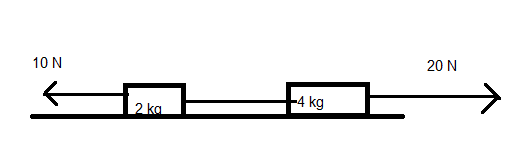
The tension in the string connected between the blocks is? (the surface is smooth)
1- \[\dfrac{80}{3}N\]
2- \[\dfrac{40}{3}N\]
3- \[\dfrac{50}{7}N\]
4- 26 N
Answer
 Verified
604.8k+ views
Hint: We can see both the blocks are attached by a single rope, so there will be one common tension, T in the string.
We can make use of Newton’s second law to arrive at a meaningful answer here. Here the tension is a kind of force and it always acts towards the point of impact.
Complete step by step answer:
Let the tension in the string be T. Now the force acting towards the right is greater than the force acting towards left, so the system will move in the right direction with a common acceleration and let it be a.
There are two forces acting each on the two blocks and they are connected by a single rope. For the body of mass 4 kg: \[20-T=4a\] ------(1)
For the body of mass 2 kg: \[T-10=2a\] ------(2)
Solving eq (1) and (2) we get,
\[\begin{align}
& 10=6a \\
& \Rightarrow a=\dfrac{5}{3}m/{{s}^{2}} \\
\end{align}\]
Now to find the value of tension, we substitute the value of acceleration in eq (1), we get,
\[T=10+\dfrac{10}{3}=\dfrac{40}{3}N\]
Thus, the value of tension is \[\dfrac{40}{3}N\]
So, the correct answer is “Option 2”.
Note:
Remember force is a vector quantity and so its direction is also to be taken into account. Such problems can be briskly solved using Newton’s equations of motions. We have to add all the forces acting on the system, since force is a vector quantity, we have to take into account the direction also.
We can make use of Newton’s second law to arrive at a meaningful answer here. Here the tension is a kind of force and it always acts towards the point of impact.
Complete step by step answer:
Let the tension in the string be T. Now the force acting towards the right is greater than the force acting towards left, so the system will move in the right direction with a common acceleration and let it be a.
There are two forces acting each on the two blocks and they are connected by a single rope. For the body of mass 4 kg: \[20-T=4a\] ------(1)
For the body of mass 2 kg: \[T-10=2a\] ------(2)
Solving eq (1) and (2) we get,
\[\begin{align}
& 10=6a \\
& \Rightarrow a=\dfrac{5}{3}m/{{s}^{2}} \\
\end{align}\]
Now to find the value of tension, we substitute the value of acceleration in eq (1), we get,
\[T=10+\dfrac{10}{3}=\dfrac{40}{3}N\]
Thus, the value of tension is \[\dfrac{40}{3}N\]
So, the correct answer is “Option 2”.
Note:
Remember force is a vector quantity and so its direction is also to be taken into account. Such problems can be briskly solved using Newton’s equations of motions. We have to add all the forces acting on the system, since force is a vector quantity, we have to take into account the direction also.
Recently Updated Pages
Master Class 11 Social Science: Engaging Questions & Answers for Success

Master Class 11 Chemistry: Engaging Questions & Answers for Success
Master Class 9 General Knowledge: Engaging Questions & Answers for Success
Master Class 9 Maths: Engaging Questions & Answers for Success
Master Class 9 Science: Engaging Questions & Answers for Success
Master Class 9 English: Engaging Questions & Answers for Success
Trending doubts
One Metric ton is equal to kg A 10000 B 1000 C 100 class 11 physics CBSE
Difference Between Prokaryotic Cells and Eukaryotic Cells
Two of the body parts which do not appear in MRI are class 11 biology CBSE
1 ton equals to A 100 kg B 1000 kg C 10 kg D 10000 class 11 physics CBSE
Explain zero factorial class 11 maths CBSE
10 examples of friction in our daily life