




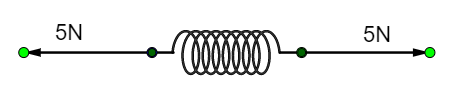
The tension in the spring is
A) Zero
B) 2.5N
C) 5N
D) 10N
Answer
 Verified
617.1k+ views
Hint: Here we need to understand that net force is the vector sum of all the forces acting on an object. When an object is in equilibrium (either at rest or moving at a constant velocity), the net force acting on it is zero.
Complete step by step solution:
In the above figure system is in equilibrium so equal force will be drawn in opposite directions.
Total tension will be due to both the applied forces,
$\Rightarrow $ The tension in spring $= 5N + 5N$
$=10N$
Therefore, the tension in the spring is 10N. So, option (D) is correct.
Additional Information:
All springs are constructed to have an initial stress, the force that holds the coil together in a defined position. As a measure, the initial stress is the load or force to overcome the internal force to initiate coil separation. The calculation of the spring stress, and its significance, will help determine how effectively the spring will function in a particular application. Measuring how much potential energy is stored in a spring and the force required to deform it must be calculated.
Springs are notable devices, and they are one of the oldest and simplest applications used for the storage and supply of mechanical energy. When a spring is deformed, that is, stretched or pulled, its elastic potential energy (PE), released from its independent state, is released into the spring. Once that potential energy is released, a spring is designed to return to its original shape after being compressed, stretched, or twisted.
Note:
A pull or push absorbs or releases energy to create a resistance to force. We know, according to Hooke's law, that when a spring is stretched or the force required to do so is compressed, it will vary in a linear way in proportion to its displacement. Hooke observed that the force of compressing or extending a spring to a specified distance is proportional to that distance.
Complete step by step solution:
In the above figure system is in equilibrium so equal force will be drawn in opposite directions.
Total tension will be due to both the applied forces,
$\Rightarrow $ The tension in spring $= 5N + 5N$
$=10N$
Therefore, the tension in the spring is 10N. So, option (D) is correct.
Additional Information:
All springs are constructed to have an initial stress, the force that holds the coil together in a defined position. As a measure, the initial stress is the load or force to overcome the internal force to initiate coil separation. The calculation of the spring stress, and its significance, will help determine how effectively the spring will function in a particular application. Measuring how much potential energy is stored in a spring and the force required to deform it must be calculated.
Springs are notable devices, and they are one of the oldest and simplest applications used for the storage and supply of mechanical energy. When a spring is deformed, that is, stretched or pulled, its elastic potential energy (PE), released from its independent state, is released into the spring. Once that potential energy is released, a spring is designed to return to its original shape after being compressed, stretched, or twisted.
Note:
A pull or push absorbs or releases energy to create a resistance to force. We know, according to Hooke's law, that when a spring is stretched or the force required to do so is compressed, it will vary in a linear way in proportion to its displacement. Hooke observed that the force of compressing or extending a spring to a specified distance is proportional to that distance.
Recently Updated Pages
Basicity of sulphurous acid and sulphuric acid are

Master Class 11 English: Engaging Questions & Answers for Success
Master Class 11 Physics: Engaging Questions & Answers for Success
Master Class 11 Computer Science: Engaging Questions & Answers for Success
Master Class 11 Chemistry: Engaging Questions & Answers for Success
Master Class 11 Social Science: Engaging Questions & Answers for Success
Trending doubts
Difference Between Prokaryotic Cells and Eukaryotic Cells
Two of the body parts which do not appear in MRI are class 11 biology CBSE
One Metric ton is equal to kg A 10000 B 1000 C 100 class 11 physics CBSE
10 examples of friction in our daily life
Draw a diagram of nephron and explain its structur class 11 biology CBSE
What will happen if the mucus is not secreted by the class 11 biology CBSE