




The tension at which a fishing line snaps is commonly called the line’s “strength.” What minimum strength is needed for a line that is to stop a salmon of weight $85\,N$ in $11\,cm$ if the fish is initially drifting at $2.8\,m/s$? Assume a constant deceleration.
Answer
 Verified
552.9k+ views
Hint: This question is answered by the concept of Newton's second law of motion and the equations of motion. The second law states that the rate of change of momentum of a body over time is directly proportional to the force applied, and occurs in the same direction as the applied force. That is $F = ma$ where $a{\text{ }}\propto {\text{ F}}$ and $a{\text{ }}\propto {\text{ }}\dfrac{1}{m}$.
Complete step by step answer:
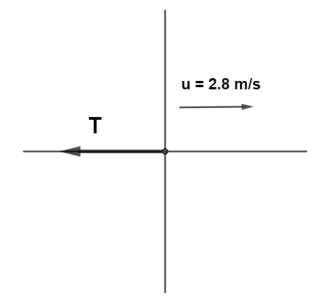
It is given that the weight of the salmon fish is $w = 85N$ . Initial velocity of the salmon $u = 2.8{\text{ m/s}}$. Final velocity of the salmon $v = 0{\text{ m/s}}$. Let a be the acceleration of the salmon The line that stops the fish in a distance $d = 11{\text{ cm = }}0.11{\text{ m}}$ . T is the tension in the line.
By using the equations of motion,
${v^2} = {u^2} + 2as$
Here s is rewritten as d. where d is the distance
${v^2} = {u^2} + 2ad$
Substituting the values we get,
$0 = {2.8^2} + 2 \times a \times 0.11$
From above equation find the value of a,
$a = {\text{ }}\dfrac{{ - {{(2.8)}^2}}}{{2 \times 0.11}}$
Further simplifying we get,
$a = - 35.6{\text{ m/}}{{\text{s}}^2}$
Here the negative sign shows that the salmon is decelerating,
From the newton’s second law we have,
$F = ma$
Rewriting force as tension
$T = ma$
Therefore, the tension in the line to stop the fish
$T = ma$
$\Rightarrow T = \dfrac{w}{g}a$..............(Because $w = mg$ therefore, $m = \dfrac{w}{g}$)
Substituting the values, we get
$T = \dfrac{{85}}{{9.8}} \times ( - 35.6)$
$\Rightarrow T = - 309N$
By taking the magnitude we get,
$\therefore T = 309{\text{ N}}$
Additional information:
Newton's first law:The first law states that an object at rest will stay at rest, and an object in motion will stay in motion unless acted on by a net external force.
Newton's second law:The second law states that the rate of change of momentum of a body over time is directly proportional to the force applied, and occurs in the same direction as the applied force.
Newton's third law:The third law states that all forces between two objects exist in equal magnitude and opposite direction. That is for every action, there is an equal and opposite reaction.
Note: We have written the force here as tension because the forces are given different names based on the types of objects in contact. Here the fishing line is a string or a rope so the force exerted by these objects is known as force tension.
Complete step by step answer:
It is given that the weight of the salmon fish is $w = 85N$ . Initial velocity of the salmon $u = 2.8{\text{ m/s}}$. Final velocity of the salmon $v = 0{\text{ m/s}}$. Let a be the acceleration of the salmon The line that stops the fish in a distance $d = 11{\text{ cm = }}0.11{\text{ m}}$ . T is the tension in the line.
By using the equations of motion,
${v^2} = {u^2} + 2as$
Here s is rewritten as d. where d is the distance
${v^2} = {u^2} + 2ad$
Substituting the values we get,
$0 = {2.8^2} + 2 \times a \times 0.11$
From above equation find the value of a,
$a = {\text{ }}\dfrac{{ - {{(2.8)}^2}}}{{2 \times 0.11}}$
Further simplifying we get,
$a = - 35.6{\text{ m/}}{{\text{s}}^2}$
Here the negative sign shows that the salmon is decelerating,
From the newton’s second law we have,
$F = ma$
Rewriting force as tension
$T = ma$
Therefore, the tension in the line to stop the fish
$T = ma$
$\Rightarrow T = \dfrac{w}{g}a$..............(Because $w = mg$ therefore, $m = \dfrac{w}{g}$)
Substituting the values, we get
$T = \dfrac{{85}}{{9.8}} \times ( - 35.6)$
$\Rightarrow T = - 309N$
By taking the magnitude we get,
$\therefore T = 309{\text{ N}}$
Additional information:
Newton's first law:The first law states that an object at rest will stay at rest, and an object in motion will stay in motion unless acted on by a net external force.
Newton's second law:The second law states that the rate of change of momentum of a body over time is directly proportional to the force applied, and occurs in the same direction as the applied force.
Newton's third law:The third law states that all forces between two objects exist in equal magnitude and opposite direction. That is for every action, there is an equal and opposite reaction.
Note: We have written the force here as tension because the forces are given different names based on the types of objects in contact. Here the fishing line is a string or a rope so the force exerted by these objects is known as force tension.
Recently Updated Pages
Which will be the least stable resonating structure class 11 chemistry CBSE

How many 5 digit telephone numbers can be construc-class-11-maths-CBSE
How do you find the angle of the resultant vector class 11 physics CBSE
Draw labelled diagram of the following i Gram seed class 11 biology CBSE
1 Quintal is equal to a 110 kg b 10 kg c 100kg d 1000 class 11 physics CBSE
What is the need and importance of classification class 11 biology CBSE
Trending doubts
One Metric ton is equal to kg A 10000 B 1000 C 100 class 11 physics CBSE
Find the value of the expression given below sin 30circ class 11 maths CBSE
Draw a diagram of nephron and explain its structur class 11 biology CBSE
10 examples of friction in our daily life
Proton was discovered by A Thomson B Rutherford C Chadwick class 11 chemistry CBSE
The teeth used for biting and cutting food are called class 11 biology CBSE