




The sum of pairs of opposite angles of a cyclic quadrilateral is:
(A) \[360{}^\circ \]
(B) \[90{}^\circ \]
(C) \[180{}^\circ \]
(D) \[60{}^\circ \]
Answer
 Verified
576k+ views
Hint: Assume a cyclic quadrilateral ABCD that has AC and BD as its diagonals intersecting at point O. We know the property that the angles in the same segment are always equal. Use this property for the chord AB, BC, CD, and AD. We also know the property that the sum of all angles of a quadrilateral is \[360{}^\circ \]. Using this property, we can say that \[\Rightarrow \angle DAC+\angle DBC+\angle CDB+\angle CAB+\angle ADB+\angle ACB+\angle ABD+\angle ACD=360{}^\circ \] . Now, simplify it using \[\angle DAC=\angle DBC\] , \[\angle CDB=\angle CAB\] , \[\angle ADB=\angle ACB\] , and \[\angle ABD=\angle ACD\] . Solve it further and get the sum of pairs of opposite angles of cyclic quadrilateral ABCD.
Complete step-by-step solution:
According to the question, we are asked to find the sum of pairs of opposite angles of a cyclic quadrilateral.
We know that the cyclic quadrilateral is the quadrilateral whose all four corners lie on the circumference of a circle.
Let us assume a cyclic quadrilateral ABCD that has AC and BD as its diagonals intersecting at point O.
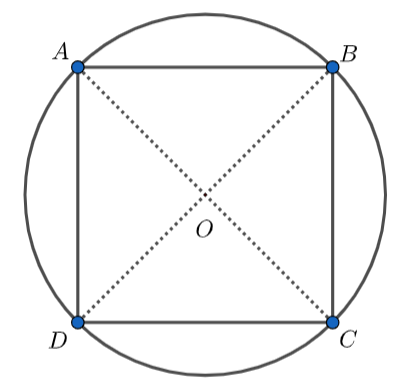
We know the property that the angles in the same segment are always equal ……………………………..(1)
From the above diagram, for chord CD, we can say that
\[\angle DAC=\angle DBC\] (using the property shown in equation (1)) …………………………….….(2)
Similarly, for chord BC, we can say that
\[\angle CDB=\angle CAB\] (using the property shown in equation (1)) …………………………….….(3)
Similarly, for chord AB, we can say that
\[\angle ADB=\angle ACB\] (using the property shown in equation (1)) …………………………….….(4)
Similarly, for chord AD, we can say that
\[\angle ABD=\angle ACD\] (using the property shown in equation (1)) …………………………….….(5)
We also know the property that the sum of all angles of a quadrilateral is \[360{}^\circ \] …………………………………(6)
Now, on using this property for the quadrilateral ABCD, we get
\[\Rightarrow \angle DAC+\angle DBC+\angle CDB+\angle CAB+\angle ADB+\angle ACB+\angle ABD+\angle ACD=360{}^\circ \] ……………………………………….(7)
From equation (2), equation (3), equation (4), equation (5), and equation (7), we get
\[\begin{align}
& \Rightarrow \angle DAC+\angle DBC+\angle CDB+\angle CAB+\angle ADB+\angle ACB+\angle ABD+\angle ACD=360{}^\circ \\
& \Rightarrow \angle DAC+\angle DAC+\angle CAB+\angle CAB+\angle ACB+\angle ACB+\angle ACD+\angle ACD=360{}^\circ \\
& \Rightarrow 2\left( \angle DAC+\angle CAB+\angle ACB+\angle ACD \right)=360{}^\circ \\
\end{align}\]
\[\Rightarrow \angle DAC+\angle CAB+\angle ACB+\angle ACD=180{}^\circ \] ……………………………………………(8)
From the above figure, we can see that
\[\angle DAB=\angle DAC+\angle CAB\] …………………………………………..(9)
\[\angle BCD=\angle ACB+\angle ACD\] …………………………………………….(10)
Now, from equation (8), equation (9), and equation (10), we get
\[\Rightarrow \angle DAB+\angle BCD=180{}^\circ \] …………………………………………….(11)
Also, from the above figure, we can see that \[\angle DAB\] and \[\angle BCD\] are opposite angles ……………………………(12)
From equation (11) and equation (12), we can say that the sum of the opposite angles is equal to \[180{}^\circ \].
Therefore, the correct option is (C).
Note: To solve this type of question quickly, whenever the name of the cyclic quadrilateral appears, always remember the property that the sum of the opposite angles of a cyclic quadrilateral is \[180{}^\circ \]. There is a possibility of misunderstanding the question and marking \[360{}^\circ \] as the correct answer. We have been asked for the sum of opposite angles, not all angles.
Complete step-by-step solution:
According to the question, we are asked to find the sum of pairs of opposite angles of a cyclic quadrilateral.
We know that the cyclic quadrilateral is the quadrilateral whose all four corners lie on the circumference of a circle.
Let us assume a cyclic quadrilateral ABCD that has AC and BD as its diagonals intersecting at point O.
We know the property that the angles in the same segment are always equal ……………………………..(1)
From the above diagram, for chord CD, we can say that
\[\angle DAC=\angle DBC\] (using the property shown in equation (1)) …………………………….….(2)
Similarly, for chord BC, we can say that
\[\angle CDB=\angle CAB\] (using the property shown in equation (1)) …………………………….….(3)
Similarly, for chord AB, we can say that
\[\angle ADB=\angle ACB\] (using the property shown in equation (1)) …………………………….….(4)
Similarly, for chord AD, we can say that
\[\angle ABD=\angle ACD\] (using the property shown in equation (1)) …………………………….….(5)
We also know the property that the sum of all angles of a quadrilateral is \[360{}^\circ \] …………………………………(6)
Now, on using this property for the quadrilateral ABCD, we get
\[\Rightarrow \angle DAC+\angle DBC+\angle CDB+\angle CAB+\angle ADB+\angle ACB+\angle ABD+\angle ACD=360{}^\circ \] ……………………………………….(7)
From equation (2), equation (3), equation (4), equation (5), and equation (7), we get
\[\begin{align}
& \Rightarrow \angle DAC+\angle DBC+\angle CDB+\angle CAB+\angle ADB+\angle ACB+\angle ABD+\angle ACD=360{}^\circ \\
& \Rightarrow \angle DAC+\angle DAC+\angle CAB+\angle CAB+\angle ACB+\angle ACB+\angle ACD+\angle ACD=360{}^\circ \\
& \Rightarrow 2\left( \angle DAC+\angle CAB+\angle ACB+\angle ACD \right)=360{}^\circ \\
\end{align}\]
\[\Rightarrow \angle DAC+\angle CAB+\angle ACB+\angle ACD=180{}^\circ \] ……………………………………………(8)
From the above figure, we can see that
\[\angle DAB=\angle DAC+\angle CAB\] …………………………………………..(9)
\[\angle BCD=\angle ACB+\angle ACD\] …………………………………………….(10)
Now, from equation (8), equation (9), and equation (10), we get
\[\Rightarrow \angle DAB+\angle BCD=180{}^\circ \] …………………………………………….(11)
Also, from the above figure, we can see that \[\angle DAB\] and \[\angle BCD\] are opposite angles ……………………………(12)
From equation (11) and equation (12), we can say that the sum of the opposite angles is equal to \[180{}^\circ \].
Therefore, the correct option is (C).
Note: To solve this type of question quickly, whenever the name of the cyclic quadrilateral appears, always remember the property that the sum of the opposite angles of a cyclic quadrilateral is \[180{}^\circ \]. There is a possibility of misunderstanding the question and marking \[360{}^\circ \] as the correct answer. We have been asked for the sum of opposite angles, not all angles.
Recently Updated Pages
Master Class 10 Computer Science: Engaging Questions & Answers for Success

Master Class 10 General Knowledge: Engaging Questions & Answers for Success
Master Class 10 English: Engaging Questions & Answers for Success
Master Class 10 Social Science: Engaging Questions & Answers for Success
Master Class 10 Maths: Engaging Questions & Answers for Success
Master Class 10 Science: Engaging Questions & Answers for Success
Trending doubts
What is the median of the first 10 natural numbers class 10 maths CBSE
Which women's tennis player has 24 Grand Slam singles titles?
Who is the Brand Ambassador of Incredible India?
Why is there a time difference of about 5 hours between class 10 social science CBSE
Write a letter to the principal requesting him to grant class 10 english CBSE
A moving boat is observed from the top of a 150 m high class 10 maths CBSE