




The sum of focal distances of any point on the ellipse $9{{x}^{2}}+16{{y}^{2}}=144$ is
A.32
B.18
C.16
D.8
Answer
 Verified
629.7k+ views
Hint: Start by converting the equation of the ellipse given in the question to its standard form and using the property that foci of the ellipse represented by $\dfrac{{{x}^{2}}}{{{a}^{2}}}+\dfrac{{{y}^{2}}}{{{b}^{2}}}=1$ are (ae,0) and (-ae,0). Now you just have to use the property of the ellipse that the sum of the distance of any point lying on the ellipse from its two foci is equal to twice the length of the semi-major axis.
Complete step-by-step answer:
Starting by drawing a rough diagram:
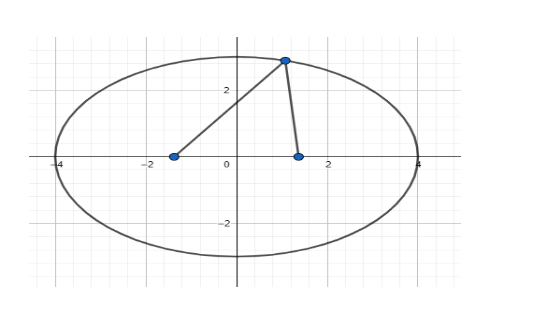
Now let us convert the equation given in the question, to the standard form of ellipse, i.e., to the form $\dfrac{{{x}^{2}}}{{{a}^{2}}}+\dfrac{{{y}^{2}}}{{{b}^{2}}}=1$ , where a and b are the length of the semi-major and semi-minor axis of the ellipse.
\[9{{x}^{2}}+16{{y}^{2}}=144\]
\[\Rightarrow \dfrac{9{{x}^{2}}}{144}+\dfrac{16{{y}^{2}}}{144}=1\]
\[\Rightarrow \dfrac{{{x}^{2}}}{16}+\dfrac{{{y}^{2}}}{9}=1\]
Now, we know that the square root of 16 and 9 are 4 and 3, respectively. Also, as a>b, i.e., 4>3, we can say that the length of the semi-major axis is equal to a, i.e., 4.
Now, we know that the sum of the distance of any point lying on the ellipse from its two foci is equal to twice the length of the semi-major axis. S, the answer to the above question is $2a=2\times 4=8$ .
Therefore, the answer to the above question is option (d).
Note: In such questions, the key is to convert the equation given to the standard form and identify the length of the semi-major axis. Also, you must know the required formulas related to the figure and the different forms in which you can represent different geometrical shapes, specially related to conics. There is a great possibility that students forget to take the square root of 16 and 9 and take the value of a = 16 instead of 4. This affects the final answer and students might choose option (a).
Complete step-by-step answer:
Starting by drawing a rough diagram:
Now let us convert the equation given in the question, to the standard form of ellipse, i.e., to the form $\dfrac{{{x}^{2}}}{{{a}^{2}}}+\dfrac{{{y}^{2}}}{{{b}^{2}}}=1$ , where a and b are the length of the semi-major and semi-minor axis of the ellipse.
\[9{{x}^{2}}+16{{y}^{2}}=144\]
\[\Rightarrow \dfrac{9{{x}^{2}}}{144}+\dfrac{16{{y}^{2}}}{144}=1\]
\[\Rightarrow \dfrac{{{x}^{2}}}{16}+\dfrac{{{y}^{2}}}{9}=1\]
Now, we know that the square root of 16 and 9 are 4 and 3, respectively. Also, as a>b, i.e., 4>3, we can say that the length of the semi-major axis is equal to a, i.e., 4.
Now, we know that the sum of the distance of any point lying on the ellipse from its two foci is equal to twice the length of the semi-major axis. S, the answer to the above question is $2a=2\times 4=8$ .
Therefore, the answer to the above question is option (d).
Note: In such questions, the key is to convert the equation given to the standard form and identify the length of the semi-major axis. Also, you must know the required formulas related to the figure and the different forms in which you can represent different geometrical shapes, specially related to conics. There is a great possibility that students forget to take the square root of 16 and 9 and take the value of a = 16 instead of 4. This affects the final answer and students might choose option (a).
Recently Updated Pages
Master Class 12 Business Studies: Engaging Questions & Answers for Success

Master Class 12 Biology: Engaging Questions & Answers for Success
Master Class 12 Chemistry: Engaging Questions & Answers for Success
Class 12 Question and Answer - Your Ultimate Solutions Guide
Master Class 11 Social Science: Engaging Questions & Answers for Success
Master Class 11 English: Engaging Questions & Answers for Success
Trending doubts
Which is more stable and why class 12 chemistry CBSE
Which are the Top 10 Largest Countries of the World?
Draw a labelled sketch of the human eye class 12 physics CBSE
Differentiate between homogeneous and heterogeneous class 12 chemistry CBSE
What are the major means of transport Explain each class 12 social science CBSE
Sulphuric acid is known as the king of acids State class 12 chemistry CBSE