




The sum of all exterior angles of a triangle is
A.\[{{360}^{0}}\]
B.\[{{180}^{0}}\]
C.\[{{540}^{0}}\]
D.None of these
Answer
 Verified
612.6k+ views
Hint: Assume a \[\Delta ABC\] in which \[\angle A=\alpha \] , \[\angle B=\beta \] , and \[\angle C=\gamma \] . We know the property that the measure of an exterior angle of a triangle is equal to the sum of the opposite interior angles. Now, using the property we can say that the exterior angle \[\angle ACP\] is equal to the summation of the angles \[\alpha \] and \[\beta \] , \[\angle BAQ\] is equal to the summation of the angles \[\gamma \] and \[\beta \] , and \[\angle CBR\] is equal to the summation of the angles \[\alpha \] and \[\gamma \] .
Complete step-by-step answer:
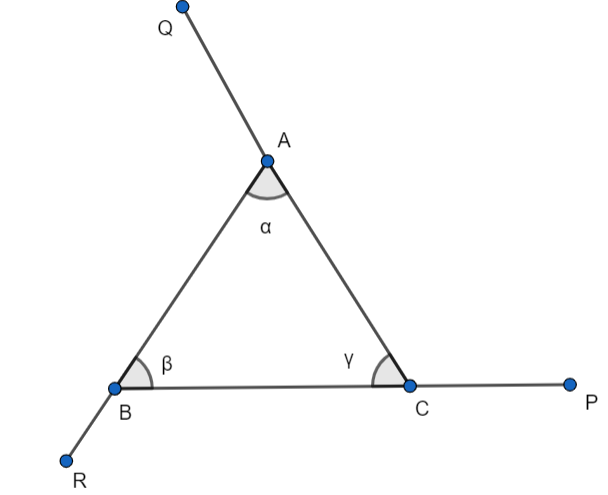
Assume a \[\Delta ABC\] in which \[\angle A=\alpha \] , \[\angle B=\beta \] , and \[\angle C=\gamma \] .
For the angles \[\alpha \] and \[\beta \] , \[\angle ACP\] is an exterior angle.
We know the property that the measure of an exterior angle of a triangle is equal to the sum of the opposite interior angles.
Now, using the property we can say that the exterior angle \[\angle ACP\] is equal to the summation of the angles \[\alpha \] and \[\beta \] .
\[\angle ACP=~\alpha +\beta \] …………………(1)
For the angles \[\gamma \] and \[\beta \] , \[\angle BAQ\] is an exterior angle.
We know the property that the measure of an exterior angle of a triangle is equal to the sum of the opposite interior angles.
Now, using the property we can say that the exterior angle \[\angle BAQ\] is equal to the summation of the angles \[\gamma \] and \[\beta \] .
\[\angle BAQ=~\gamma +\beta \] …………………(2)
For the angles \[\alpha \] and \[\gamma \] , \[\angle CBR\] is an exterior angle.
We know the property that the measure of an exterior angle of a triangle is equal to the sum of the opposite interior angles.
Now, using the property we can say that the exterior angle \[\angle CBR\] is equal to the summation of the angles \[\alpha \] and \[\gamma \] .
\[\angle CBR=~\alpha +\gamma \] …………………(3)
For the \[\Delta ABC\] exterior angles are \[\angle CBR\] , \[\angle BAQ\] , and \[\angle ACP\] .
Now, the sum of all exterior angles,
\[~\angle ACP+\angle BAQ+\angle CBR\] ………………………(4)
From equation (1), equation (2), equation (3), and equation (4), we get
\[\begin{align}
& ~\angle ACP+\angle BAQ+\angle CBR \\
& =~\alpha +\beta +~\gamma +\beta +~\alpha +\gamma \\
\end{align}\]
\[=2(\alpha +\beta +\gamma )\] ………………(5)
We know that the sum of all interior angles of a triangle is \[{{180}^{0}}\] .
That is,
\[(\alpha +\beta +\gamma )={{180}^{0}}\] …………………..(6)
From equation (5) and equation (6), we get
\[\begin{align}
& =2(\alpha +\beta +\gamma ) \\
& =2\times {{180}^{0}} \\
& ={{360}^{0}} \\
\end{align}\]
So, the sum of all exterior angles of a triangle is \[{{360}^{0}}\] .
Hence, the correct option is A.
Note: We can also solve this question by using linear pair angles.
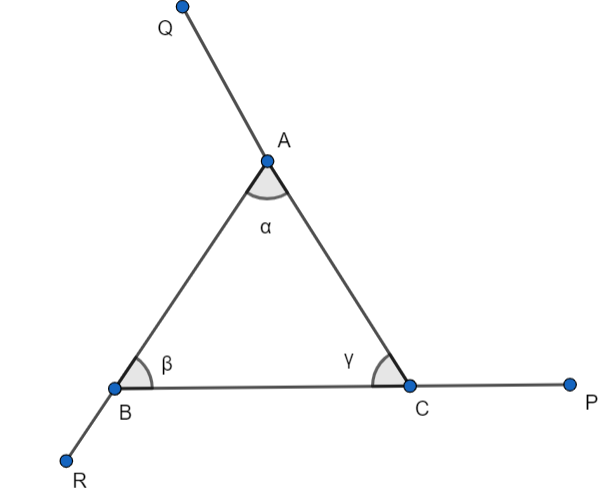
Assume a \[\Delta ABC\] in which \[\angle A=\alpha \] , \[\angle B=\beta \] , and \[\angle C=\gamma \] .
Here, \[\angle ACB\] and \[\angle ACP\] are linear pair angles.
So, \[\angle ACB+\angle ACP={{180}^{0}}\]
\[\angle ACP=~{{180}^{0}}-\gamma \] ……………(1)
Here, \[\angle BAQ\] and \[\angle BAC\] are also linear pair angles.
So, \[\angle BAQ+\angle BAC={{180}^{0}}\]
\[\angle BAQ=~{{180}^{0}}-\alpha \] ……………(2)
Here, \[\angle CBR\]and \[\angle CBA\] are linear pair angles.
So, \[\angle CBR+\angle CBA={{180}^{0}}\]
\[\angle CBR=~{{180}^{0}}-\beta \] ……………(3)
From equation (1), equation (2), and equation (3),
\[\begin{align}
& ~\angle ACP+\angle BAQ+\angle CBR \\
& =~~{{180}^{0}}-\gamma +{{180}^{0}}-\alpha +{{180}^{0}}-\beta \\
\end{align}\]
\[={{540}^{0}}-(\alpha +\beta +\gamma )\] ………………….(4)
We know that the sum of all interior angles of a triangle is \[{{180}^{0}}\] .
That is,
\[(\alpha +\beta +\gamma )={{180}^{0}}\] ………………….(5)
From equation (4) and equation (5),
\[\begin{align}
& ={{540}^{0}}-(\alpha +\beta +\gamma ) \\
& ={{540}^{0}}-{{180}^{0}} \\
& ={{360}^{0}} \\
\end{align}\]
So, the sum of all exterior angles of a triangle is \[{{360}^{0}}\] .
Complete step-by-step answer:
Assume a \[\Delta ABC\] in which \[\angle A=\alpha \] , \[\angle B=\beta \] , and \[\angle C=\gamma \] .
For the angles \[\alpha \] and \[\beta \] , \[\angle ACP\] is an exterior angle.
We know the property that the measure of an exterior angle of a triangle is equal to the sum of the opposite interior angles.
Now, using the property we can say that the exterior angle \[\angle ACP\] is equal to the summation of the angles \[\alpha \] and \[\beta \] .
\[\angle ACP=~\alpha +\beta \] …………………(1)
For the angles \[\gamma \] and \[\beta \] , \[\angle BAQ\] is an exterior angle.
We know the property that the measure of an exterior angle of a triangle is equal to the sum of the opposite interior angles.
Now, using the property we can say that the exterior angle \[\angle BAQ\] is equal to the summation of the angles \[\gamma \] and \[\beta \] .
\[\angle BAQ=~\gamma +\beta \] …………………(2)
For the angles \[\alpha \] and \[\gamma \] , \[\angle CBR\] is an exterior angle.
We know the property that the measure of an exterior angle of a triangle is equal to the sum of the opposite interior angles.
Now, using the property we can say that the exterior angle \[\angle CBR\] is equal to the summation of the angles \[\alpha \] and \[\gamma \] .
\[\angle CBR=~\alpha +\gamma \] …………………(3)
For the \[\Delta ABC\] exterior angles are \[\angle CBR\] , \[\angle BAQ\] , and \[\angle ACP\] .
Now, the sum of all exterior angles,
\[~\angle ACP+\angle BAQ+\angle CBR\] ………………………(4)
From equation (1), equation (2), equation (3), and equation (4), we get
\[\begin{align}
& ~\angle ACP+\angle BAQ+\angle CBR \\
& =~\alpha +\beta +~\gamma +\beta +~\alpha +\gamma \\
\end{align}\]
\[=2(\alpha +\beta +\gamma )\] ………………(5)
We know that the sum of all interior angles of a triangle is \[{{180}^{0}}\] .
That is,
\[(\alpha +\beta +\gamma )={{180}^{0}}\] …………………..(6)
From equation (5) and equation (6), we get
\[\begin{align}
& =2(\alpha +\beta +\gamma ) \\
& =2\times {{180}^{0}} \\
& ={{360}^{0}} \\
\end{align}\]
So, the sum of all exterior angles of a triangle is \[{{360}^{0}}\] .
Hence, the correct option is A.
Note: We can also solve this question by using linear pair angles.
Assume a \[\Delta ABC\] in which \[\angle A=\alpha \] , \[\angle B=\beta \] , and \[\angle C=\gamma \] .
Here, \[\angle ACB\] and \[\angle ACP\] are linear pair angles.
So, \[\angle ACB+\angle ACP={{180}^{0}}\]
\[\angle ACP=~{{180}^{0}}-\gamma \] ……………(1)
Here, \[\angle BAQ\] and \[\angle BAC\] are also linear pair angles.
So, \[\angle BAQ+\angle BAC={{180}^{0}}\]
\[\angle BAQ=~{{180}^{0}}-\alpha \] ……………(2)
Here, \[\angle CBR\]and \[\angle CBA\] are linear pair angles.
So, \[\angle CBR+\angle CBA={{180}^{0}}\]
\[\angle CBR=~{{180}^{0}}-\beta \] ……………(3)
From equation (1), equation (2), and equation (3),
\[\begin{align}
& ~\angle ACP+\angle BAQ+\angle CBR \\
& =~~{{180}^{0}}-\gamma +{{180}^{0}}-\alpha +{{180}^{0}}-\beta \\
\end{align}\]
\[={{540}^{0}}-(\alpha +\beta +\gamma )\] ………………….(4)
We know that the sum of all interior angles of a triangle is \[{{180}^{0}}\] .
That is,
\[(\alpha +\beta +\gamma )={{180}^{0}}\] ………………….(5)
From equation (4) and equation (5),
\[\begin{align}
& ={{540}^{0}}-(\alpha +\beta +\gamma ) \\
& ={{540}^{0}}-{{180}^{0}} \\
& ={{360}^{0}} \\
\end{align}\]
So, the sum of all exterior angles of a triangle is \[{{360}^{0}}\] .
Recently Updated Pages
Basicity of sulphurous acid and sulphuric acid are

Master Class 10 English: Engaging Questions & Answers for Success
Master Class 10 Social Science: Engaging Questions & Answers for Success
Master Class 10 Computer Science: Engaging Questions & Answers for Success
Class 10 Question and Answer - Your Ultimate Solutions Guide
Master Class 10 General Knowledge: Engaging Questions & Answers for Success
Trending doubts
Who is known as the "Little Master" in Indian cricket history?
A boat goes 24 km upstream and 28 km downstream in class 10 maths CBSE
State and explain Ohms law class 10 physics CBSE
Distinguish between soap and detergent class 10 chemistry CBSE
a Why did Mendel choose pea plants for his experiments class 10 biology CBSE
Draw the diagram of the sectional view of the human class 10 biology CBSE