




The structure of potassium ferrocyanide is:
A.Tetrahedral
B.Octahedral
C.Square planar
D.Linear
Answer
 Verified
612k+ views
Hint:
Solve this question by breaking up the name of the compound. The given compound is a salt made up of potassium and ferrocyanide ions. Potassium is the cation, whereas cyanide is an anion.
Complete step by step answer:
Potassium ferrocyanide is an inorganic compound with the molecular formula – \[{{K}_{4}}[Fe{{(CN)}_{6}}]\]. It occurs as a lemon-yellow monoclinic crystal and is therefore also known as yellow potash prussiate.
It is a coordination compound. From the name, we can decipher that the compound is made of a cation (potassium) and cation (ferrocyanide). Now, let us break the term ferrocyanide –
‘ferro’ stands for ferrous, i.e., the element iron with an oxidation state of +2.
‘cyanide’ stands for a compound made up of C and N which is triple bonded to each other. The structure of cyanide is as given below –

Cyanide has an overall charge = -1.
Therefore, the overall charge of ferrocyanide = (+2) + 6(-1) = -4.
From here, we can see, 4 potassium ions are needed to balance these.
The structure of potassium ferrocyanide can be drawn as –
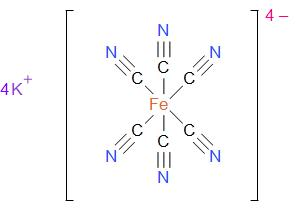
The geometry of the compound is dependent on ferrocyanide. A coordination compound with six ligands is always octahedral. It is known as the octahedral because it has eight faces.
Therefore, the answer is – option (b) – The structure of potassium ferrocyanide is octahedral.
Additional Information:
The IUPAC name of this compound is potassium hexacyanoferrate (II).
Note:
Do not confuse potassium ferrocyanide with potassium ferricyanide. In potassium ferricyanide, the iron atom has an oxidation state of +3. Iron is a d-block element with atomic number 26. It has two oxidation states - +2 (ferrous) and +3 (ferric).
Solve this question by breaking up the name of the compound. The given compound is a salt made up of potassium and ferrocyanide ions. Potassium is the cation, whereas cyanide is an anion.
Complete step by step answer:
Potassium ferrocyanide is an inorganic compound with the molecular formula – \[{{K}_{4}}[Fe{{(CN)}_{6}}]\]. It occurs as a lemon-yellow monoclinic crystal and is therefore also known as yellow potash prussiate.
It is a coordination compound. From the name, we can decipher that the compound is made of a cation (potassium) and cation (ferrocyanide). Now, let us break the term ferrocyanide –
‘ferro’ stands for ferrous, i.e., the element iron with an oxidation state of +2.
‘cyanide’ stands for a compound made up of C and N which is triple bonded to each other. The structure of cyanide is as given below –
Cyanide has an overall charge = -1.
Therefore, the overall charge of ferrocyanide = (+2) + 6(-1) = -4.
From here, we can see, 4 potassium ions are needed to balance these.
The structure of potassium ferrocyanide can be drawn as –
The geometry of the compound is dependent on ferrocyanide. A coordination compound with six ligands is always octahedral. It is known as the octahedral because it has eight faces.
Therefore, the answer is – option (b) – The structure of potassium ferrocyanide is octahedral.
Additional Information:
The IUPAC name of this compound is potassium hexacyanoferrate (II).
Note:
Do not confuse potassium ferrocyanide with potassium ferricyanide. In potassium ferricyanide, the iron atom has an oxidation state of +3. Iron is a d-block element with atomic number 26. It has two oxidation states - +2 (ferrous) and +3 (ferric).
Recently Updated Pages
Basicity of sulphurous acid and sulphuric acid are

Master Class 11 Business Studies: Engaging Questions & Answers for Success
Master Class 11 Computer Science: Engaging Questions & Answers for Success
Master Class 11 Economics: Engaging Questions & Answers for Success
Master Class 11 Social Science: Engaging Questions & Answers for Success
Master Class 11 English: Engaging Questions & Answers for Success
Trending doubts
One Metric ton is equal to kg A 10000 B 1000 C 100 class 11 physics CBSE
The largest wind power cluster is located in the state class 11 social science CBSE
Explain zero factorial class 11 maths CBSE
State and prove Bernoullis theorem class 11 physics CBSE
Which among the following are examples of coming together class 11 social science CBSE
Can anyone list 10 advantages and disadvantages of friction