




The structure of di-chloromethane is
a.Tetrahedral
b.Trigonal
c.Linear
d.Hexagonal
Answer
 Verified
552.9k+ views
Hint: We know that dichloromethane is an organochlorine compound with the formula $C{H_2}C{l_2}$. It is a colourless, volatile liquid with chloroform- like sweet odour is widely used as a solvent. We know that it is non-combustible but if exposed to high temperatures it may produce toxic chloride fumes.
Complete step by step answer:
We should know that the other name of di-chloromethane is Methylene chloride or Methylene dichloride.
The structure of dichloromethane is tetrahedral as it is $s{p^3}$ hybridized.
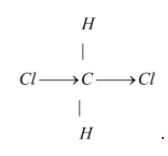
So it has a tetrahedral structure.
Hence the correct option is (a) tetrahedral.
Note:
We should know that even though $C{H_2}C{l_{12}}$ is not miscible in water, it can be dissolved in a wide range of organic solvents. This property of dichloromethane is combined with its volatility, making DCM a highly effective solvent in most industrial processes. It is also commonly used as a paint remover.
Complete step by step answer:
We should know that the other name of di-chloromethane is Methylene chloride or Methylene dichloride.
The structure of dichloromethane is tetrahedral as it is $s{p^3}$ hybridized.
So it has a tetrahedral structure.
Hence the correct option is (a) tetrahedral.
Note:
We should know that even though $C{H_2}C{l_{12}}$ is not miscible in water, it can be dissolved in a wide range of organic solvents. This property of dichloromethane is combined with its volatility, making DCM a highly effective solvent in most industrial processes. It is also commonly used as a paint remover.
Recently Updated Pages
Master Class 11 Social Science: Engaging Questions & Answers for Success

Master Class 11 English: Engaging Questions & Answers for Success
Master Class 11 Maths: Engaging Questions & Answers for Success
Master Class 11 Chemistry: Engaging Questions & Answers for Success
Master Class 11 Biology: Engaging Questions & Answers for Success
Master Class 11 Physics: Engaging Questions & Answers for Success
Trending doubts
One Metric ton is equal to kg A 10000 B 1000 C 100 class 11 physics CBSE
Difference Between Prokaryotic Cells and Eukaryotic Cells
Draw a diagram of a plant cell and label at least eight class 11 biology CBSE
Two of the body parts which do not appear in MRI are class 11 biology CBSE
Which gas is abundant in air class 11 chemistry CBSE
10 examples of friction in our daily life