



The structure of a loudspeaker is given,
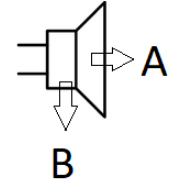
What does $A$ and $B$ represent?
Answer
 Verified
551.7k+ views
Hint:An electroacoustic transducer, or loudspeaker, is a device that transforms an electrical audio stream into sound. The dynamic speaker is the most common form of speaker. Before the signal is transmitted to the speaker, the sound source (e.g., a sound recording or a microphone) must be amplified or strengthened by an audio power amplifier.
Complete answer:
$A$ is the diaphragm of the loudspeaker. A diaphragm is a thin, semi-rigid membrane connected to the voice coil of a dynamic loudspeaker. The voice coil travels in a magnetic gap, vibrating the diaphragm and creating sound. Although not all speaker diaphragms are cone-shaped, it is also known as a cone. Headphones have diaphragms as well.
Paper, paper composites and laminates, plastic materials such as polypropylene, and mineral/fiber filled polypropylene are used to make high-quality midrange and bass drivers. These materials have extremely high strength-to-weight ratios (even higher than metals) and are resistant to bending during big excursions. This enables the driver to respond rapidly during musical changes.
$B$ is the soft iron core. A huge, multilayer field coil is coiled around the centre leg of the electrodynamic speaker, which features a soft iron magnetic circuit that is non-retentive to magnetism. The iron core is magnetised when dc runs through this field coil. Across the air gap, a magnetic flux field precisely proportional to the current through the coil is therefore created.
The iron core is only magnetised for as long as current runs through the field coil; it is not permanently magnetised. The oldest form of electric loudspeaker was the moving iron speaker. They're still employed in certain micro speakers today, where size and cost take precedence over sound quality.
Note:Bell Labs has been conducting research on digital speakers since the 1920s.The layout is straightforward: each bit controls a driver that is either totally 'on' or entirely 'off.' Due to issues with this design, manufacturers have deemed it unfeasible for the time being. For starters, when a suitable number of bits is used, the physical size of a speaker system grows significantly. Second, owing to intrinsic analog-to-digital conversion issues, aliasing is inescapable, causing the audio output to be "reflected" in the frequency domain at equal amplitude on the other side of the Nyquist limit, resulting in an unacceptably high level of ultrasonics accompanying the desired output.
Complete answer:
$A$ is the diaphragm of the loudspeaker. A diaphragm is a thin, semi-rigid membrane connected to the voice coil of a dynamic loudspeaker. The voice coil travels in a magnetic gap, vibrating the diaphragm and creating sound. Although not all speaker diaphragms are cone-shaped, it is also known as a cone. Headphones have diaphragms as well.
Paper, paper composites and laminates, plastic materials such as polypropylene, and mineral/fiber filled polypropylene are used to make high-quality midrange and bass drivers. These materials have extremely high strength-to-weight ratios (even higher than metals) and are resistant to bending during big excursions. This enables the driver to respond rapidly during musical changes.
$B$ is the soft iron core. A huge, multilayer field coil is coiled around the centre leg of the electrodynamic speaker, which features a soft iron magnetic circuit that is non-retentive to magnetism. The iron core is magnetised when dc runs through this field coil. Across the air gap, a magnetic flux field precisely proportional to the current through the coil is therefore created.
The iron core is only magnetised for as long as current runs through the field coil; it is not permanently magnetised. The oldest form of electric loudspeaker was the moving iron speaker. They're still employed in certain micro speakers today, where size and cost take precedence over sound quality.
Note:Bell Labs has been conducting research on digital speakers since the 1920s.The layout is straightforward: each bit controls a driver that is either totally 'on' or entirely 'off.' Due to issues with this design, manufacturers have deemed it unfeasible for the time being. For starters, when a suitable number of bits is used, the physical size of a speaker system grows significantly. Second, owing to intrinsic analog-to-digital conversion issues, aliasing is inescapable, causing the audio output to be "reflected" in the frequency domain at equal amplitude on the other side of the Nyquist limit, resulting in an unacceptably high level of ultrasonics accompanying the desired output.

Recently Updated Pages
Basicity of sulphurous acid and sulphuric acid are

Master Class 12 Economics: Engaging Questions & Answers for Success
Master Class 12 Biology: Engaging Questions & Answers for Success
Master Class 11 English: Engaging Questions & Answers for Success
Master Class 11 Physics: Engaging Questions & Answers for Success
Master Class 11 Computer Science: Engaging Questions & Answers for Success
Trending doubts
Difference Between Plant Cell and Animal Cell
Fill the blanks with the suitable prepositions 1 The class 9 english CBSE
What is pollution? How many types of pollution? Define it
What is the full form of pH?
What is the Full Form of ICSE, CBSE and SSC
Name 10 Living and Non living things class 9 biology CBSE