




The straight lines \[x+2y-9=0,\,\,3x=5y-5=0\,\text{and}\,ax+by+1=0\] are concurrent, if the straight line \[35x-22y+1=0\] passes through the point
A.\[(a,b)\]
B.\[(b,a)\]
C.\[(-a,-b)\]
D.None of these
Answer
 Verified
561.9k+ views
Hint: In this particular problem, it has been mentioned that the three equations are concurrent, which means two non-parallel intersect at one point. If a third line formed passed through one common point or intersecting at one common point, these straight lines are termed as concurrent lines Another way we can say that determinant \[\Delta =0\]to find the points which are passing through the equation.
Complete step-by-step answer:
In this type of problems there are three equation is given that is
\[x+2y-9=0---(1)\]
\[3x+5y-5=0---(2)\]
\[ax+by+1=0---(3)\]
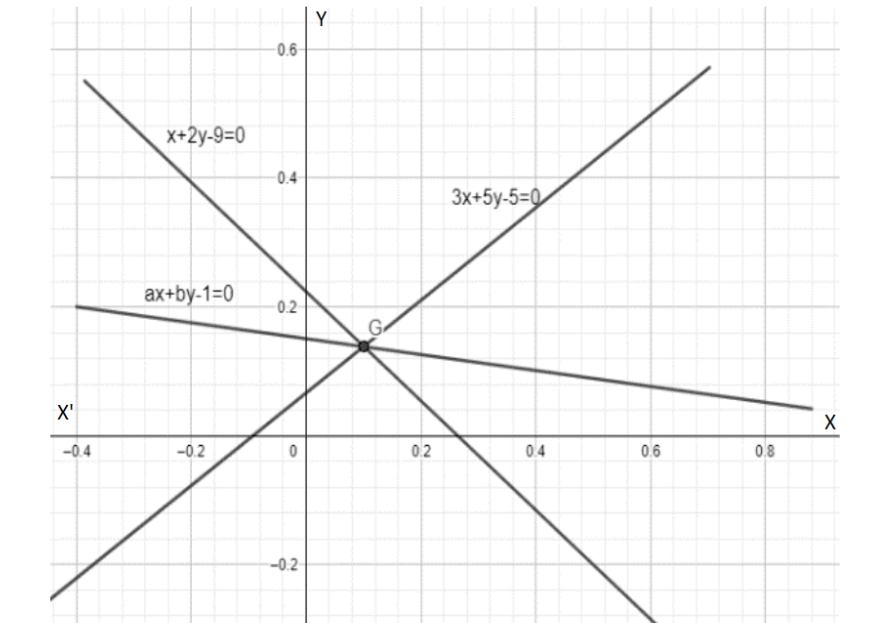
Above figures show that three lines of equation are intersecting at a common point that is called concurrent lines.
Another way we can also say that to satisfy the three equations concurrent determinants should be Zero.
It is represented as \[\Delta =\left| \begin{matrix}
{{a}_{1}} & {{b}_{1}} & {{c}_{1}} \\
{{a}_{2}} & {{b}_{2}} & {{c}_{2}} \\
{{a}_{3}} & {{b}_{3}} & {{c}_{3}} \\
\end{matrix} \right|=0\]
So, first of all there are three equation so, this three equation can be written in the form of determinant
\[\Delta =\left| \begin{matrix}
1 & 2 & -9 \\
3 & 5 & -5 \\
a & b & -1 \\
\end{matrix} \right|=0\]
By simplifying the above equation we get:
\[1(-5-(-5b))-2(-3-(-5a))+(-9)(3b-5a)=0\]
By simplifying and further solving we get:
\[1(-5+5b)-2(-3+5a)-9(3b-5a)=0\]
After expanding this above equation we get:
\[-5+5b+6-10a-27b+45a=0\]
After simplifying and further solving this above equation we get:
\[35a-22b+1=0--(1)\]
And another equation which we have is \[35x-22y+1=0--(2)\]
So comparing equation (1) and (2) we get:
We can say that the equation (2) is passed through a point that is \[(a,b)\]
So, the correct option is “option A”.
So, the correct answer is “Option A”.
Note: In this problem always remember the condition which is used in case of concurrent lines. Only we have to use the condition that the determinant should be 0. And simplifying the step and comparing with the original equation which is given you will get the points. Don’t get confused between concurrent lines and intersection lines. More than two lines that meet at common points are concurrent lines and only two points that intersect at common points are called intersection lines.
Complete step-by-step answer:
In this type of problems there are three equation is given that is
\[x+2y-9=0---(1)\]
\[3x+5y-5=0---(2)\]
\[ax+by+1=0---(3)\]
Above figures show that three lines of equation are intersecting at a common point that is called concurrent lines.
Another way we can also say that to satisfy the three equations concurrent determinants should be Zero.
It is represented as \[\Delta =\left| \begin{matrix}
{{a}_{1}} & {{b}_{1}} & {{c}_{1}} \\
{{a}_{2}} & {{b}_{2}} & {{c}_{2}} \\
{{a}_{3}} & {{b}_{3}} & {{c}_{3}} \\
\end{matrix} \right|=0\]
So, first of all there are three equation so, this three equation can be written in the form of determinant
\[\Delta =\left| \begin{matrix}
1 & 2 & -9 \\
3 & 5 & -5 \\
a & b & -1 \\
\end{matrix} \right|=0\]
By simplifying the above equation we get:
\[1(-5-(-5b))-2(-3-(-5a))+(-9)(3b-5a)=0\]
By simplifying and further solving we get:
\[1(-5+5b)-2(-3+5a)-9(3b-5a)=0\]
After expanding this above equation we get:
\[-5+5b+6-10a-27b+45a=0\]
After simplifying and further solving this above equation we get:
\[35a-22b+1=0--(1)\]
And another equation which we have is \[35x-22y+1=0--(2)\]
So comparing equation (1) and (2) we get:
We can say that the equation (2) is passed through a point that is \[(a,b)\]
So, the correct option is “option A”.
So, the correct answer is “Option A”.
Note: In this problem always remember the condition which is used in case of concurrent lines. Only we have to use the condition that the determinant should be 0. And simplifying the step and comparing with the original equation which is given you will get the points. Don’t get confused between concurrent lines and intersection lines. More than two lines that meet at common points are concurrent lines and only two points that intersect at common points are called intersection lines.
Recently Updated Pages
Which will be the least stable resonating structure class 11 chemistry CBSE

How many 5 digit telephone numbers can be construc-class-11-maths-CBSE
How do you find the angle of the resultant vector class 11 physics CBSE
Draw labelled diagram of the following i Gram seed class 11 biology CBSE
What is the need and importance of classification class 11 biology CBSE
The way in which the sparrows expressed their sorrow class 11 english CBSE
Trending doubts
One Metric ton is equal to kg A 10000 B 1000 C 100 class 11 physics CBSE
Find the value of the expression given below sin 30circ class 11 maths CBSE
1 Quintal is equal to a 110 kg b 10 kg c 100kg d 1000 class 11 physics CBSE
Draw a diagram of nephron and explain its structur class 11 biology CBSE
10 examples of friction in our daily life
Proton was discovered by A Thomson B Rutherford C Chadwick class 11 chemistry CBSE