




The stability order of the following singlet halocarbene is:
(A)$C{{F}_{2}}$>$CC{{l}_{2}}$>$CB{{r}_{2}}$>$C{{I}_{2}}$
(B) $C{{I}_{2}}$>$CB{{r}_{2}}$>$CC{{l}_{2}}$>$C{{F}_{2}}$
(C) $CC{{l}_{2}}$>$C{{F}_{2}}$>$CB{{r}_{2}}$>$C{{I}_{2}}$
(D) $C{{F}_{2}}$>$C{{I}_{2}}$>$CC{{l}_{2}}$> $CB{{r}_{2}}$
Answer
 Verified
627.3k+ views
Hint One type of carbon cations without a formal charge is carbine and the other valence electron in nonbonding pair orthogonal to the $\pi $system. Carbenes can act as both electrophile and nucleophile. Both triplet methylene and singlet methylene are $s{{p}^{2}}$ hybridizations with bent shape and bond angles are ${{125}^{0}}-{{140}^{0}}$ and ${{102}^{0}}$ respectively
Complete step by step solution:
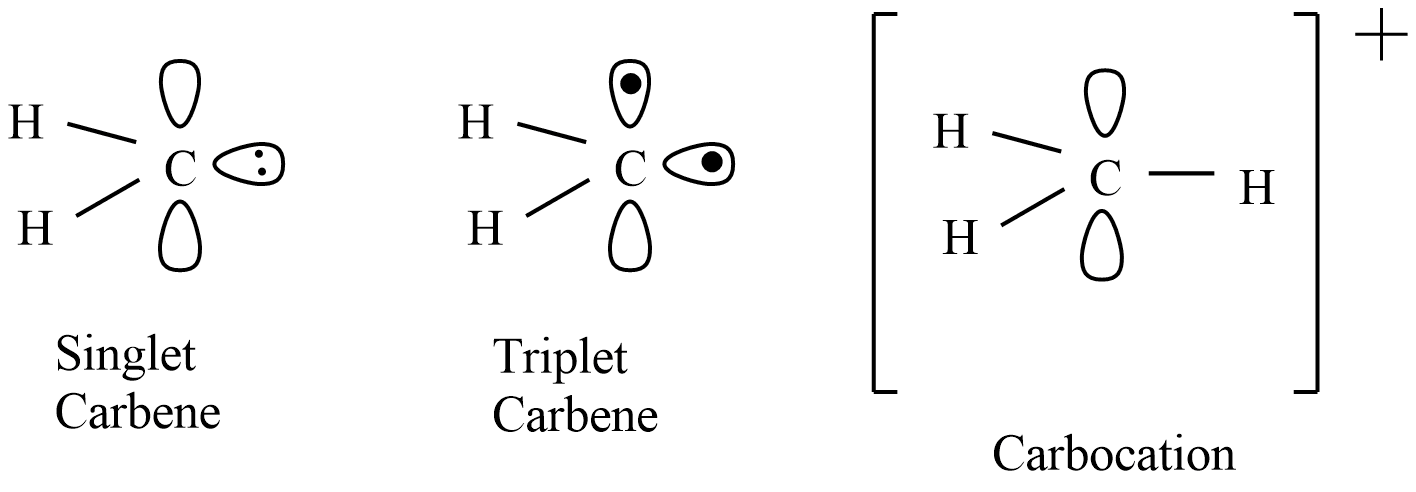
The singlet carbene is the lowest energy than triplet carbene, which means singlet carbene is the excited state spice and triplet carbene is a more stable state. This stability of carbenes decreases in the inductive withdrawal while stabilizes on$\pi $- orbital donation capability.
The single carbene will stabilize with substituents that can donate electron pairs like halogens by delocalizing the pair into an empty p-orbital. Due to the unavailability of vacant orbital at carbon, no corresponding stabilization possible for triplet carbene. So, the singlet carbene is more stable than the triplet carbene when there is a substituent with lone pairs in the singlet carbene.
Therefore, the order of stability of singlet carbene as follows,
\[C{{l}_{2}}\]<$CB{{r}_{2}}$<$CC{{l}_{2}}$<$C{{F}_{2}}$<$C{{H}_{2}}$
The order of stability of triplet carbene as follows,
\[C{{l}_{2}}\]>$CB{{r}_{2}}$>$CC{{l}_{2}}$>$C{{F}_{2}}$>$C{{H}_{2}}$
Hence, the stability order of the following singlet halocarbene is,
\[C{{F}_{2}}\]>$CC{{l}_{2}}$>$CB{{r}_{2}}$>$C{{I}_{2}}$
Thus, the correct answer is option A.
Note: Singlet carbene cannot do things like triplet carbenes do, because triplet carbene is highly reactive diradical. But singlet carbenes are not radicals. There is one electron in the usually full orbital and one in the empty orbital called triplets which determine triplets reactivity with olefins in cyclopropanation reactions
Complete step by step solution:
The singlet carbene is the lowest energy than triplet carbene, which means singlet carbene is the excited state spice and triplet carbene is a more stable state. This stability of carbenes decreases in the inductive withdrawal while stabilizes on$\pi $- orbital donation capability.
The single carbene will stabilize with substituents that can donate electron pairs like halogens by delocalizing the pair into an empty p-orbital. Due to the unavailability of vacant orbital at carbon, no corresponding stabilization possible for triplet carbene. So, the singlet carbene is more stable than the triplet carbene when there is a substituent with lone pairs in the singlet carbene.
Therefore, the order of stability of singlet carbene as follows,
\[C{{l}_{2}}\]<$CB{{r}_{2}}$<$CC{{l}_{2}}$<$C{{F}_{2}}$<$C{{H}_{2}}$
The order of stability of triplet carbene as follows,
\[C{{l}_{2}}\]>$CB{{r}_{2}}$>$CC{{l}_{2}}$>$C{{F}_{2}}$>$C{{H}_{2}}$
Hence, the stability order of the following singlet halocarbene is,
\[C{{F}_{2}}\]>$CC{{l}_{2}}$>$CB{{r}_{2}}$>$C{{I}_{2}}$
Thus, the correct answer is option A.
Note: Singlet carbene cannot do things like triplet carbenes do, because triplet carbene is highly reactive diradical. But singlet carbenes are not radicals. There is one electron in the usually full orbital and one in the empty orbital called triplets which determine triplets reactivity with olefins in cyclopropanation reactions
Recently Updated Pages
Write structures of the following compounds i 2 Chloro3methylpentane class 11 chemistry CBSE

What is BLO What is the full form of BLO class 8 social science CBSE
Explain the Treaty of Vienna of 1815 class 10 social science CBSE
A Paragraph on Pollution in about 100-150 Words
XIX+XXX A 49 B 51 C 55 D 44 class 5 maths CBSE
If x a + bt + ct2 where x is in meters and t is in class 11 physics CBSE
Trending doubts
One Metric ton is equal to kg A 10000 B 1000 C 100 class 11 physics CBSE
Find the value of the expression given below sin 30circ class 11 maths CBSE
What do you mean by retardation What is its SI uni class 11 physics CBSE
Draw a diagram of nephron and explain its structur class 11 biology CBSE
10 examples of friction in our daily life
Difference between physical and chemical change class 11 chemistry CBSE