




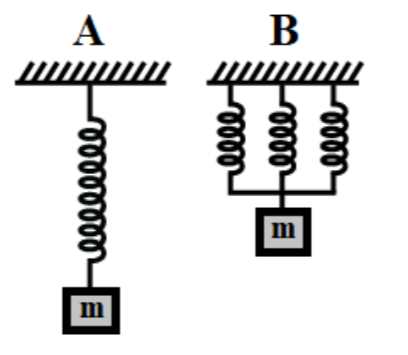
The springs in figure A and B are identical but the length of spring in A is three times than the length of each spring in B. The ratio of period $\dfrac{{{T}_{A}}}{{{T}_{B}}}$:
$\begin{align}
& \text{A}\text{. }\sqrt{3} \\
& \text{B}\text{. }\dfrac{1}{3} \\
& \text{C}\text{. }3 \\
& \text{D}\text{. }\dfrac{1}{\sqrt{3}} \\
\end{align}$
Answer
 Verified
585.3k+ views
Hint: For a simple spring-mass system, we can apply the direct equation to obtain the time period of the simple harmonic motion executed by the system. When springs are connected in parallel combination, the displacement of each spring is the same, but the restoring force is different. In a parallel combination system, we need to calculate the equivalent spring constant of the combination and thus the time period of the simple harmonic motion executed by the system.
Complete step-by-step solution:
A vertical spring-mass system undergoes simple harmonic motion in the vertical direction about the mean or equilibrium position. The equilibrium position in a spring system is the point where the net force acting on the mass is zero.
Spring mass system can be composed of different combinations, series combinations and parallel combinations.
1). When springs are connected in series combination, the force acting on each string is the same, but the displacement of each string is different.
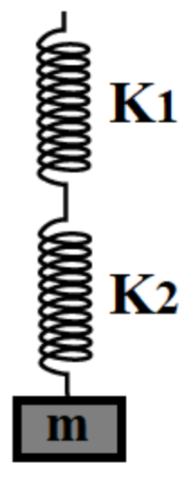
The equivalent spring constant in a series combination of spring system is given as,
\[{{K}_{S}}=\dfrac{{{K}_{1}}{{K}_{2}}}{{{K}_{1}}+{{K}_{2}}}\]
The time period in the series combination of spring system is given as,
$\begin{align}
& T=2\pi \sqrt{\dfrac{m}{\dfrac{{{K}_{1}}{{K}_{2}}}{{{K}_{1}}+{{K}_{2}}}}} \\
&\Rightarrow T=2\pi \sqrt{\dfrac{m\left( {{K}_{1}}+{{K}_{2}} \right)}{{{K}_{1}}{{K}_{2}}}} \\
\end{align}$
2). When springs are connected in parallel combination, the displacement of each spring is the same, but the restoring force is different.
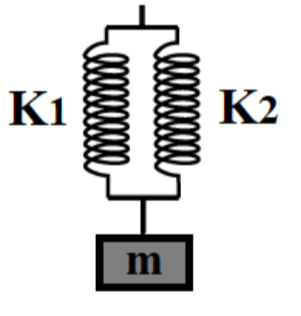
The equivalent spring constant in parallel combination of spring system is given as,
\[{{K}_{P}}={{K}_{1}}+{{K}_{2}}\]
The time period in series combination of spring system is given as,
$T=2\pi \sqrt{\dfrac{m}{{{K}_{1}}+{{K}_{2}}}}$
We are given that the two springs A and B are identical but the length of spring in A is three times than the length of each spring in B. The ratio of period $\dfrac{{{T}_{A}}}{{{T}_{B}}}$:
The spring constant is inversely proportional to the length of the spring, that is,
$K\propto \dfrac{1}{L}$
Where,
$K$ is the spring constant and,
$L$ is the length of the spring
Let the spring constant of A is ${{K}_{A}}$ and the spring constant of each spring in B is ${{K}_{B}}$
Let the length of spring A is ${{L}_{A}}$ and the length of each spring B is ${{L}_{B}}$
Given that,
${{L}_{A}}=3{{L}_{B}}$
It means that,
${{K}_{A}}=\dfrac{{{K}_{B}}}{3}$
Or,
${{K}_{B}}=3{{K}_{A}}$
The equivalent spring constant in B is given as,
${{K}_{eqB}}={{K}_{B}}+{{K}_{B}}+{{K}_{B}}=3{{K}_{B}}$
Put ${{K}_{B}}=3{{K}_{A}}$
We get,
${{K}_{eqB}}=9{{K}_{A}}$
(Let’s say equation 1)
The time period of spring system A is given as,
${{T}_{A}}=2\pi \sqrt{\dfrac{m}{{{K}_{A}}}}$
(Let’s say equation 2)
Where,
$m$ is the mass attached to the spring
${{K}_{A}}$ is the spring constant of A
The time period of spring system B is given as,
${{T}_{B}}=2\pi \sqrt{\dfrac{m}{{{K}_{eqB}}}}$
(Let’s say equation 3)
Where,
$m$ is the mass attached to the spring
${{K}_{eqB}}$ is the equivalent spring constant of B
From equation 1, we have,
${{K}_{eqB}}=9{{K}_{A}}$
It means that,
${{T}_{B}}=2\pi \sqrt{\dfrac{m}{9{{K}_{A}}}}$
(Let’s say equation 4)
Dividing equation 2 and equation 4, we get,
\[\begin{align}
& \dfrac{{{T}_{A}}}{{{T}_{B}}}=\dfrac{2\pi \sqrt{\dfrac{m}{{{K}_{A}}}}}{2\pi \sqrt{\dfrac{m}{9{{K}_{A}}}}}=\dfrac{\sqrt{\dfrac{1}{{{K}_{A}}}}}{\sqrt{\dfrac{1}{9{{K}_{A}}}}} \\
&\Rightarrow \dfrac{{{T}_{A}}}{{{T}_{B}}}=\dfrac{1}{\sqrt{\dfrac{1}{9}}}=\sqrt{9} \\
&\Rightarrow \dfrac{{{T}_{A}}}{{{T}_{B}}}=3 \\
\end{align}\]
The ratio of time period $\dfrac{{{T}_{A}}}{{{T}_{B}}}$ is 3
Hence, the correct option is C.
Note: That simple harmonic motion executed by a spring-mass system is centered about a point of equilibrium, where the net force on the mass is zero rather than where the spring is at its rest position. The most important point to remember here is that force constant of spring(k) is inversely proportional to length(L) of the spring."
Complete step-by-step solution:
A vertical spring-mass system undergoes simple harmonic motion in the vertical direction about the mean or equilibrium position. The equilibrium position in a spring system is the point where the net force acting on the mass is zero.
Spring mass system can be composed of different combinations, series combinations and parallel combinations.
1). When springs are connected in series combination, the force acting on each string is the same, but the displacement of each string is different.
The equivalent spring constant in a series combination of spring system is given as,
\[{{K}_{S}}=\dfrac{{{K}_{1}}{{K}_{2}}}{{{K}_{1}}+{{K}_{2}}}\]
The time period in the series combination of spring system is given as,
$\begin{align}
& T=2\pi \sqrt{\dfrac{m}{\dfrac{{{K}_{1}}{{K}_{2}}}{{{K}_{1}}+{{K}_{2}}}}} \\
&\Rightarrow T=2\pi \sqrt{\dfrac{m\left( {{K}_{1}}+{{K}_{2}} \right)}{{{K}_{1}}{{K}_{2}}}} \\
\end{align}$
2). When springs are connected in parallel combination, the displacement of each spring is the same, but the restoring force is different.
The equivalent spring constant in parallel combination of spring system is given as,
\[{{K}_{P}}={{K}_{1}}+{{K}_{2}}\]
The time period in series combination of spring system is given as,
$T=2\pi \sqrt{\dfrac{m}{{{K}_{1}}+{{K}_{2}}}}$
We are given that the two springs A and B are identical but the length of spring in A is three times than the length of each spring in B. The ratio of period $\dfrac{{{T}_{A}}}{{{T}_{B}}}$:
The spring constant is inversely proportional to the length of the spring, that is,
$K\propto \dfrac{1}{L}$
Where,
$K$ is the spring constant and,
$L$ is the length of the spring
Let the spring constant of A is ${{K}_{A}}$ and the spring constant of each spring in B is ${{K}_{B}}$
Let the length of spring A is ${{L}_{A}}$ and the length of each spring B is ${{L}_{B}}$
Given that,
${{L}_{A}}=3{{L}_{B}}$
It means that,
${{K}_{A}}=\dfrac{{{K}_{B}}}{3}$
Or,
${{K}_{B}}=3{{K}_{A}}$
The equivalent spring constant in B is given as,
${{K}_{eqB}}={{K}_{B}}+{{K}_{B}}+{{K}_{B}}=3{{K}_{B}}$
Put ${{K}_{B}}=3{{K}_{A}}$
We get,
${{K}_{eqB}}=9{{K}_{A}}$
(Let’s say equation 1)
The time period of spring system A is given as,
${{T}_{A}}=2\pi \sqrt{\dfrac{m}{{{K}_{A}}}}$
(Let’s say equation 2)
Where,
$m$ is the mass attached to the spring
${{K}_{A}}$ is the spring constant of A
The time period of spring system B is given as,
${{T}_{B}}=2\pi \sqrt{\dfrac{m}{{{K}_{eqB}}}}$
(Let’s say equation 3)
Where,
$m$ is the mass attached to the spring
${{K}_{eqB}}$ is the equivalent spring constant of B
From equation 1, we have,
${{K}_{eqB}}=9{{K}_{A}}$
It means that,
${{T}_{B}}=2\pi \sqrt{\dfrac{m}{9{{K}_{A}}}}$
(Let’s say equation 4)
Dividing equation 2 and equation 4, we get,
\[\begin{align}
& \dfrac{{{T}_{A}}}{{{T}_{B}}}=\dfrac{2\pi \sqrt{\dfrac{m}{{{K}_{A}}}}}{2\pi \sqrt{\dfrac{m}{9{{K}_{A}}}}}=\dfrac{\sqrt{\dfrac{1}{{{K}_{A}}}}}{\sqrt{\dfrac{1}{9{{K}_{A}}}}} \\
&\Rightarrow \dfrac{{{T}_{A}}}{{{T}_{B}}}=\dfrac{1}{\sqrt{\dfrac{1}{9}}}=\sqrt{9} \\
&\Rightarrow \dfrac{{{T}_{A}}}{{{T}_{B}}}=3 \\
\end{align}\]
The ratio of time period $\dfrac{{{T}_{A}}}{{{T}_{B}}}$ is 3
Hence, the correct option is C.
Note: That simple harmonic motion executed by a spring-mass system is centered about a point of equilibrium, where the net force on the mass is zero rather than where the spring is at its rest position. The most important point to remember here is that force constant of spring(k) is inversely proportional to length(L) of the spring."
Recently Updated Pages
Master Class 11 Computer Science: Engaging Questions & Answers for Success

Master Class 11 Business Studies: Engaging Questions & Answers for Success
Master Class 11 Economics: Engaging Questions & Answers for Success
Master Class 11 English: Engaging Questions & Answers for Success
Master Class 11 Maths: Engaging Questions & Answers for Success
Master Class 11 Biology: Engaging Questions & Answers for Success
Trending doubts
One Metric ton is equal to kg A 10000 B 1000 C 100 class 11 physics CBSE
There are 720 permutations of the digits 1 2 3 4 5 class 11 maths CBSE
Discuss the various forms of bacteria class 11 biology CBSE
Draw a diagram of a plant cell and label at least eight class 11 biology CBSE
State the laws of reflection of light
Explain zero factorial class 11 maths CBSE