




The sphere rolls down on an inclined plane of inclination $\theta $. What is the acceleration as the sphere reaches bottom?
Answer
 Verified
632.4k+ views
Hint – In this question first draw a free body diagram of a sphere of radius R units and mass m. The mg will be acting vertically downwards from the sphere, so resolve this force with its two components that is $mg\sin \theta $ and $mg\cos \theta $. The force of friction will be trying to oppose the rolling motion of the ball down the slope. Balance the equations to obtain the required value if acceleration.
Complete step-by-step answer:
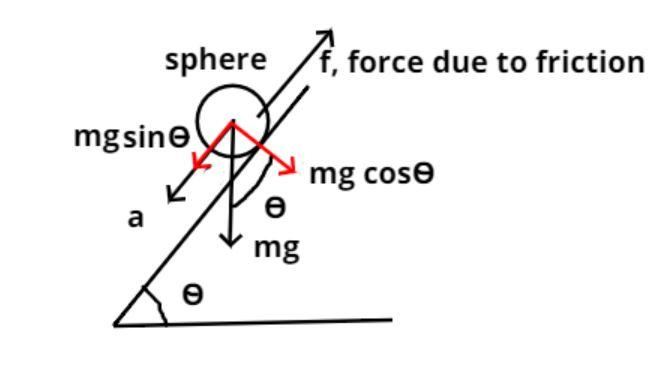
Sphere is rolling on the surface which is inclined at an angle $\theta $ with the horizontal as shown in the figure.
Let the radius of the sphere be R units.
Let the weight of the sphere be m kg.
So the force acting downward according to Newton’s second law of motion due to acceleration of the gravity (g) is given as
$ \Rightarrow {F_g} = mg$N (see figure).
Let the acceleration of the sphere be (a) as shown in the figure.
So the force working on the sphere which is opposite to the direction of the movement according to Newton’s law is ${F_a} = ma$N.
Now the force $\left( {{F_g}} \right)$ makes an angle $\theta $ with the radius (R) of the sphere as shown in the figure.
Let the force due to friction be (f) working opposite to the direction of movement of the sphere.
Now, resolve the component of force in $mg\cos \theta {\text{ and }}mg\sin \theta $ as shown in the figure.
Now balance the forces we have,
$ \Rightarrow mg\sin \theta = f + {F_a}$
Now substitute the value we have,
$ \Rightarrow mg\sin \theta = f + ma$................. (1)
Now let the angular velocity and moment of inertia of the sphere be $\alpha $ and $I$.
So force due to friction (f) multiplied by the radius (R) is equal to the product of moment of inertia and angular velocity of the sphere.
$ \Rightarrow f \times R = I \times \alpha $.................... (2)
Now the acceleration working on the sphere is the product of the radius of the sphere and the angular velocity of the sphere.
$ \Rightarrow a = R \times \alpha $ .................. (3).
Now from equation (2) and (3) we have,
$ \Rightarrow f \times R = I \times \dfrac{a}{R}$
$ \Rightarrow f \times {R^2} = I \times a$
$ \Rightarrow f = \dfrac{{I \times a}}{{{R^2}}}$................... (1)
Now from equation (1) and (4) we have,
$ \Rightarrow mg\sin \theta = \dfrac{{I \times a}}{{{R^2}}} + ma$
Now simplify this equation we have,
$ \Rightarrow g\sin \theta = a\left( {\dfrac{I}{{m{R^2}}} + 1} \right)$
$ \Rightarrow a = \dfrac{{g\sin \theta }}{{1 + \dfrac{I}{{m{R^2}}}}}$
Now as we know that the moment of inertia of the sphere is $I = \dfrac{2}{5}m{R^2}$
So substitute this value in above equation we have,
$ \Rightarrow a = \dfrac{{g\sin \theta }}{{1 + \dfrac{{\dfrac{2}{5}m{R^2}}}{{m{R^2}}}}}$
Now simplify this we have,
$ \Rightarrow a = \dfrac{{g\sin \theta }}{{1 + \dfrac{2}{5}}} = \dfrac{5}{7}g\sin \theta $
So this is the required acceleration working on the sphere.
Hence option (A) is the correct answer.
Note – The trick point here was regarding the concept of moment of inertia, a body always has a tendency to resist the angular acceleration so the entity that expresses this tendency is the moment of inertia. This is the physical significance of MOI. In general the moment of inertia is defined as the sum of the products of masses with the square of its distance from the axis of the rotation that is $I = \sum {{m_i}{r_i}^2} $. It is advised to remember the M.O.I value for basic shapes like for sphere is $I = \dfrac{2}{5}m{R^2}$.
Complete step-by-step answer:
Sphere is rolling on the surface which is inclined at an angle $\theta $ with the horizontal as shown in the figure.
Let the radius of the sphere be R units.
Let the weight of the sphere be m kg.
So the force acting downward according to Newton’s second law of motion due to acceleration of the gravity (g) is given as
$ \Rightarrow {F_g} = mg$N (see figure).
Let the acceleration of the sphere be (a) as shown in the figure.
So the force working on the sphere which is opposite to the direction of the movement according to Newton’s law is ${F_a} = ma$N.
Now the force $\left( {{F_g}} \right)$ makes an angle $\theta $ with the radius (R) of the sphere as shown in the figure.
Let the force due to friction be (f) working opposite to the direction of movement of the sphere.
Now, resolve the component of force in $mg\cos \theta {\text{ and }}mg\sin \theta $ as shown in the figure.
Now balance the forces we have,
$ \Rightarrow mg\sin \theta = f + {F_a}$
Now substitute the value we have,
$ \Rightarrow mg\sin \theta = f + ma$................. (1)
Now let the angular velocity and moment of inertia of the sphere be $\alpha $ and $I$.
So force due to friction (f) multiplied by the radius (R) is equal to the product of moment of inertia and angular velocity of the sphere.
$ \Rightarrow f \times R = I \times \alpha $.................... (2)
Now the acceleration working on the sphere is the product of the radius of the sphere and the angular velocity of the sphere.
$ \Rightarrow a = R \times \alpha $ .................. (3).
Now from equation (2) and (3) we have,
$ \Rightarrow f \times R = I \times \dfrac{a}{R}$
$ \Rightarrow f \times {R^2} = I \times a$
$ \Rightarrow f = \dfrac{{I \times a}}{{{R^2}}}$................... (1)
Now from equation (1) and (4) we have,
$ \Rightarrow mg\sin \theta = \dfrac{{I \times a}}{{{R^2}}} + ma$
Now simplify this equation we have,
$ \Rightarrow g\sin \theta = a\left( {\dfrac{I}{{m{R^2}}} + 1} \right)$
$ \Rightarrow a = \dfrac{{g\sin \theta }}{{1 + \dfrac{I}{{m{R^2}}}}}$
Now as we know that the moment of inertia of the sphere is $I = \dfrac{2}{5}m{R^2}$
So substitute this value in above equation we have,
$ \Rightarrow a = \dfrac{{g\sin \theta }}{{1 + \dfrac{{\dfrac{2}{5}m{R^2}}}{{m{R^2}}}}}$
Now simplify this we have,
$ \Rightarrow a = \dfrac{{g\sin \theta }}{{1 + \dfrac{2}{5}}} = \dfrac{5}{7}g\sin \theta $
So this is the required acceleration working on the sphere.
Hence option (A) is the correct answer.
Note – The trick point here was regarding the concept of moment of inertia, a body always has a tendency to resist the angular acceleration so the entity that expresses this tendency is the moment of inertia. This is the physical significance of MOI. In general the moment of inertia is defined as the sum of the products of masses with the square of its distance from the axis of the rotation that is $I = \sum {{m_i}{r_i}^2} $. It is advised to remember the M.O.I value for basic shapes like for sphere is $I = \dfrac{2}{5}m{R^2}$.
Recently Updated Pages
Master Class 11 Social Science: Engaging Questions & Answers for Success

Master Class 11 English: Engaging Questions & Answers for Success
Master Class 11 Maths: Engaging Questions & Answers for Success
Master Class 11 Chemistry: Engaging Questions & Answers for Success
Master Class 11 Biology: Engaging Questions & Answers for Success
Master Class 11 Physics: Engaging Questions & Answers for Success
Trending doubts
One Metric ton is equal to kg A 10000 B 1000 C 100 class 11 physics CBSE
Difference Between Prokaryotic Cells and Eukaryotic Cells
How many of the following diseases can be studied with class 11 biology CBSE
Draw a diagram of a plant cell and label at least eight class 11 biology CBSE
Two of the body parts which do not appear in MRI are class 11 biology CBSE
Which gas is abundant in air class 11 chemistry CBSE