




The sperm and the egg make different contributions to the zygote. Which of the following statements about their contributions are true?
Sperm contributes most of the mitochondria
Egg contributes most of the cytoplasm
Both sperm and egg contribute a haploid nucleus
Both sperm and egg contribute centrioles
(i) and (ii)
(ii) and (iii)
(iii) and (iv)
(i), (ii), (iii) and (iv)
Answer
 Verified
638.4k+ views
Hint: The haploid sperm and ovum fuses to form a diploid zygote.
The egg is larger in size and the sperm only fuses the egg by its head portion.
Complete answer: The sperm and the egg fuse during fertilization and form a zygote.
The absence of either sperm and/or ovum will lead to the information of the zygote.
The zygote is diploid that means it has 46 chromosomes, 23 chromosomes come from the father and the rest 23 comes from the mother.
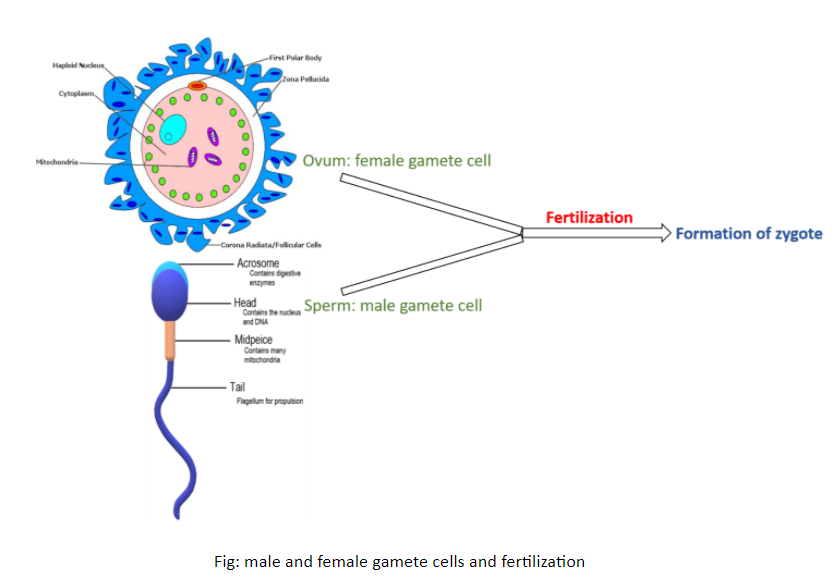
Now coming to clarify the statements,
1. Sperm do not contribute to the mitochondria. Only the head portion of the sperm gets fused with the egg. The head portion of the sperm only contains the nucleus. So, it is not possible for sperm to donate the mitochondria, instead, it donates the DNA.
2. The mitochondria are donated by the mother.
3. The egg is larger in size than that of the sperm and it contributes most of the cytoplasm.
4. The sperm and egg contribute 23 chromosomes each, thus, makes the zygote diploid.
5. The centrioles are present in the cytoplasm. So, it is not possible for the sperm to donate it and can be donated by eggs only.
Thus, option B. (ii) and (iii) is the correct answer.
Note: Sperms only donate nucleus whereas egg contributes nucleus as well as the cytoplasm – mitochondria, centrioles.
The egg is larger in size and the sperm only fuses the egg by its head portion.
Complete answer: The sperm and the egg fuse during fertilization and form a zygote.
The absence of either sperm and/or ovum will lead to the information of the zygote.
The zygote is diploid that means it has 46 chromosomes, 23 chromosomes come from the father and the rest 23 comes from the mother.
Now coming to clarify the statements,
1. Sperm do not contribute to the mitochondria. Only the head portion of the sperm gets fused with the egg. The head portion of the sperm only contains the nucleus. So, it is not possible for sperm to donate the mitochondria, instead, it donates the DNA.
2. The mitochondria are donated by the mother.
3. The egg is larger in size than that of the sperm and it contributes most of the cytoplasm.
4. The sperm and egg contribute 23 chromosomes each, thus, makes the zygote diploid.
5. The centrioles are present in the cytoplasm. So, it is not possible for the sperm to donate it and can be donated by eggs only.
Thus, option B. (ii) and (iii) is the correct answer.
Note: Sperms only donate nucleus whereas egg contributes nucleus as well as the cytoplasm – mitochondria, centrioles.
Recently Updated Pages
Basicity of sulphurous acid and sulphuric acid are

Master Class 12 Economics: Engaging Questions & Answers for Success
Master Class 12 Biology: Engaging Questions & Answers for Success
Master Class 11 English: Engaging Questions & Answers for Success
Master Class 11 Physics: Engaging Questions & Answers for Success
Master Class 11 Computer Science: Engaging Questions & Answers for Success
Trending doubts
Draw a labelled sketch of the human eye class 12 physics CBSE
The chemical formula of tear gas is A CO Cl 2 B C 10 class 12 chemistry CBSE
Draw ray diagrams each showing i myopic eye and ii class 12 physics CBSE
Which are the Top 10 Largest Countries of the World?
Differentiate between homogeneous and heterogeneous class 12 chemistry CBSE
Which is the correct genotypic ratio of mendel dihybrid class 12 biology CBSE