




The speed of an aircraft in still air is $200\,km\,{h^{ - 1}}$. The wind blows from the west at a speed of $85.0\,km\,{h^{ - 1}}$.
In which direction must the pilot steer the aircraft in order to fly due north?
A) $23.0^\circ $ east of north.
B) $23.0^\circ $ west of north.
C) $25.2^\circ $ east of north.
D) $25.2^\circ $ west of north.
Answer
 Verified
609.6k+ views
Hint:Just keep in mind that the speed of an object in still air is equal to the speed relative to the air, no matter whether the air is moving or not relative to the ground. Also, to get in the north direction all the resultant of all the vectors should be in the north direction.
Complete Step by Step answer
As given in the question, the wind is blowing from the west at a speed of $85\,km\,{h^{ - 1}}$. The blowing wind will cause the aircraft to change its direction during its motion. Thus, if the pilot wants to steer in the north. Also, the resultant of all the vectors should be in the north direction.
Now, let us represent the velocity of air and wind in the form of a diagram as given below
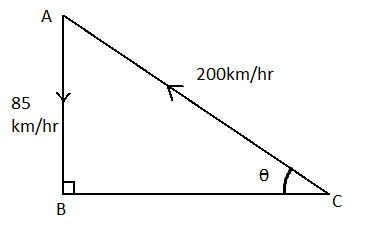
Now, we will calculate the angle subtended by the velocity of air and velocity of aircraft. For this, we are given that,
The Speed of an aircraft, ${v_{aircraft}} = 200\,km\,{h^{ - 1}}$
Also, the speed of the wind, ${v_{wind}} = 85.0\,km\,{h^{ - 1}}$
Therefore, the angle subtended $\theta $ can be calculated as
$\sin \theta = \dfrac{{{v_{aircraft}}}}{{{v_{wind}}}}$
Therefore, putting the values, we get
$\sin \theta = \dfrac{{85.0}}{{200}}$
$ \Rightarrow \theta = {\sin ^{ - 1}}\dfrac{{85.0}}{{200}}$
$ \Rightarrow \theta = 25.2^\circ $
Therefore, the pilot should steer the aircraft in $25.2^\circ $ west to the north direction so that its resultant direction would be north when the wind blows in the west direction.
Therefore, option (D) is the correct option.
Note:We cannot use the Pythagoras theorem here to calculate the resultant vectors because the velocity of the plane and wind cannot be perpendicular to each other. Also, the magnitude of the resultant is not required to calculate the angle subtended.
Complete Step by Step answer
As given in the question, the wind is blowing from the west at a speed of $85\,km\,{h^{ - 1}}$. The blowing wind will cause the aircraft to change its direction during its motion. Thus, if the pilot wants to steer in the north. Also, the resultant of all the vectors should be in the north direction.
Now, let us represent the velocity of air and wind in the form of a diagram as given below
Now, we will calculate the angle subtended by the velocity of air and velocity of aircraft. For this, we are given that,
The Speed of an aircraft, ${v_{aircraft}} = 200\,km\,{h^{ - 1}}$
Also, the speed of the wind, ${v_{wind}} = 85.0\,km\,{h^{ - 1}}$
Therefore, the angle subtended $\theta $ can be calculated as
$\sin \theta = \dfrac{{{v_{aircraft}}}}{{{v_{wind}}}}$
Therefore, putting the values, we get
$\sin \theta = \dfrac{{85.0}}{{200}}$
$ \Rightarrow \theta = {\sin ^{ - 1}}\dfrac{{85.0}}{{200}}$
$ \Rightarrow \theta = 25.2^\circ $
Therefore, the pilot should steer the aircraft in $25.2^\circ $ west to the north direction so that its resultant direction would be north when the wind blows in the west direction.
Therefore, option (D) is the correct option.
Note:We cannot use the Pythagoras theorem here to calculate the resultant vectors because the velocity of the plane and wind cannot be perpendicular to each other. Also, the magnitude of the resultant is not required to calculate the angle subtended.
Recently Updated Pages
Master Class 12 Economics: Engaging Questions & Answers for Success

Master Class 12 English: Engaging Questions & Answers for Success
Master Class 12 Social Science: Engaging Questions & Answers for Success
Master Class 12 Maths: Engaging Questions & Answers for Success
Master Class 12 Physics: Engaging Questions & Answers for Success
Master Class 11 Social Science: Engaging Questions & Answers for Success
Trending doubts
One Metric ton is equal to kg A 10000 B 1000 C 100 class 11 physics CBSE
Difference Between Prokaryotic Cells and Eukaryotic Cells
Find the value of the expression given below sin 30circ class 11 maths CBSE
Two of the body parts which do not appear in MRI are class 11 biology CBSE
Draw a diagram of nephron and explain its structur class 11 biology CBSE
10 examples of friction in our daily life