




The sound-producing organ in a singing bird is _____
(a) Vocal sac
(b) Syrinx
(c) Larynx
(d) Synsacrum
Answer
 Verified
596.4k+ views
Hint: It is located at the base of a bird’s trachea and it produces sounds without the vocal folds of mammals.
Complete answer: The syrinx is considered as the vocal or sound-producing organ of birds. The sound in them is produced by vibrations of some or all of the membrane tympaniformis, that is, the walls of the Syrinx and the pessulus, which is due to air flowing through the syrinx. This airflow sets up a self-oscillating system that modulates the airflow and creates the sound. The muscles present their hep in modulating the sound shape by changing the tension of the membranes and the bronchial openings. Birds also have a larynx, but unlike mammals, they do not vocalize.
Additional Information: Syrinx is a bony structure at the bottom of the trachea (unlike the larynx which is located at the top of the mammalian trachea). The syrinx and sometimes its surrounding air sac resonates with the sound waves that are made by membranes past which the bird forces air.
The birds can modulate the pitch of voice by altering the tension on the wall of Syrinx. Birds can control the two sides of the trachea independent of each other and this is how some species can produce two notes at once.
Due to syrinx, some species of birds like parrots, crows, and mynas can even mimic human speech. Some species of birds like New World vultures, lack syrinx and so communicate through throaty hisses.
So, the correct answer is ‘Syrinx’.
Note: Main functions of bird song are as follows-
1. A very important function of bird song is to attract males.
2. The quality of bird songs may be considered as a good indicator of their fitness.
3. Another function of a bird song is territory defense. Territorial birds interact with each other using songs to negotiate their territory boundaries.
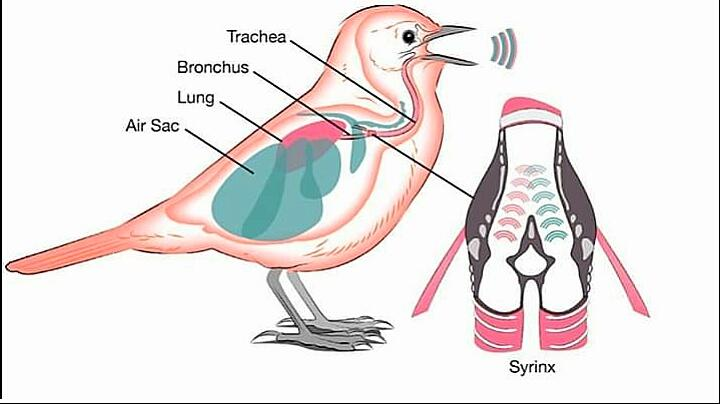
Complete answer: The syrinx is considered as the vocal or sound-producing organ of birds. The sound in them is produced by vibrations of some or all of the membrane tympaniformis, that is, the walls of the Syrinx and the pessulus, which is due to air flowing through the syrinx. This airflow sets up a self-oscillating system that modulates the airflow and creates the sound. The muscles present their hep in modulating the sound shape by changing the tension of the membranes and the bronchial openings. Birds also have a larynx, but unlike mammals, they do not vocalize.
Additional Information: Syrinx is a bony structure at the bottom of the trachea (unlike the larynx which is located at the top of the mammalian trachea). The syrinx and sometimes its surrounding air sac resonates with the sound waves that are made by membranes past which the bird forces air.
The birds can modulate the pitch of voice by altering the tension on the wall of Syrinx. Birds can control the two sides of the trachea independent of each other and this is how some species can produce two notes at once.
Due to syrinx, some species of birds like parrots, crows, and mynas can even mimic human speech. Some species of birds like New World vultures, lack syrinx and so communicate through throaty hisses.
So, the correct answer is ‘Syrinx’.
Note: Main functions of bird song are as follows-
1. A very important function of bird song is to attract males.
2. The quality of bird songs may be considered as a good indicator of their fitness.
3. Another function of a bird song is territory defense. Territorial birds interact with each other using songs to negotiate their territory boundaries.
Recently Updated Pages
Master Class 11 Computer Science: Engaging Questions & Answers for Success

Master Class 11 Business Studies: Engaging Questions & Answers for Success
Master Class 11 Economics: Engaging Questions & Answers for Success
Master Class 11 English: Engaging Questions & Answers for Success
Master Class 11 Maths: Engaging Questions & Answers for Success
Master Class 11 Biology: Engaging Questions & Answers for Success
Trending doubts
One Metric ton is equal to kg A 10000 B 1000 C 100 class 11 physics CBSE
There are 720 permutations of the digits 1 2 3 4 5 class 11 maths CBSE
Discuss the various forms of bacteria class 11 biology CBSE
Draw a diagram of a plant cell and label at least eight class 11 biology CBSE
State the laws of reflection of light
Explain zero factorial class 11 maths CBSE