




The solution of $\dfrac{3\sin \theta -\sin 3\theta }{1+\cos \theta }+\dfrac{3\cos \theta +\cos 3\theta }{1-\sin \theta }=4\sqrt{2}\cos \left( \theta +\dfrac{\pi }{4} \right)$
A. $n\pi $
B. $n\pi +\dfrac{\pi }{12}$
C. $n\pi \pm \dfrac{\pi }{2}$
D. $2n\pi $
Answer
 Verified
573.6k+ views
Hint: First we will expand the term $\cos \left( \theta +\dfrac{\pi }{4} \right)$ by using the formula $\cos \left( A+B \right)=\cos A.\cos B-\sin A.\sin B$. Now we will substitute the value $\cos \dfrac{\pi }{4}=\sin \dfrac{\pi }{4}=\dfrac{1}{\sqrt{2}}$ and simplify the term in the right side of the given equation. Now in the left side we have the terms $\sin 3\theta $, $\cos 3\theta $. So we will use the formulas $\sin 3\theta =3\sin \theta -4{{\sin }^{3}}\theta $ and $\cos 3\theta =4{{\cos }^{3}}\theta -3\cos \theta $ then we will simplify the terms in the right side and equate the obtained value to the simplified form of the right side term. Now we will solve the obtained equation to get the result.
Complete step-by-step answer:
Given that,
$\dfrac{3\sin \theta -\sin 3\theta }{1+\cos \theta }+\dfrac{3\cos \theta +\cos 3\theta }{1-\sin \theta }=4\sqrt{2}\cos \left( \theta +\dfrac{\pi }{4} \right)$
Expanding the term $\cos \left( \theta +\dfrac{\pi }{4} \right)$ by using the formula $\cos \left( A+B \right)=\cos A.\cos B-\sin A.\sin B$, then we will get
$\Rightarrow \dfrac{3\sin \theta -\sin 3\theta }{1+\cos \theta }+\dfrac{3\cos \theta +\cos 3\theta }{1-\sin \theta }=4\sqrt{2}\left[ \cos \theta .\cos \dfrac{\pi }{4}-\sin \theta .\sin \dfrac{\pi }{4} \right]$
Now substituting the value $\cos \dfrac{\pi }{4}=\sin \dfrac{\pi }{4}=\dfrac{1}{\sqrt{2}}$ in the above equation, we will get
$\begin{align}
& \Rightarrow \dfrac{3\sin \theta -\sin 3\theta }{1+\cos \theta }+\dfrac{3\cos \theta +\cos 3\theta }{1-\sin \theta }=4\sqrt{2}\left[ \cos \theta .\dfrac{1}{\sqrt{2}}-\sin \theta .\dfrac{1}{\sqrt{2}} \right] \\
& \Rightarrow \dfrac{3\sin \theta -\sin 3\theta }{1+\cos \theta }+\dfrac{3\cos \theta +\cos 3\theta }{1-\sin \theta }=4\sqrt{2}\times \dfrac{1}{\sqrt{2}}\left[ \cos \theta -\sin \theta \right] \\
& \Rightarrow \dfrac{3\sin \theta -\sin 3\theta }{1+\cos \theta }+\dfrac{3\cos \theta +\cos 3\theta }{1-\sin \theta }=4\left( \cos \theta -\sin \theta \right) \\
\end{align}$
We know that $\sin 3\theta =3\sin \theta -4{{\sin }^{3}}\theta $ and $\cos 3\theta =4{{\cos }^{3}}\theta -3\cos \theta $, so substituting these values in the above equation, then we will have
$\begin{align}
& \Rightarrow \dfrac{3\sin \theta -\left( 3\sin \theta -4{{\sin }^{3}}\theta \right)}{1+\cos \theta }+\dfrac{3\cos \theta +4{{\cos }^{3}}\theta -3\cos \theta }{1-\sin \theta }=4\left( \cos \theta -\sin \theta \right) \\
& \Rightarrow \dfrac{4{{\sin }^{3}}\theta }{1+\cos \theta }+\dfrac{4{{\cos }^{3}}\theta }{1-\sin \theta }=4\left( \cos \theta -\sin \theta \right) \\
\end{align}$
Multiplying the term $\dfrac{1-\cos \theta }{1-\cos \theta }$ with $\dfrac{4{{\sin }^{3}}\theta }{1+\cos \theta }$ and $\dfrac{1+\sin \theta }{1+\sin \theta }$ with $\dfrac{4{{\cos }^{3}}\theta }{1-\sin \theta }$ in the above equation, then we will get
$\Rightarrow \dfrac{4{{\sin }^{3}}\theta }{1+\cos \theta }\times \dfrac{1-\cos \theta }{1-\cos \theta }+\dfrac{4{{\cos }^{3}}\theta }{1-\sin \theta }\times \dfrac{1+\sin \theta }{1+\sin \theta }=4\left( \cos \theta -\sin \theta \right)$
Using the formula $\left( a+b \right)\left( a-b \right)={{a}^{2}}-{{b}^{2}}$ in the above equation, then we will get
$\Rightarrow \dfrac{4{{\sin }^{3}}\theta \left( 1-\cos \theta \right)}{{{1}^{2}}-{{\cos }^{2}}\theta }+\dfrac{4{{\cos }^{3}}\theta \left( 1+\sin \theta \right)}{{{1}^{2}}-{{\sin }^{2}}\theta }=4\left( \cos \theta -\sin \theta \right)$
We have the trigonometric identity ${{\sin }^{2}}\theta +{{\cos }^{2}}\theta =1$, from this identity the values of $1-{{\cos }^{2}}\theta $ and $1-{{\sin }^{2}}\theta $ are ${{\sin }^{2}}\theta $, ${{\cos }^{2}}\theta $ respectively. Substituting these values in the above equation, then we will have
$\begin{align}
& \Rightarrow \dfrac{4{{\sin }^{3}}\theta \left( 1-\cos \theta \right)}{{{\sin }^{2}}\theta }+\dfrac{4{{\cos }^{3}}\theta \left( 1+\sin \theta \right)}{{{\cos }^{2}}\theta }=4\left( \cos \theta -\sin \theta \right) \\
& \Rightarrow 4\sin \theta \left( 1-\cos \theta \right)+4\cos \theta \left( 1+\sin \theta \right)=4\left( \cos \theta -\sin \theta \right) \\
\end{align}$
Applying multiplication distribution law in the above equation, then we will get
$\begin{align}
& \Rightarrow 4\sin \theta -4\sin \theta .\cos \theta +4\cos \theta +4\cos \theta .\sin \theta =4\cos \theta -4\sin \theta \\
& \Rightarrow 4\sin \theta +4\cos \theta -4\cos \theta +4\sin \theta =0 \\
& \Rightarrow 8\sin \theta =0 \\
& \Rightarrow \sin \theta =0 \\
\end{align}$
We know that the solution for the equation $\sin \theta =0$ is given by $\theta =n\pi $.
Hence the solution for the given equation is $\theta =n\pi $.
So, the correct answer is “Option A”.
Note: We can also solve the problem by drawing the equation in graph. When we solve the given equation, we get the equation $\sin \theta =0$ so draw a graph for the $\sin \theta =0$ as shown in the figure below.
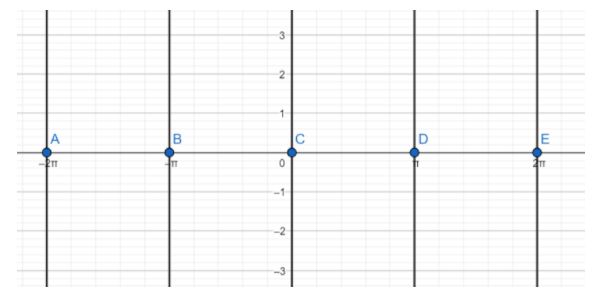
Here we can clearly observe that the equation has zero value for $\theta =\pm \pi ,\pm 2\pi ,\pm 3\pi ,...$. We can simply write it as $\theta =n\pi $. From both the methods we got the same result.
Complete step-by-step answer:
Given that,
$\dfrac{3\sin \theta -\sin 3\theta }{1+\cos \theta }+\dfrac{3\cos \theta +\cos 3\theta }{1-\sin \theta }=4\sqrt{2}\cos \left( \theta +\dfrac{\pi }{4} \right)$
Expanding the term $\cos \left( \theta +\dfrac{\pi }{4} \right)$ by using the formula $\cos \left( A+B \right)=\cos A.\cos B-\sin A.\sin B$, then we will get
$\Rightarrow \dfrac{3\sin \theta -\sin 3\theta }{1+\cos \theta }+\dfrac{3\cos \theta +\cos 3\theta }{1-\sin \theta }=4\sqrt{2}\left[ \cos \theta .\cos \dfrac{\pi }{4}-\sin \theta .\sin \dfrac{\pi }{4} \right]$
Now substituting the value $\cos \dfrac{\pi }{4}=\sin \dfrac{\pi }{4}=\dfrac{1}{\sqrt{2}}$ in the above equation, we will get
$\begin{align}
& \Rightarrow \dfrac{3\sin \theta -\sin 3\theta }{1+\cos \theta }+\dfrac{3\cos \theta +\cos 3\theta }{1-\sin \theta }=4\sqrt{2}\left[ \cos \theta .\dfrac{1}{\sqrt{2}}-\sin \theta .\dfrac{1}{\sqrt{2}} \right] \\
& \Rightarrow \dfrac{3\sin \theta -\sin 3\theta }{1+\cos \theta }+\dfrac{3\cos \theta +\cos 3\theta }{1-\sin \theta }=4\sqrt{2}\times \dfrac{1}{\sqrt{2}}\left[ \cos \theta -\sin \theta \right] \\
& \Rightarrow \dfrac{3\sin \theta -\sin 3\theta }{1+\cos \theta }+\dfrac{3\cos \theta +\cos 3\theta }{1-\sin \theta }=4\left( \cos \theta -\sin \theta \right) \\
\end{align}$
We know that $\sin 3\theta =3\sin \theta -4{{\sin }^{3}}\theta $ and $\cos 3\theta =4{{\cos }^{3}}\theta -3\cos \theta $, so substituting these values in the above equation, then we will have
$\begin{align}
& \Rightarrow \dfrac{3\sin \theta -\left( 3\sin \theta -4{{\sin }^{3}}\theta \right)}{1+\cos \theta }+\dfrac{3\cos \theta +4{{\cos }^{3}}\theta -3\cos \theta }{1-\sin \theta }=4\left( \cos \theta -\sin \theta \right) \\
& \Rightarrow \dfrac{4{{\sin }^{3}}\theta }{1+\cos \theta }+\dfrac{4{{\cos }^{3}}\theta }{1-\sin \theta }=4\left( \cos \theta -\sin \theta \right) \\
\end{align}$
Multiplying the term $\dfrac{1-\cos \theta }{1-\cos \theta }$ with $\dfrac{4{{\sin }^{3}}\theta }{1+\cos \theta }$ and $\dfrac{1+\sin \theta }{1+\sin \theta }$ with $\dfrac{4{{\cos }^{3}}\theta }{1-\sin \theta }$ in the above equation, then we will get
$\Rightarrow \dfrac{4{{\sin }^{3}}\theta }{1+\cos \theta }\times \dfrac{1-\cos \theta }{1-\cos \theta }+\dfrac{4{{\cos }^{3}}\theta }{1-\sin \theta }\times \dfrac{1+\sin \theta }{1+\sin \theta }=4\left( \cos \theta -\sin \theta \right)$
Using the formula $\left( a+b \right)\left( a-b \right)={{a}^{2}}-{{b}^{2}}$ in the above equation, then we will get
$\Rightarrow \dfrac{4{{\sin }^{3}}\theta \left( 1-\cos \theta \right)}{{{1}^{2}}-{{\cos }^{2}}\theta }+\dfrac{4{{\cos }^{3}}\theta \left( 1+\sin \theta \right)}{{{1}^{2}}-{{\sin }^{2}}\theta }=4\left( \cos \theta -\sin \theta \right)$
We have the trigonometric identity ${{\sin }^{2}}\theta +{{\cos }^{2}}\theta =1$, from this identity the values of $1-{{\cos }^{2}}\theta $ and $1-{{\sin }^{2}}\theta $ are ${{\sin }^{2}}\theta $, ${{\cos }^{2}}\theta $ respectively. Substituting these values in the above equation, then we will have
$\begin{align}
& \Rightarrow \dfrac{4{{\sin }^{3}}\theta \left( 1-\cos \theta \right)}{{{\sin }^{2}}\theta }+\dfrac{4{{\cos }^{3}}\theta \left( 1+\sin \theta \right)}{{{\cos }^{2}}\theta }=4\left( \cos \theta -\sin \theta \right) \\
& \Rightarrow 4\sin \theta \left( 1-\cos \theta \right)+4\cos \theta \left( 1+\sin \theta \right)=4\left( \cos \theta -\sin \theta \right) \\
\end{align}$
Applying multiplication distribution law in the above equation, then we will get
$\begin{align}
& \Rightarrow 4\sin \theta -4\sin \theta .\cos \theta +4\cos \theta +4\cos \theta .\sin \theta =4\cos \theta -4\sin \theta \\
& \Rightarrow 4\sin \theta +4\cos \theta -4\cos \theta +4\sin \theta =0 \\
& \Rightarrow 8\sin \theta =0 \\
& \Rightarrow \sin \theta =0 \\
\end{align}$
We know that the solution for the equation $\sin \theta =0$ is given by $\theta =n\pi $.
Hence the solution for the given equation is $\theta =n\pi $.
So, the correct answer is “Option A”.
Note: We can also solve the problem by drawing the equation in graph. When we solve the given equation, we get the equation $\sin \theta =0$ so draw a graph for the $\sin \theta =0$ as shown in the figure below.
Here we can clearly observe that the equation has zero value for $\theta =\pm \pi ,\pm 2\pi ,\pm 3\pi ,...$. We can simply write it as $\theta =n\pi $. From both the methods we got the same result.
Recently Updated Pages
Basicity of sulphurous acid and sulphuric acid are

Master Class 11 Business Studies: Engaging Questions & Answers for Success
Master Class 11 Computer Science: Engaging Questions & Answers for Success
Master Class 11 Economics: Engaging Questions & Answers for Success
Master Class 11 Social Science: Engaging Questions & Answers for Success
Master Class 11 English: Engaging Questions & Answers for Success
Trending doubts
One Metric ton is equal to kg A 10000 B 1000 C 100 class 11 physics CBSE
The largest wind power cluster is located in the state class 11 social science CBSE
Explain zero factorial class 11 maths CBSE
State and prove Bernoullis theorem class 11 physics CBSE
Which among the following are examples of coming together class 11 social science CBSE
Can anyone list 10 advantages and disadvantages of friction