




The slope of the graph between $ \log p $ and $ \log V $ at constant temperature for a given mass of a gas is:
(A) $ +1 $
(B) $ -1 $
(C) $ 1/T $
(D) $ 1/n $
Answer
 Verified
546.3k+ views
Hint :We know that according to Boyle’s law, for a given mass of a gas, the pressure is inversely proportional to volume occupied by that gas at a constant temperature. From this information, a relationship between $ \log p $ and $ \log V $ can be easily established for the given conditions. Formula Used: $ {{p}_{1}}{{V}_{1}}={{p}_{2}}{{V}_{2}} $ .
Complete Step By Step Answer:
According to Boyle’s law:
$ p\propto 1/V $ , for constant number of moles, $ n $ at constant temperature, $ T $
We can say that, $ p=c/V $ , where $ c $ is a constant.
$ \Rightarrow pV=c $ (constant).
Taking logarithms of both sides, we get:
$ \log pV=\log c $ .
Applying the formula, $ \log mn=\log m+\log n $ :
$ \log p+\log V=\log c $ .
Rearranging the above equation:
$ \log p=-\log V+\log c $ .
Here, $ \log p $ and $ \log V $ are variables and $ \log c $ is a constant.
Comparing the above equation with $ y=mx+C $ , we get:
$ y=\log p $ , $ m=-1 $ , $ x=\log V $ and constant $ C=\log c $ .
Here, $ m $ is the slope between the graph of $ y $ and $ x $ .
Therefore, the slope of the graph between $ \log p $ and $ \log V $ at constant temperature for a given mass of a gas is equal to $ -1 $ .
The following slope graph is given as:
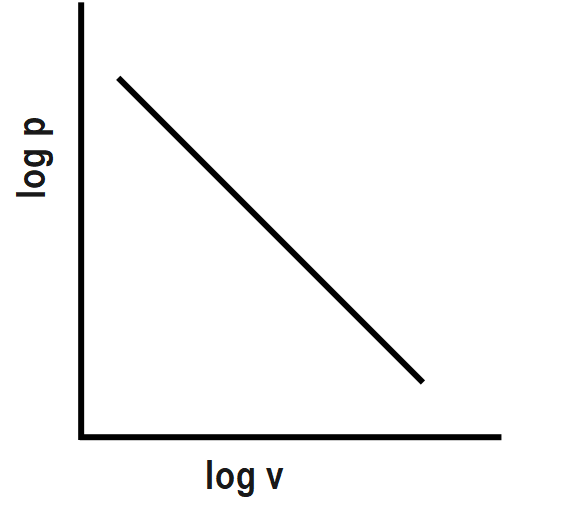
Hence, option (B) is the correct answer.
Note :
Remember that Boyle’s law holds good for an ideal gas. Gases are at high temperature and low pressures behave near to ideal gas. Here, we have assumed that the given gas behaves as an ideal gas. Therefore, the required slope can also be found out by using the ideal gas equation, $ pV=nRT $ .
Taking logarithms of both sides, we get:
$ \log pV=\log nRT $ .
Here, $ n $ , $ R $ and $ T $ are constant, thus:
$ \log p+\log V=\text{constant} $ .
Rearranging the above equation:
$ \log p=-\log V+\text{constant} $ .
Hence, we get the same value of slope, $ m=-1 $ .
Complete Step By Step Answer:
According to Boyle’s law:
$ p\propto 1/V $ , for constant number of moles, $ n $ at constant temperature, $ T $
We can say that, $ p=c/V $ , where $ c $ is a constant.
$ \Rightarrow pV=c $ (constant).
Taking logarithms of both sides, we get:
$ \log pV=\log c $ .
Applying the formula, $ \log mn=\log m+\log n $ :
$ \log p+\log V=\log c $ .
Rearranging the above equation:
$ \log p=-\log V+\log c $ .
Here, $ \log p $ and $ \log V $ are variables and $ \log c $ is a constant.
Comparing the above equation with $ y=mx+C $ , we get:
$ y=\log p $ , $ m=-1 $ , $ x=\log V $ and constant $ C=\log c $ .
Here, $ m $ is the slope between the graph of $ y $ and $ x $ .
Therefore, the slope of the graph between $ \log p $ and $ \log V $ at constant temperature for a given mass of a gas is equal to $ -1 $ .
The following slope graph is given as:
Hence, option (B) is the correct answer.
Note :
Remember that Boyle’s law holds good for an ideal gas. Gases are at high temperature and low pressures behave near to ideal gas. Here, we have assumed that the given gas behaves as an ideal gas. Therefore, the required slope can also be found out by using the ideal gas equation, $ pV=nRT $ .
Taking logarithms of both sides, we get:
$ \log pV=\log nRT $ .
Here, $ n $ , $ R $ and $ T $ are constant, thus:
$ \log p+\log V=\text{constant} $ .
Rearranging the above equation:
$ \log p=-\log V+\text{constant} $ .
Hence, we get the same value of slope, $ m=-1 $ .
Recently Updated Pages
Master Class 11 Social Science: Engaging Questions & Answers for Success

Master Class 11 Physics: Engaging Questions & Answers for Success
Master Class 11 Maths: Engaging Questions & Answers for Success
Master Class 11 Economics: Engaging Questions & Answers for Success
Master Class 11 Computer Science: Engaging Questions & Answers for Success
Master Class 11 Chemistry: Engaging Questions & Answers for Success
Trending doubts
One Metric ton is equal to kg A 10000 B 1000 C 100 class 11 physics CBSE
There are 720 permutations of the digits 1 2 3 4 5 class 11 maths CBSE
1 Quintal is equal to a 110 kg b 10 kg c 100kg d 1000 class 11 physics CBSE
State and prove Bernoullis theorem class 11 physics CBSE
Difference Between Prokaryotic Cells and Eukaryotic Cells
Which among the following are examples of coming together class 11 social science CBSE