



The size of a square computer is measured by the length of its diagonal. How much bigger is the visible area of a square 24-inch screen than the area of a square of 20-inch screen ?
(a) 46 sq. inches
(b) 72 sq. inches
(c) 60 sq. inches
(d) 88 sq. inches
Answer
 Verified
650.7k+ views
Hint: In this question, from the given respective lengths we can get the side of the square screen using the formula \[s=\dfrac{d}{\sqrt{2}}\]. Now, from the side lengths we can get the areas of both the square screens using the formula \[A={{s}^{2}}\]. Then subtract the area of the smaller screen from the larger screen to get the result.
Complete step-by-step answer:
We have the figure of the computer screen as below,
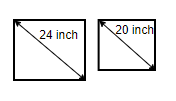
Now, let us assume the diagonals as \[{{d}_{1}},{{d}_{2}}\] and sides lengths as \[{{s}_{1}},{{s}_{2}}\]
Now, given in the question that size of the screen is measured by its diagonal so we get,
\[{{d}_{1}}=24,{{d}_{2}}=20\]
As we already know that relation between side of square and diagonal of square is given by the formula
\[s=\dfrac{d}{\sqrt{2}}\]
Now, let us find the side length of the larger screen by substituting the respective value
\[\Rightarrow {{s}_{1}}=\dfrac{{{d}_{1}}}{\sqrt{2}}\]
Now, on substituting the value of diagonal in the above formula we get,
\[\Rightarrow {{s}_{1}}=\dfrac{24}{\sqrt{2}}\]
Now, on further simplification we get,
\[\therefore {{s}_{1}}=12\sqrt{2}\text{ inches}\]
Now, let us find the side length of the smaller screen
\[\Rightarrow {{s}_{2}}=\dfrac{{{d}_{2}}}{\sqrt{2}}\]
Now, on substituting the respective value of the diagonal in the above formula we get,
\[\Rightarrow {{s}_{2}}=\dfrac{20}{\sqrt{2}}\]
Now, on further simplification we get,
\[\therefore {{s}_{2}}=10\sqrt{2}\text{ inches}\]
Now, let us find the areas of the respective screen using the formula
\[A={{s}^{2}}\]
Let us assume the area of the larger screen as\[{{A}_{1}}\]and the area of the smaller screen as \[{{A}_{2}}\]
Now, let us find the area of the larger screen
\[\Rightarrow {{A}_{1}}={{s}_{1}}^{2}\]
Now, on substituting the respective value of side we get,
\[\Rightarrow {{A}_{1}}={{\left( 12\sqrt{2} \right)}^{2}}\]
Now, on further simplification we get,
\[\Rightarrow {{A}_{1}}=144\times 2\]
Now, this can be further written in the simplified form as
\[\therefore {{A}_{1}}=288\text{ sq}\text{. inches}\]
Now, let us find the area of the smaller screen
\[\Rightarrow {{A}_{2}}={{s}_{2}}^{2}\]
Now, on substituting the respective value of side we get,
\[\Rightarrow {{A}_{2}}={{\left( 10\sqrt{2} \right)}^{2}}\]
Now, on further simplification we get,
\[\Rightarrow {{A}_{2}}=100\times 2\]
Now, this can be further written in the simplified form as
\[\therefore {{A}_{2}}=200\text{ sq}\text{. inches}\]
Now, to get how much bigger is the 24 inch screen than 20 inch screen we need to subtract their areas
\[\Rightarrow {{A}_{1}}-{{A}_{2}}\]
Now, on substituting the respective values we get,
\[\Rightarrow 288-200\]
Now, on further simplification we get,
\[\Rightarrow 88\text{ sq}\text{. inches}\]
Hence, the correct option is (d).
Note:
Instead of finding the side length from the given diagonal length we can directly find the area by using the relation between diagonal and area and simplify further to get the result. Both the methods give the same result but this reduces the number of steps and would be easy.
It is important to note that to find how much bigger is the larger screen than the smaller one we need to subtract them but not do any other arithmetic operations.
Complete step-by-step answer:
We have the figure of the computer screen as below,
Now, let us assume the diagonals as \[{{d}_{1}},{{d}_{2}}\] and sides lengths as \[{{s}_{1}},{{s}_{2}}\]
Now, given in the question that size of the screen is measured by its diagonal so we get,
\[{{d}_{1}}=24,{{d}_{2}}=20\]
As we already know that relation between side of square and diagonal of square is given by the formula
\[s=\dfrac{d}{\sqrt{2}}\]
Now, let us find the side length of the larger screen by substituting the respective value
\[\Rightarrow {{s}_{1}}=\dfrac{{{d}_{1}}}{\sqrt{2}}\]
Now, on substituting the value of diagonal in the above formula we get,
\[\Rightarrow {{s}_{1}}=\dfrac{24}{\sqrt{2}}\]
Now, on further simplification we get,
\[\therefore {{s}_{1}}=12\sqrt{2}\text{ inches}\]
Now, let us find the side length of the smaller screen
\[\Rightarrow {{s}_{2}}=\dfrac{{{d}_{2}}}{\sqrt{2}}\]
Now, on substituting the respective value of the diagonal in the above formula we get,
\[\Rightarrow {{s}_{2}}=\dfrac{20}{\sqrt{2}}\]
Now, on further simplification we get,
\[\therefore {{s}_{2}}=10\sqrt{2}\text{ inches}\]
Now, let us find the areas of the respective screen using the formula
\[A={{s}^{2}}\]
Let us assume the area of the larger screen as\[{{A}_{1}}\]and the area of the smaller screen as \[{{A}_{2}}\]
Now, let us find the area of the larger screen
\[\Rightarrow {{A}_{1}}={{s}_{1}}^{2}\]
Now, on substituting the respective value of side we get,
\[\Rightarrow {{A}_{1}}={{\left( 12\sqrt{2} \right)}^{2}}\]
Now, on further simplification we get,
\[\Rightarrow {{A}_{1}}=144\times 2\]
Now, this can be further written in the simplified form as
\[\therefore {{A}_{1}}=288\text{ sq}\text{. inches}\]
Now, let us find the area of the smaller screen
\[\Rightarrow {{A}_{2}}={{s}_{2}}^{2}\]
Now, on substituting the respective value of side we get,
\[\Rightarrow {{A}_{2}}={{\left( 10\sqrt{2} \right)}^{2}}\]
Now, on further simplification we get,
\[\Rightarrow {{A}_{2}}=100\times 2\]
Now, this can be further written in the simplified form as
\[\therefore {{A}_{2}}=200\text{ sq}\text{. inches}\]
Now, to get how much bigger is the 24 inch screen than 20 inch screen we need to subtract their areas
\[\Rightarrow {{A}_{1}}-{{A}_{2}}\]
Now, on substituting the respective values we get,
\[\Rightarrow 288-200\]
Now, on further simplification we get,
\[\Rightarrow 88\text{ sq}\text{. inches}\]
Hence, the correct option is (d).
Note:
Instead of finding the side length from the given diagonal length we can directly find the area by using the relation between diagonal and area and simplify further to get the result. Both the methods give the same result but this reduces the number of steps and would be easy.
It is important to note that to find how much bigger is the larger screen than the smaller one we need to subtract them but not do any other arithmetic operations.

Recently Updated Pages
Basicity of sulphurous acid and sulphuric acid are

Master Class 12 Economics: Engaging Questions & Answers for Success
Master Class 12 Biology: Engaging Questions & Answers for Success
Master Class 11 English: Engaging Questions & Answers for Success
Master Class 11 Physics: Engaging Questions & Answers for Success
Master Class 11 Computer Science: Engaging Questions & Answers for Success
Trending doubts
Difference Between Plant Cell and Animal Cell
Fill the blanks with the suitable prepositions 1 The class 9 english CBSE
What is pollution? How many types of pollution? Define it
What is the full form of pH?
What is the Full Form of ICSE, CBSE and SSC
Name 10 Living and Non living things class 9 biology CBSE